Installation Best Practices for Common Types of Wood in Carpentry
Discover essential installation best practices for different types of wood in carpentry. Learn species-specific fastening, acclimation, and finishing techniques.

The Core Rule: Moisture Content and Acclimation by Species
The most common point of failure in wood carpentry and flooring installation is ignoring the hygroscopic nature of timber. Wood continuously exchanges moisture with its environment until it reaches Equilibrium Moisture Content (EMC). Installation best practices dictate that you never install wood until its internal moisture matches the ambient conditions of the structure.
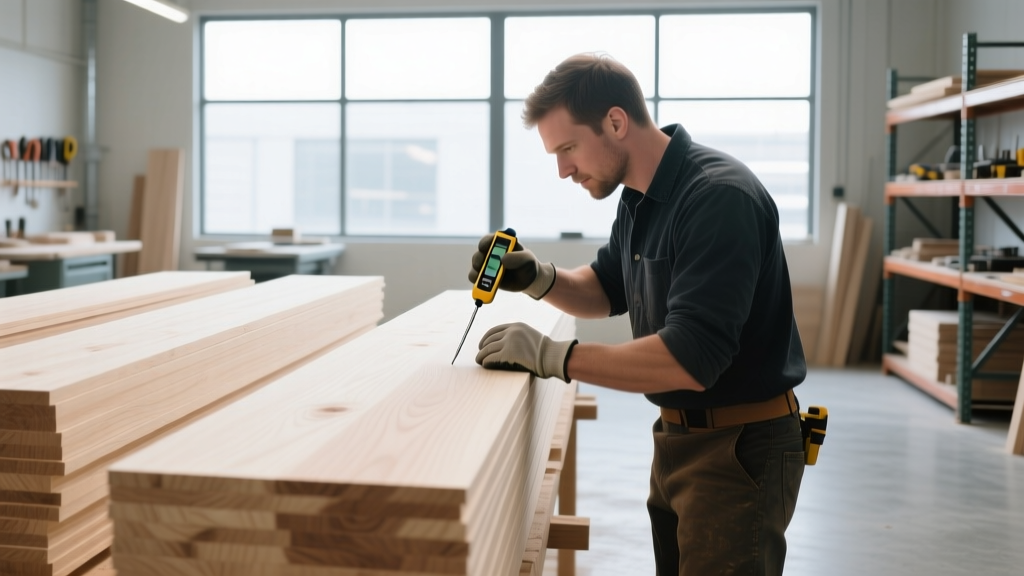
According to the USDA Forest Products Laboratory Wood Handbook, solid hardwoods like Red Oak, White Oak, and Hard Maple require a strict acclimation period of 7 to 14 days in the installation environment. The HVAC system must be operational, maintaining a relative humidity (RH) of 30-50% and a temperature between 60°F and 80°F. Use a pin-type moisture meter (such as the Delmhorst J-2000) to verify the wood has reached an EMC of 6% to 9% before fastening.
Softwood vs. Hardwood Acclimation Timelines
- Dense Hardwoods (Hickory, Maple, Ipe): 10-14 days. These species have tightly packed cellular structures that slow moisture exchange. Stack the boards with 3/4-inch spacers (stickers) between each layer to ensure cross-ventilation.
- Softwoods (Pine, Cedar, Fir): 3-7 days. Kiln-dried softwoods acclimate faster but are also more prone to rapid swelling if exposed to sudden humidity spikes during the staging phase.
- Engineered Wood: 2-4 days. The cross-ply core restricts lateral expansion, but the top veneer still requires time to adjust to the room's ambient humidity.
Fastener Selection: Matching Hardware to Wood Chemistry
Selecting the wrong fastener for a specific wood species leads to galvanic corrosion, tannin staining, and structural degradation. Woods like Western Red Cedar and Redwood contain high levels of water-soluble tannins and natural acids. When these acids react with standard zinc-galvanized nails or screws, they produce a black, ink-like stain that bleeds through finishes, while simultaneously corroding the metal.
The Cedar Shake and Shingle Bureau explicitly mandates the use of stainless steel fasteners for all cedar applications. For coastal or high-humidity environments, upgrade from 304 to 316 stainless steel to resist chloride-induced pitting.
Modern pressure-treated Southern Yellow Pine utilizes micronized copper azole (MCA) or alkaline copper quaternary (ACQ) preservatives. These copper-based chemicals are highly corrosive to standard aluminum and electro-galvanized steel. You must use hot-dipped galvanized fasteners (minimum G185 coating) or polymer-coated structural screws (like GRK RSS) to prevent the fastener from dissolving inside the timber.
Species-Specific Fastening Matrix
| Wood Species Category | Tannin / Acid Level | Required Fastener Type | Pre-Drill Bit Size (Relative to Shank) |
|---|---|---|---|
| Western Red Cedar / Redwood | High | 304 or 316 Stainless Steel | 85% of shank diameter |
| Pressure-Treated Pine | Low (High Copper) | Hot-Dipped Galvanized (G185) | 75% of shank diameter |
| Hickory / Hard Maple | Low | Hardened Steel / Ceramic Coated | 70% of shank diameter |
| Ipe / Cumaru (Tropical) | Variable (High Oil) | 316 Stainless Steel | 90% of shank diameter (Deep countersink) |
Milling, Joinery, and Tooling Tolerances for Dense Hardwoods
When working with high-Janka hardwoods (e.g., Hickory at 1820 lbf, or Ipe at 3680 lbf), standard carpentry tooling will fail. The extreme density of these woods generates immense friction and heat, leading to burnt cut edges and shattered carbide teeth.
Blade and Bit Specifications
For crosscutting and ripping dense hardwoods, abandon standard 24-tooth or 40-tooth framing blades. Utilize an 80-tooth Alternate Top Bevel (ATB) carbide-tipped blade with a negative hook angle (typically -5 degrees). The negative hook prevents the blade from aggressively grabbing the dense fibers, reducing tear-out and kickback.
When routing edges for joinery (such as mortise and tenon or edge profiles), feed rate is critical. Pushing the router too slowly burns the wood; pushing too fast shatters the carbide bit. Maintain a consistent feed rate of 1 to 2 feet per minute, and take multiple shallow passes (no more than 1/16-inch depth per pass) rather than one full-depth cut.
"When pre-drilling for dense tropical hardwoods, the clearance hole must be exactly the diameter of the screw shank, while the pilot hole in the receiving material must be 75% to 80% of the root diameter. Failing to clear the shank hole will cause the screw to act like a wedge, splitting even the hardest Ipe board."
Substrate Preparation and Vapor Retarders
Installing solid wood over concrete slabs requires rigorous moisture testing. The National Wood Flooring Association (NWFA) requires in-situ relative humidity testing of concrete substrates using ASTM F2170 probe methods. If the concrete RH exceeds 75%, a vapor retarder is mandatory.
- For Solid Hardwood over Wood Subfloors: Use 15 lb asphalt-saturated felt paper. This provides a secondary moisture barrier and reduces wood-on-wood squeaking.
- For Solid Hardwood over Concrete (Above Grade): Apply a two-part epoxy moisture mitigation system (such as Bostik MVP4) or use a liquid-applied polyurethane membrane. Never use standard polyethylene sheeting under nail-down solid wood, as the nails will pierce the vapor barrier, rendering it useless and creating condensation pockets.
Finishing and Sealing: Species-Specific Penetration Rates
The final installation phase involves protecting the wood, but the type of wood dictates the chemical compatibility of the finish.
Dealing with Oily and Resinous Woods
Species like Teak, Rosewood, and Cocobolo contain natural oils and resins that actively inhibit the curing process of standard polyurethanes and oil-based varnishes. If you apply a standard finish directly to these woods, it will remain tacky for weeks and eventually peel.
Before applying any film-building finish to oily tropical hardwoods, wipe the raw wood surface with pure acetone. The acetone flashes off rapidly, temporarily dissolving and removing the surface oils. You must apply your primer or seal coat within 15 to 30 minutes of the acetone evaporating, before the internal oils migrate back to the surface. For maximum adhesion on these species, use a catalyzed water-based polyurethane or a specialized dewaxed shellac sealer (like Zinsser SealCoat) as a barrier coat.
Conversely, highly porous woods like Ash and Red Oak absorb finishes rapidly and unevenly. For these species, apply a pre-stain wood conditioner or a sanding sealer to partially fill the open grain, ensuring a uniform color build and preventing blotchiness during the staining phase.
Summary Checklist for the Job Site
Mastering the installation of various types of wood in carpentry requires moving beyond generic rules and adapting to the specific biological and chemical properties of the species in your hands. Verify your moisture content with a pin meter, match your fastener metallurgy to the wood's tannin profile, adjust your tooling for the Janka hardness, and respect the chemical interactions between natural wood oils and modern synthetic finishes. By treating each species as a unique material rather than generic 'lumber', you ensure structural longevity and a flawless aesthetic finish.
Written by
Sarah WhitfieldSarah Whitfield is a chartered quantity surveyor (MRICS) and construction cost analyst with 15 years of experience in material pricing, procurement strategy, and project budgeting. She earned her degree in Construction Management from the University of Reading (UK) and has worked on projects ranging from $2M custom homes to $180M mixed-use developments across North America and Europe. Sarah currently leads cost estimating for BuildMat Insight, maintaining a proprietary database of 4,000+ material price points updated quarterly. She is a frequent contributor to RSMeans cost data panels and has presented at the International Cost Engineering Council (ICEC) congress. Based in Denver, CO, Sarah is an avid trail runner and volunteer mentor for Women in Construction.
More from Sarah Whitfield
View all
Wood & Lumber
What Are the Different Types of Wood? A Builder's Guide
Compare structural softwoods, finish hardwoods, and engineered lumber. Analyze Janka ratings, MOE values, and 2026 pricing for construction.
Aug 4, 2026

Walls & Panels
Steel Framing vs Wood Framing: Corrosion and Moisture Defense
Compare steel framing vs wood framing for moisture resistance. Learn about galvanized coatings, condensation risks, and corrosion protection strategies.
Jul 21, 2026

Stone & Masonry
How to Cut Stone Veneer: Wet Saw vs Grinder Comparison
Compare the best tools for cutting stone veneer. We review wet saws, angle grinders, and chop saws to help you achieve clean, chip-free cuts.
Jul 21, 2026