Types of Wood Maple Compared: Hard vs Soft for Construction
Compare types of wood maple for construction. Analyze hard vs. soft maple Janka ratings, pricing, NHLA grades, and best applications.
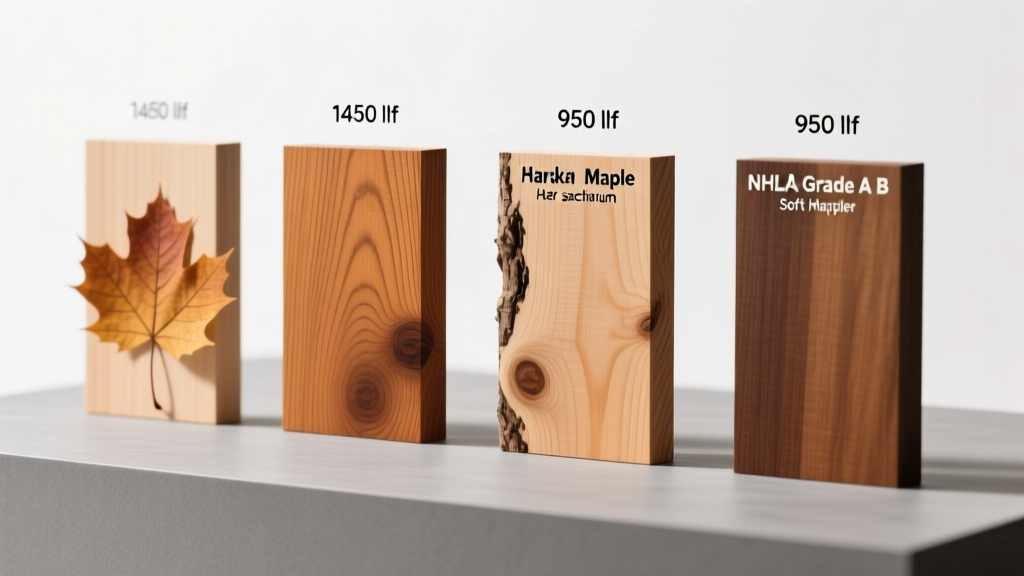
The Botanical and Structural Divide
When sourcing lumber for interior millwork, flooring, or cabinetry, the phrase "types of wood maple" encompasses a broad spectrum of species with vastly different mechanical properties. In the North American timber market, maple is strictly bifurcated into two commercial categories: Hard Maple and Soft Maple. This distinction is not merely semantic; it dictates machining parameters, structural load capacities, fastener retention, and ultimate project longevity.
Hard Maple refers almost exclusively to Acer saccharum (Sugar Maple) and occasionally Acer nigrum (Black Maple). Soft Maple is an umbrella commercial term that includes Red Maple (Acer rubrum), Silver Maple (Acer saccharinum), and Boxelder (Acer negundo). Crucially, "soft" maple is not a softwood like pine or cedar; it is a deciduous angiosperm. Its Janka hardness simply falls below the extreme density threshold of Sugar Maple. Understanding the precise mechanical and aesthetic differences between these types of wood maple is essential for specifying the correct material for architectural and structural applications.
Hard Maple (Sugar Maple) Profile and Specifications
Hard Maple is the benchmark for high-wear interior applications. Its cellular structure is incredibly dense, resulting in a Janka hardness rating of 1,450 lbf (6,450 N). This density makes it the undisputed standard for commercial bowling alleys, dance floors, and heavy-duty butcher blocks.
- Average Dried Weight: 44 lbs/ft³ (705 kg/m³)
- Crushing Strength: 7,830 lbf/in² (54.0 MPa)
- Modulus of Elasticity: 1,830,000 lbf/in² (12.62 GPa)
- Radial Shrinkage: 4.8%
- Tangential Shrinkage: 9.9%
The high crushing strength and modulus of elasticity mean Hard Maple can withstand significant point loads without permanent deformation. However, this density comes with a trade-off: it has a severe blunting effect on cutting edges. Fabricators must use premium carbide-tipped tooling and reduce feed rates to prevent burning the wood during routing or milling. According to the Wood Database, Hard Maple also exhibits a T/R ratio (tangential-to-radial shrinkage) of roughly 2.1, indicating moderate dimensional stability, requiring strict moisture acclimation prior to installation.
Soft Maple Varieties: Red, Silver, and Boxelder
Soft maples are the workhorses of the paint-grade cabinetry and interior trim industries. While they lack the extreme wear resistance of Sugar Maple, they offer superior workability and a lower price point.
Red Maple (Acer rubrum)
Red Maple is the most common and structurally viable of the soft maples. With a Janka hardness of 950 lbf, it is approximately 35% softer than Hard Maple, yet still harder than many other domestic hardwoods like Cherry (950 lbf) or Walnut (1,010 lbf). It machines beautifully, holds screws well, and takes paint exceptionally smoothly, making it the industry standard for painted shaker-style cabinet doors.
Silver Maple (Acer saccharinum)
Silver Maple drops to 700 lbf on the Janka scale. It is lighter, more brittle, and prone to tearout during machining. It is rarely specified for structural or high-wear applications but is frequently utilized for hidden structural blocks, drawer sides, and secondary furniture components where cost reduction is prioritized.
Comparative Matrix: Types of Wood Maple
| Species | Janka Hardness (lbf) | Density (lbs/ft³) | 2026 Avg. Price (FAS/BdFt) | Primary Construction Use |
|---|---|---|---|---|
| Hard Maple (Sugar) | 1,450 | 44.0 | $6.50 - $8.50 | Flooring, Stairs, Butcher Block |
| Red Maple | 950 | 38.0 | $4.50 - $6.00 | Painted Cabinetry, Millwork |
| Silver Maple | 700 | 33.0 | $3.50 - $5.00 | Drawer Sides, Secondary Parts |
| Boxelder | 720 | 34.0 | $3.00 - $4.50 | Pallets, Utility Crating |
Application-Specific Decision Framework
Selecting between these types of wood maple requires matching the material's mechanical profile to the environmental and physical demands of the project.
Scenario A: High-Traffic Commercial Flooring
Verdict: Hard Maple exclusively. The 1,450 lbf Janka rating is required to resist denting from high heels, dropped equipment, and rolling loads. Specify quartersawn or riftsawn Hard Maple to minimize tangential shrinkage and prevent seasonal gapping. Ensure the material is kiln-dried to a 6-8% Equilibrium Moisture Content (EMC) and acclimated on-site for a minimum of 14 days before installation.
Scenario B: Paint-Grade Kitchen Cabinetry
Verdict: Red Maple. Hard Maple is overkill for painted cabinet frames and doors. Red Maple provides a closed-grain, smooth surface that requires less sanding and fewer coats of primer to achieve a glass-like finish. Furthermore, Red Maple's lower density reduces wear on CNC router bits during the mass production of shaker or raised-panel doors, lowering fabrication costs.
Scenario C: Heavy-Duty Workbenches and Stair Treads
Verdict: Hard Maple. Stair treads require high modulus of rupture (15,800 psi for Hard Maple) to prevent deflection under concentrated loads. For workbenches, the sheer mass and density of Hard Maple provide the necessary inertia to absorb mallet strikes without bouncing or denting.
Both Hard and Soft maples have dense, irregular grain patterns that notoriously absorb pigmented oil stains unevenly, resulting in severe, splotchy finishes. If a dark stain is required, do not use standard wiping stains. Instead, apply a 1 lb. cut of dewaxed shellac as a washcoat to seal the pores, followed by a gel stain or an alcohol-based aniline dye. For the most uniform color, specify Soft Maple, as its slightly more open pore structure accepts stain marginally better than the glass-like surface of Hard Maple.
NHLA Grading Standards and Yield Economics
When purchasing types of wood maple, understanding the National Hardwood Lumber Association (NHLA) grading rules is critical for budget management. Maple is graded based on the percentage of clear, defect-free cuttings available on a board.
- FAS (Firsts and Seconds): Yields a minimum of 83-1/3% clear cuttings. Boards must be at least 6 inches wide and 8 feet long. Specify FAS for long, continuous runs of stair handrails, wide plank flooring, and architectural trim where long, clear lengths are mandatory.
- Select: Similar to FAS but allows for smaller board sizes (minimum 4 inches wide, 6 feet long). Ideal for cabinet door stiles and rails.
- #1 Common: Yields 66-2/3% clear cuttings. This is the most economical grade for cabinetry and furniture manufacturing, as the smaller clear cuttings are perfectly suited for cutting around knots to produce smaller components like drawer fronts or face frames. Purchasing #1 Common instead of FAS for a kitchen remodel can reduce material costs by up to 35%.
The Figure Premium: Birdseye, Curly, and Quilted
While standard Hard Maple is priced between $6.50 and $8.50 per board foot, highly figured variants command massive premiums. Birdseye maple, characterized by small, swirling knots that resemble bird eyes, and Curly (or Tiger) maple, featuring a 3D wavy grain pattern, are highly sought after for luxury architectural accents, custom instrument building, and high-end veneer work.
"Figured maple does not grow in distinct, predictable stands. It is a genetic and environmental anomaly. Consequently, Birdseye and Curly Hard Maple can range from $25 to over $60 per board foot depending on the intensity of the figure and the clarity of the board. Always inspect figured maple in person or request high-resolution wetted photos, as the figure can disappear entirely when finished with certain sealers."
Moisture Management and Fastening Protocols
Because Hard Maple is exceptionally dense, driving screws or nails directly into the end grain or near the edges without pre-drilling will almost certainly cause the wood to split. For structural joinery or installing heavy hardware on Hard Maple:
- Pre-drill pilot holes using a bit that is 80% the diameter of the screw's shank.
- Use a countersink bit to prevent the screw head from fracturing the surface fibers.
- Opt for high-quality, heat-hardened steel screws; standard brass or soft steel screws will snap under the torque required to drive them into 44 lbs/ft³ density wood.
For comprehensive data on specific gravity and mechanical testing of domestic timber, the Wood Database's Red Maple profile and related species pages remain the definitive reference for cross-referencing structural capacities before finalizing material schedules.
Summary: Specifying the Right Maple
The decision between the various types of wood maple hinges entirely on the intersection of budget, wear requirements, and fabrication capabilities. Hard Maple is an uncompromising, high-density material reserved for surfaces that will endure severe mechanical abuse. Soft maples, particularly Red Maple, offer a highly workable, cost-effective alternative for the vast majority of interior millwork and cabinetry applications where extreme surface hardness is not a structural prerequisite.
Written by
Sarah WhitfieldSarah Whitfield is a chartered quantity surveyor (MRICS) and construction cost analyst with 15 years of experience in material pricing, procurement strategy, and project budgeting. She earned her degree in Construction Management from the University of Reading (UK) and has worked on projects ranging from $2M custom homes to $180M mixed-use developments across North America and Europe. Sarah currently leads cost estimating for BuildMat Insight, maintaining a proprietary database of 4,000+ material price points updated quarterly. She is a frequent contributor to RSMeans cost data panels and has presented at the International Cost Engineering Council (ICEC) congress. Based in Denver, CO, Sarah is an avid trail runner and volunteer mentor for Women in Construction.
More from Sarah Whitfield
View all
Wood & Lumber
What Are the Different Types of Wood? A Builder's Guide
Compare structural softwoods, finish hardwoods, and engineered lumber. Analyze Janka ratings, MOE values, and 2026 pricing for construction.
Aug 4, 2026

Walls & Panels
Steel Framing vs Wood Framing: Corrosion and Moisture Defense
Compare steel framing vs wood framing for moisture resistance. Learn about galvanized coatings, condensation risks, and corrosion protection strategies.
Jul 21, 2026

Stone & Masonry
How to Cut Stone Veneer: Wet Saw vs Grinder Comparison
Compare the best tools for cutting stone veneer. We review wet saws, angle grinders, and chop saws to help you achieve clean, chip-free cuts.
Jul 21, 2026