Wood Species Guide: Types of Wooden Pallets for Heavy-Duty Shipping
Discover the best wood species for shipping pallets. Compare oak, pine, and maple for load capacity, ISPM-15 compliance, and 2026 pricing.

The Hardwood vs. Softwood Pallet Divide
When evaluating the types of wooden pallets available for industrial logistics, the fundamental differentiator is not just the structural design (block vs. stringer), but the botanical classification of the lumber used. The choice between hardwood and softwood species dictates the pallet's static and dynamic load capacities, fastener withdrawal resistance, and susceptibility to environmental degradation. According to the USDA Forest Products Laboratory Wood Handbook, the anatomical structure of hardwoods (angiosperms) features dense, interlocking fibers and vessel elements that provide superior compressive strength, while softwoods (gymnosperms) rely on tracheids that offer high flexibility and lower overall density.
Top Hardwood Species for Heavy-Duty & Block Pallets
Hardwood species are the mandatory choice for closed-loop pool systems, heavy machinery transport, and block-style pallets that require extreme forklift tine durability. These species resist the shearing forces applied by automated guided vehicles (AGVs) and robotic palletizers.
White Oak (Quercus alba)
White oak is the premium standard for heavy-duty shipping pallets. With a Janka hardness rating of 1,360 lbf and a specific gravity of 0.68, it offers unparalleled resistance to impact and abrasion. White oak contains tyloses—cellular structures that block water penetration—making it naturally resistant to fungal decay and rot. In 2026, heat-treated white oak pallet components command a 30% to 45% premium over standard mixed hardwoods, typically pricing a finished heavy-duty block pallet between $22.00 and $28.00 per unit.
Red Oak (Quercus rubra)
While slightly less moisture-resistant than white oak due to open vessel structures, red oak (Janka: 1,290 lbf) is the most abundant hardwood used in North American pallet manufacturing. It provides excellent nail-holding power but requires strict adherence to ISPM-15 heat treatment protocols, as its high starch content makes untreated lumber highly attractive to wood-boring pests.
Hard Maple (Acer saccharum)
Maple is exceptionally dense (Janka: 1,450 lbf) and features a tight, uniform grain. It is frequently utilized in cleanroom environments or food-grade pharmaceutical pallets because its non-porous surface resists bacterial harborage and does not shed splinters easily. However, its extreme density requires specialized helical-shank fasteners during assembly to prevent board splitting.
Leading Softwood Species for Stringer & Export Pallets
Softwoods dominate the one-way export market and lightweight domestic shipping due to their rapid growth cycles, lower cost, and ease of fabrication. The National Wooden Pallet & Container Association (NWPCA) notes that over 60% of single-use stringer pallets are manufactured from Southern Pine or Spruce-Pine-Fir mixes.
Southern Yellow Pine (SYP)
SYP is the heavyweight champion of the softwood category. With a specific gravity ranging from 0.55 to 0.59 and a Janka hardness up to 870 lbf, it bridges the gap between softwood workability and hardwood strength. SYP has a high resin content, which naturally increases fastener withdrawal resistance once the resin cures around the nail shank. It is the preferred species for heavy-load stringer pallets, with 2026 market pricing averaging $14.00 to $17.50 per 48x40 unit.
Spruce-Pine-Fir (SPF)
SPF is a marketing grouping of white spruce, Engelmann spruce, lodgepole pine, and alpine fir. It is lightweight (Janka: 480-510 lbf) and highly uniform, making it ideal for automated nailing machines. SPF is the primary species used for lightweight, one-way export pallets where minimizing shipping tare weight is critical. However, its low density results in poor forklift tine resistance; SPF stringers will crush and splinter under repeated rough handling.
ISPM-15 Heat Treatment Dynamics by Species
For any wooden pallet crossing international borders, compliance with the International Standards for Phytosanitary Measures No. 15 (ISPM-15) is legally mandatory. The USDA APHIS ISPM-15 Guidelines require the wood core to reach 56°C (132.8°F) for a minimum of 30 minutes. The species of wood drastically alters the kiln schedule required to achieve this without degrading the lumber.
- Dense Hardwoods (Oak/Hickory): Require longer ramp-up times in the kiln to prevent severe case-hardening and internal honeycomb checking. Rapid heating causes the exterior to dry and shrink while the interior remains wet, leading to structural failure.
- Resinous Softwoods (SYP): High kiln temperatures can cause resin bleed (pitch pocket expulsion), which creates sticky surfaces that can stain packaged goods. Kiln operators must carefully manage humidity levels to allow resin to set properly.
- Low-Density Softwoods (SPF): Heat treat rapidly but are prone to excessive warping and twisting if stacked improperly during the 30-minute holding phase due to rapid moisture loss.
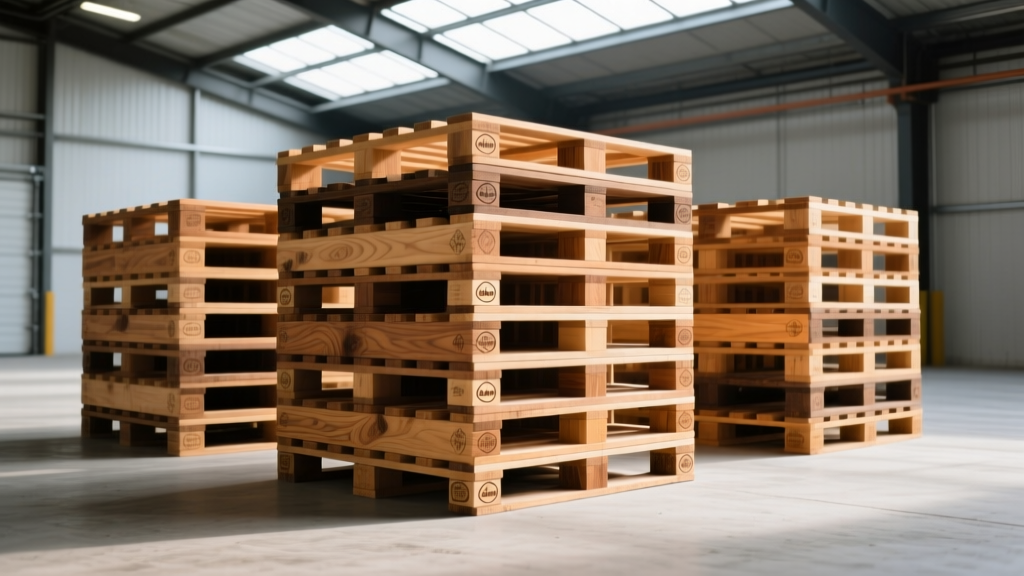
Species Selection Decision Matrix
Selecting the correct wood species requires balancing load requirements, handling environment, and budget constraints. Use the following matrix to specify materials for your pallet procurement contracts.
| Wood Species | Janka Hardness (lbf) | Avg. 2026 Cost (48x40) | Optimal Use Case |
|---|---|---|---|
| White Oak | 1,360 | $22.00 - $28.00 | Aerospace parts, heavy machinery, outdoor storage |
| Red Oak | 1,290 | $18.00 - $22.00 | Closed-loop automotive, heavy block pallets |
| Southern Yellow Pine | 870 | $14.00 - $17.50 | Heavy domestic stringer pallets, building materials |
| Hard Maple | 1,450 | $25.00 - $32.00 | Pharmaceutical, food-grade, cleanroom environments |
| SPF Mix | 490 | $9.50 - $12.50 | One-way export, lightweight consumer goods, air freight |
Fastener Withdrawal and Moisture Content Variables
The structural integrity of any wooden pallet relies entirely on the friction and mechanical lock between the wood fibers and the fastener. Fastener withdrawal resistance is directly proportional to the specific gravity of the wood species and inversely proportional to the moisture content (MC) at the time of assembly.
Species-Specific Fastener Protocols
- For Oak and Maple: The high density causes extreme lateral pressure on standard staples. Manufacturers must use 0.113-inch or larger diameter helical-shank nails to prevent fastener shear and minimize end-grain splitting.
- For SYP: Standard 0.092-inch ring-shank nails provide optimal withdrawal. The natural resins in SYP act as an adhesive, locking the rings into the tracheids as the wood dries.
- For SPF: Because the wood is soft, wider crown staples (e.g., 1/2-inch or 5/8-inch) are required to distribute the clamping load across a broader surface area, preventing the fastener head from pulling through the deck board under dynamic stress.
Troubleshooting Species-Specific Pallet Failures
When pallets fail in the supply chain, the root cause is frequently tied to a mismatch between the wood species selected and the operational environment.
- Stringer Crushing (SPF/Pine): If forklift tines are tearing through the stringer notches, the species is too soft for the handling equipment. Solution: Upgrade to SYP or add a hardwood wear block (oak) specifically at the tine entry points to reduce costs while maintaining durability.
- Deck Board Splitting (Red Oak): Splitting at the board ends occurs when red oak is assembled at moisture contents below 14% using smooth-shank fasteners. Solution: Implement a strict moisture meter QA check at the green chain and switch to ring-shank fasteners.
- Black Staining (White Oak): White oak contains high levels of tannic acid. When exposed to moisture and ferrous metals (like standard steel nails), a chemical reaction creates a black stain that can transfer to packaged goods. Solution: Specify galvanized or polymer-coated fasteners for white oak pallets used in moisture-prone environments.
Frequently Asked Questions
Can mixed hardwood and softwood species be used on the same pallet?
Yes, but it requires engineered design. A common cost-saving hybrid uses softwood (SPF or Pine) for the top and bottom deck boards to reduce weight and cost, while utilizing dense hardwood (Oak) for the structural stringers or blocks to maintain forklift handling durability and racking strength.
Does the wood species affect the pallet's fire rating?
Wood species minimally affect the baseline combustibility of a standard pallet. However, denser hardwoods like oak have a higher thermal mass and char slower than low-density softwoods like SPF. For strict fire-code compliance in warehouse racking, rely on the overall pallet design and potential fire-retardant chemical treatments rather than the natural species alone.
Written by
Marcus ChenMarcus Chen is a licensed structural engineer (PE) and building materials analyst with over 12 years of experience across residential, commercial, and industrial construction. He holds a Master of Science in Civil Engineering from UC Berkeley and spent six years at Thornton Tomasetti before transitioning to independent consulting and technical writing. Marcus specializes in material selection for seismic-prone regions, concrete reinforcement strategies, and lifecycle cost analysis. His work has been cited by the American Concrete Institute (ACI) and the Structural Engineers Association of California (SEAOC). When he is not on a job site or at his desk, you will find him hiking the Sierra Nevada or restoring a 1920s craftsman bungalow in Oakland, CA.
More from Marcus Chen
View all
Construction Cost
How Much Did the Eiffel Tower Cost to Build?
How much did the Eiffel Tower cost to build in 1889? We adjust for inflation and compare its budget to modern skyscraper construction.
Aug 4, 2026

Fire Resistance
What Is a Fire Resistant Material? Testing & Certification Guide
Discover what is a fire resistant material through ASTM and UL testing. Learn how fire ratings, certifications, and assemblies work in construction.
Aug 4, 2026

Construction Cost
How Much Did the Burj Khalifa Cost to Build?
How much did the Burj Khalifa cost to build? We break down the $1.5B project and extract 5 money-saving strategies for your next build.
Jul 30, 2026