Selection Framework: Choosing Types of Joints for Wood
Master the selection framework for types of joints for wood. Compare load vectors, wood movement, and AWS grades for structural and millwork joinery.

The 4-Axis Joint Selection Matrix
Selecting the appropriate joinery for timber framing, architectural millwork, or case goods requires moving beyond aesthetic preference. The structural integrity of any wood assembly depends on how well the joint geometry manages mechanical stress and hygroscopic movement. According to the USDA Forest Products Laboratory Wood Handbook, wood is an anisotropic material, meaning its mechanical properties and shrinkage rates vary drastically depending on the grain direction. Therefore, evaluating the types of joints for wood requires a systematic framework based on four critical axes: load vectors, moisture-induced movement, fabrication tolerances, and adhesive synergy.
Axis 1: Load Vector Analysis
Every joint must resist specific mechanical forces. A mortise and tenon excels in shear and compression but requires mechanical fasteners (like drawbore pegs) to resist tension. Conversely, a dovetail joint provides exceptional mechanical tensile strength in one direction while relying entirely on adhesive shear strength in the other. Identifying the primary load vector—whether racking, bending, shear, or direct tension—dictates the baseline geometry required for the joint.
Axis 2: Moisture and Tangential Shrinkage
Wood shrinks and swells primarily across the grain. Flat-sawn lumber shrinks roughly twice as much tangentially as it does radially. When joining end-grain to long-grain, or when constructing frame-and-panel assemblies, the joint must accommodate this differential movement. Rigidly gluing cross-grain members guarantees catastrophic failure as seasonal relative humidity fluctuates between 20% and 80%.
Comparative Matrix: Types of Joints for Wood
The following matrix categorizes common wood joints based on their optimal applications and structural behaviors, aligning with the Architectural Woodwork Institute (AWI) standards for interior architectural woodwork.
| Joint Type | Primary Load Resistance | Wood Movement Accommodation | Fabrication Method | AWI Grade Applicability |
|---|---|---|---|---|
| Through Dovetail | Tensile (uniaxial), Shear | Poor (locks cross-grain) | Hand, CNC Router | Custom / Premium |
| Half-Blind Dovetail | Tensile, Shear | Poor (locks cross-grain) | CNC Router, Jigs | Premium |
| Mortise and Tenon | Shear, Compression, Racking | Moderate (if pegged/haunched) | Hollow Chisel, CNC | Custom / Structural |
| Scarf Joint (1:12) | Bending, Tension (splicing) | High (long-grain to long-grain) | Power Planer, Saw | Structural Framing |
| Dowel-Reinforced Butt | Shear, Moderate Racking | Low (end-grain glue failure risk) | Drill Press, CNC | Economy / Standard |
| Bridle Joint | Compression, Racking | Moderate (exposed end grain) | Table Saw, Band Saw | Custom / Arts & Crafts |
Structural Framing: Mortise, Tenon, and Scarf Splices
In heavy timber construction and structural framing, the selection of joint types is governed by engineering loads rather than visual concealment. The mortise and tenon remains the foundational joint for post-and-beam structures. However, the execution details determine its structural viability.
To eliminate reliance on structural adhesives—which can degrade in high-moisture exterior environments—structural engineers utilize drawboring. By offsetting the peg hole in the tenon by 1/16 to 1/8 of an inch relative to the mortise hole, driving a tapered hardwood peg (typically oak or locust) pulls the joint tightly together, creating permanent compressive pre-stress that resists racking forces without glue.
When continuous timber lengths are unavailable, scarf joints are required to splice beams. A common error is cutting the scarf slope too steeply. For structural members subjected to bending moments, the slope must be at least 1:12 (one unit of rise for every twelve units of run). A 1:12 slope ensures that the shear stress along the glue line remains well below the rolling shear capacity of the wood, transferring the load smoothly across the splice.
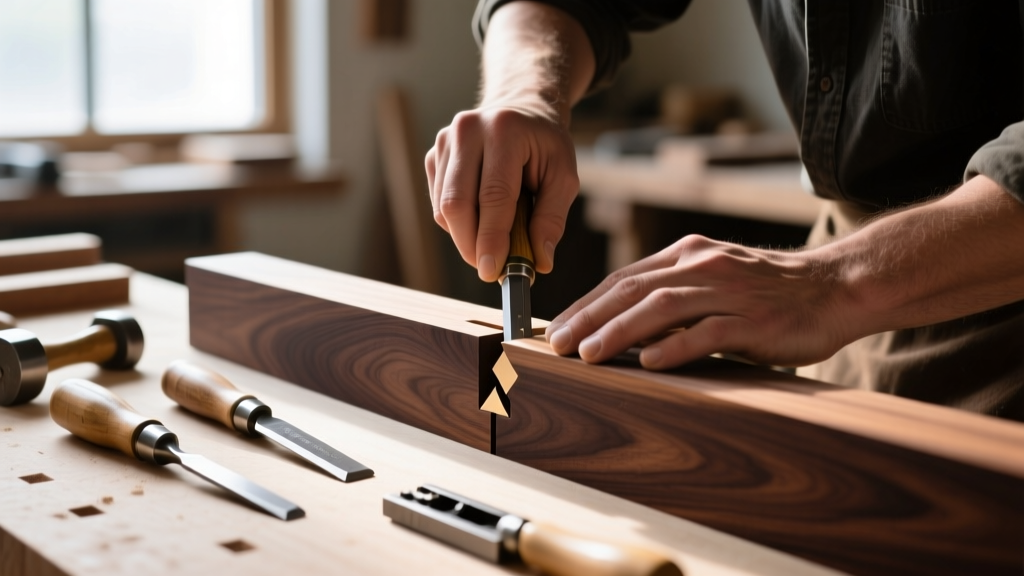
Case Goods and Millwork: Dovetails and Box Joints
For cabinetry, drawer boxes, and architectural millwork, the types of joints for wood shift toward maximizing long-grain glue surface area and aesthetic detailing. The dovetail joint is frequently specified in AWI Premium grade millwork for drawer construction due to its mechanical lock.
Geometric Ratios and Species Selection
The angle of the dovetail pins and tails must be calibrated to the specific wood species to prevent corner shearing:
- Hardwoods (e.g., Black Walnut, Hard Maple): Use a 1:8 ratio (approximately 7 degrees). The compressive strength of hardwoods supports the steeper angle without crushing the end grain of the pins.
- Softwoods (e.g., Eastern White Pine, Cedar): Use a 1:6 ratio (approximately 9.5 degrees). The wider angle distributes the mechanical stress over a broader area, preventing the softer fibers from compressing and causing the joint to loosen over time.
For high-volume production where CNC routing is standard, the box joint (finger joint) is often substituted. While it lacks the mechanical tensile lock of a dovetail, a properly machined box joint with 1/4-inch fingers provides up to 40% more long-grain glue surface area than a standard rabbet joint, yielding exceptional shear strength when paired with a Type I waterproof PVA adhesive.
Adhesive Synergy and Glue Line Starvation
The strongest mechanical joint will fail if the adhesive chemistry is mismatched to the joint geometry and wood porosity. A prevalent failure mode in tight-fitting CNC-machined joints is glue starvation. This occurs when the tolerance between the mortise and tenon (or dowel and hole) is too tight (under 0.003 inches), forcing the adhesive out of the joint during assembly and leaving a wood-to-wood bond with no polymer matrix.
End-grain acts like a bundle of microscopic straws, rapidly wicking moisture and adhesive away from the glue line. When joining end-grain to long-grain (such as in a standard dowel butt joint), you must "size" the end grain. Apply a thin, 50/50 water-diluted PVA coat, let it cure for 15 minutes to seal the pores, and then apply full-strength adhesive for the final assembly. Alternatively, use a gap-filling epoxy (like System Three T-88) for structural end-grain connections.
Troubleshooting Joint Failure Modes
When specifying the types of joints for wood, anticipating failure modes allows for proactive design adjustments. Use this diagnostic framework when evaluating joint failures in existing millwork or prototyping new assemblies:
- Symptom: The joint is tight, but the wood splits adjacent to the glue line.
Cause: Cross-grain restriction. The joint is preventing natural tangential shrinkage.
Fix: Redesign the joint to allow sliding movement. Convert a fixed rail-and-stile glue-up into a frame-and-panel assembly with a floating panel, or use slotted screw holes in the secondary member. - Symptom: The joint pulls apart cleanly, with adhesive sticking only to one surface.
Cause: Glue starvation or surface contamination (e.g., burnished wood from dull CNC router bits).
Fix: Increase machining tolerance to 0.005–0.008 inches to allow an adhesive reservoir. Sand or hand-plane the mating surfaces immediately prior to gluing to open the wood pores. - Symptom: Mortise and tenon joint racks and loosens under cyclic loading.
Cause: Insufficient shoulder bearing surface or tenon length.
Fix: Increase tenon length to at least two-thirds the width of the receiving mortise member. Add a haunch to the tenon to increase the glue surface area and resist torsional twisting.
Ultimately, the correct selection of wood joints requires balancing the physical limitations of the material with the mechanical demands of the structure. By applying this 4-axis framework, builders and millworkers can ensure that their assemblies remain dimensionally stable and structurally sound across decades of environmental cycling.
Written by
Sarah WhitfieldSarah Whitfield is a chartered quantity surveyor (MRICS) and construction cost analyst with 15 years of experience in material pricing, procurement strategy, and project budgeting. She earned her degree in Construction Management from the University of Reading (UK) and has worked on projects ranging from $2M custom homes to $180M mixed-use developments across North America and Europe. Sarah currently leads cost estimating for BuildMat Insight, maintaining a proprietary database of 4,000+ material price points updated quarterly. She is a frequent contributor to RSMeans cost data panels and has presented at the International Cost Engineering Council (ICEC) congress. Based in Denver, CO, Sarah is an avid trail runner and volunteer mentor for Women in Construction.
More from Sarah Whitfield
View all
Wood & Lumber
What Are the Different Types of Wood? A Builder's Guide
Compare structural softwoods, finish hardwoods, and engineered lumber. Analyze Janka ratings, MOE values, and 2026 pricing for construction.
Aug 4, 2026

Walls & Panels
Steel Framing vs Wood Framing: Corrosion and Moisture Defense
Compare steel framing vs wood framing for moisture resistance. Learn about galvanized coatings, condensation risks, and corrosion protection strategies.
Jul 21, 2026

Stone & Masonry
How to Cut Stone Veneer: Wet Saw vs Grinder Comparison
Compare the best tools for cutting stone veneer. We review wet saws, angle grinders, and chop saws to help you achieve clean, chip-free cuts.
Jul 21, 2026