Concrete Pool vs Fiberglass: Technical Specs & Build Data
Compare concrete pool vs fiberglass with deep technical specs, structural tolerances, curing times, and 2026 installation costs for builders.

Structural Shell Engineering & Material Tolerances
The decision between a concrete pool vs fiberglass hinges on fundamental differences in structural engineering, material science, and load distribution. While both systems successfully retain water, their approach to handling hydrostatic pressure, soil expansion, and thermal cycling diverges significantly.
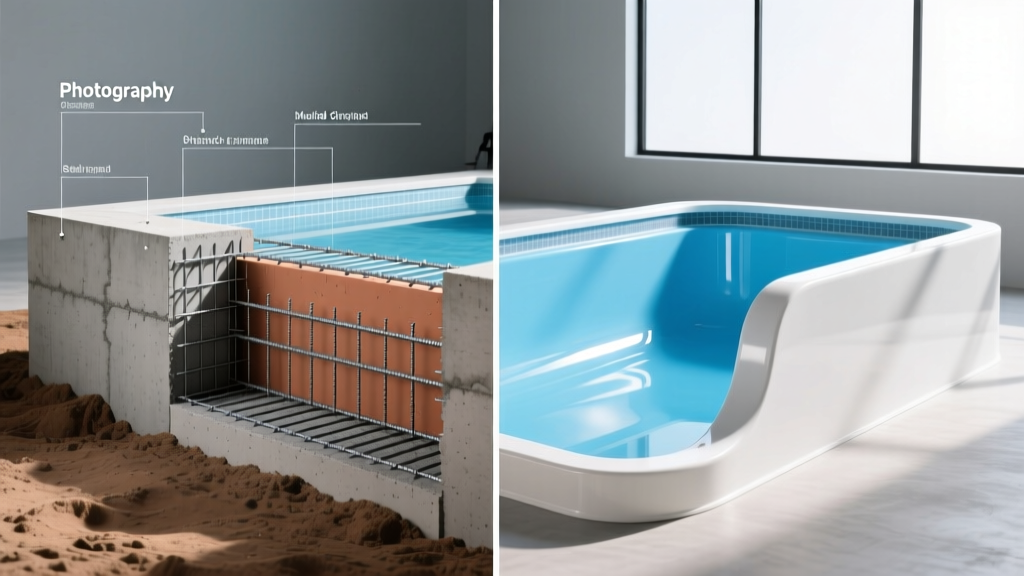
Pneumatically applied concrete (gunite and shotcrete) relies on mass and rigid steel reinforcement. Modern shotcrete applications utilize a wet-mix process achieving compressive strengths of 5,000 to 6,000 PSI at 28 days, as outlined by the American Concrete Institute. The structural skeleton typically consists of #4 (1/2-inch) steel rebar tied on 8-inch to 10-inch centers, encased in 8 to 12 inches of concrete.
Conversely, fiberglass pools operate on a flexible, tensile-strength model. The shell is manufactured using a composite layup process: a 15-to-20-mil isophthalic polyester gel coat, followed by chopped fiberglass strands, woven roving, and a structural core (often polyurethane foam or honeycomb). The total thickness rarely exceeds 3/8 of an inch. Instead of resisting earth loads through sheer mass, a fiberglass shell transfers lateral soil pressure into the surrounding backfill envelope.
Comparative Material Matrix
| Specification | Shotcrete / Gunite Shell | Fiberglass Composite Shell |
|---|---|---|
| Compressive Strength | 5,000 - 6,000 PSI | ~15,000 PSI (Resin dependent) |
| Tensile Strength | High (via #4 steel rebar grid) | Very High (woven roving matrix) |
| Shell Thickness | 8 to 12 inches | 3/16 to 3/8 inch |
| Empty Shell Weight | 40,000 - 80,000+ lbs | 2,000 - 4,500 lbs |
| Permeability | Semi-permeable (requires interior sealant) | Zero permeability (non-porous gel coat) |
Hydraulic Loading & Hydrostatic Risk Management
Water weighs 62.4 pounds per cubic foot. When a pool is emptied for maintenance, the surrounding groundwater exerts upward hydrostatic pressure. This is where the mass differential between a concrete pool vs fiberglass becomes a critical engineering factor.
A standard 14x28 fiberglass pool weighs approximately 3,500 pounds empty. If the local water table rises above the pool floor during heavy seasonal rains, the buoyant force can easily exceed the shell's weight, causing the pool to "float" or pop out of the ground. To mitigate this, fiberglass installations mandate hydrostatic relief valves in the main drain sump and deep-point gravel relief columns.
Curing Physics vs. Backfill Mechanics
The installation timeline and structural integrity of these two materials are governed by entirely different physical processes.
Concrete Hydration and Shrinkage
Shotcrete requires a 28-day primary curing period to reach its design strength. During this hydration process, the concrete undergoes volumetric shrinkage. If the mix design lacks proper water-reducing admixtures or if the application includes excessive "rebound" (bouncing concrete that is improperly troweled back into the shell), micro-fissures will form. These shrinkage cracks do not compromise structural integrity but will telegraph through the interior plaster finish if not addressed with structural staples and epoxy injection.
Fiberglass Backfill Protocols
Fiberglass pools do not cure on-site; they arrive fully polymerized. However, their structural viability relies entirely on the backfill material. Native soil is strictly prohibited for fiberglass backfill. The expansion and contraction of clay soils create uneven point-loads that will cause the flexible shell to bulge or crack.
- Standard Backfill: Clean, 3/4-inch crushed limestone or gravel, mechanically tamped in 12-inch lifts.
- Flowable Fill (Slurry): A low-strength (150-200 PSI) cementitious slurry that flows into all voids without mechanical tamping, eliminating point-loads and providing uniform lateral support.
Surface Chemistry & Long-Term Degradation
The interior finish dictates the chemical maintenance and lifecycle degradation of the vessel.
Concrete pools require an interior plaster coat (marcite, quartz, or pebble). Plaster is inherently alkaline and porous. Over the first 28 days, it leaches calcium hydroxide into the water, requiring aggressive acid dosing to maintain pH balance. Over a 15-year lifecycle, plaster undergoes calcium leaching, leading to surface etching and eventual delamination, necessitating a $15,000 to $25,000 resurfacing.
Fiberglass utilizes an isophthalic gel coat that is chemically inert and non-porous. It does not alter water chemistry, drastically reducing the consumption of muriatic acid and chlorine. However, fiberglass is susceptible to osmotic blistering (cobaltosis) if water-soluble impurities are trapped in the laminate during manufacturing, or UV degradation if the gel coat is exposed to direct sunlight above the waterline for prolonged periods without UV-stabilized additives.
2026 Installation Economics & Lifecycle Costs
Material and labor inflation have shifted the baseline costs for pool construction in 2026. While fiberglass offers a lower initial capital expenditure, the long-term depreciation models differ.
2026 Baseline Cost Estimates (14x28 ft. Vessel)
- Shotcrete/Gunite Base Build: $95,000 - $145,000
- Fiberglass Composite Base Build: $75,000 - $105,000
- 15-Year Maintenance (Concrete): $12,000 (chemicals, acid washes) + $18,000 (resurfacing at year 15)
- 15-Year Maintenance (Fiberglass): $6,500 (reduced chemical consumption, no resurfacing required)
While the fiberglass shell holds a lower maintenance cost, concrete offers superior ROI in high-end real estate markets due to the ability to engineer custom vanishing edges, negative-edge catch basins, and integrated architectural benching that fiberglass molds cannot replicate.
Geotechnical Decision Framework
Site-specific soil conditions should dictate the material selection. Use the following framework to determine the optimal shell type based on geotechnical reports:
- Expansive Clay Soils (High Plasticity Index): Choose Concrete. The rigid, heavily reinforced shotcrete shell can be engineered with structural grade beams to bridge expansive soil movements. Fiberglass shells in heavy clay risk severe bulging despite proper backfill.
- High Water Table / Coastal Sands: Choose Concrete (with advanced hydrostatic relief systems). The dead weight of the concrete prevents buoyant uplift during seasonal water table fluctuations.
- Tight Urban Access / Rocky Subgrades: Choose Fiberglass (if crane access permits). A fiberglass pool can be set in a single day, bypassing the need for large concrete mixer trucks and shotcrete rigs in narrow lot lines. If bedrock is encountered during excavation, a fiberglass shell can be set directly on a leveled gravel bed, whereas concrete requires extensive over-excavation and formwork.
Ultimately, selecting between a concrete pool vs fiberglass requires aligning the material's mechanical properties with the site's geotechnical realities and the owner's long-term maintenance tolerance.
Written by
Elena RodriguezElena Rodriguez is a civil engineer and technical writer specializing in concrete technology, masonry systems, and ASTM/ACI compliance. She earned her B.S. in Civil Engineering from Texas A&M University and spent a decade at a materials testing laboratory, performing over 2,000 concrete compressive strength tests and masonry prism evaluations. Elena is an ACI-certified Field Testing Technician (Grade I) and a member of ASTM Committee C12 on Natural Building Stone. She currently consults on forensic engineering cases involving concrete failures and moisture intrusion. Based in San Antonio, TX, Elena is a proud member of the Society of Women Engineers (SWE) and coaches her daughter's FIRST Robotics team.
More from Elena Rodriguez
View all
Walls & Panels
Cost Analysis: Light Gauge Steel Framing Advantages and Disadvantages
Evaluate light gauge steel framing advantages and disadvantages through a strict cost analysis lens, comparing material, labor, and lifecycle expenses.
Aug 4, 2026

Walls & Panels
Gypsum Board Types: Exact Specifications, Thickness & Dimensions
Compare standard, Type X, and moisture-resistant gypsum board types. Get exact specifications, thicknesses, dimensions, and ASTM standards for your project.
Aug 4, 2026

Fire Resistance
Best Fire-Resistant Outdoor Decking Materials: 2026 Buyer Guide
Discover the best fire-resistant outdoor decking materials for 2026. Compare Class A PVC, aluminum, and hardwood options for WUI compliance and safety.
Aug 4, 2026