Asphalt vs Concrete Basketball Court: 2026 Cost Breakdown
Compare asphalt vs concrete basketball court costs in 2026. Detailed breakdown of installation, surfacing, maintenance, and lifespan for residential builds.

The True Cost of Building a Residential Basketball Court
Building a dedicated backyard basketball court is a significant property investment that enhances both lifestyle and real estate value. When planning this project, the most critical decision you will face is choosing the base material: asphalt vs concrete basketball court construction. While both materials can yield a professional-grade playing surface, their upfront costs, structural requirements, and long-term maintenance profiles differ drastically.
For this 2026 cost breakdown analysis, we are basing our calculations on a standard residential full-court pad measuring 40x50 feet (2,000 square feet). This size accommodates a full 94-foot court length with adequate runoff space, or a generous half-court setup with perimeter clearance. Raw pavement alone does not make a sports court; both materials require specialized acrylic surfacing to achieve proper ball bounce, player traction, and UV protection. Below, we dissect the exact financial and structural realities of both options.
Base Material Showdown: Asphalt vs. Concrete Pricing
The foundation of any sports court dictates its lifespan. According to guidelines from the American Sports Builders Association (ASBA), the subgrade preparation and base paving must meet strict tolerances to prevent water pooling (birdbaths) and structural failure.
Concrete Base Installation
A concrete basketball court requires a rigid, heavily reinforced slab. For a 2,000 sq ft court, contractors typically pour a 4-inch to 5-inch thick slab using a 4,000 PSI air-entrained concrete mix. The American Concrete Institute (ACI) recommends air-entrainment (4% to 7%) for outdoor slabs in freeze-thaw climates to prevent surface spalling. Reinforcement usually consists of #4 (1/2-inch) steel rebar placed on an 18-inch to 24-inch grid, elevated on chairs to sit in the middle of the slab.
- Excavation & Sub-base: $1.50 - $2.50 per sq ft (4-6 inches of compacted crushed aggregate)
- Forming, Rebar & Pouring: $4.50 - $7.50 per sq ft
- Total Concrete Base Cost: $6.00 - $10.00 per sq ft ($12,000 - $20,000 for 2,000 sq ft)
Asphalt Base Installation
Asphalt is a flexible pavement. The National Asphalt Pavement Association notes that asphalt courts rely on a deep, highly compacted aggregate base to distribute loads. A standard sports court requires a 3-inch compacted asphalt layer (often a 2-inch binder course and a 1-inch fine wear course) laid over a 4-inch to 6-inch crushed stone base. Asphalt must be paved using a laser-guided paver to ensure a precise 1% slope for drainage.
- Excavation & Sub-base: $1.50 - $2.50 per sq ft
- Asphalt Paving & Compaction: $2.50 - $4.50 per sq ft
- Total Asphalt Base Cost: $4.00 - $7.00 per sq ft ($8,000 - $14,000 for 2,000 sq ft)
Initial Installation Cost Matrix (2,000 Sq Ft Court)
| Cost Category | Asphalt Base | Concrete Base |
|---|---|---|
| Site Prep & Excavation | $4,000 | $4,000 |
| Base Material & Labor | $7,000 | $12,000 |
| Acrylic Sport Surfacing | $6,000 | $5,000 |
| Total Estimated Initial Cost | $17,000 | $21,000 |
The Great Equalizer: Acrylic Sport Surfacing Costs
Neither raw concrete nor raw asphalt is suitable for high-level basketball play. Raw concrete is too abrasive and causes severe joint stress, while raw asphalt softens in high heat and lacks consistent ball rebound. Both require a multi-layer acrylic coating system (such as Plexipave or DecoTurf) mixed with silica sand for traction.
Acrylic surfacing typically costs between $2.50 and $4.50 per square foot. However, the preparation required for each base material creates a hidden cost disparity:
- Asphalt Preparation: Asphalt is a petroleum-based, flexible material that naturally develops hairline cracks and oxidizes. Before acrylic coatings can be applied, asphalt requires a 14-to-28-day curing period to allow oils to leach out. It then requires multiple heavy resurfacing coats and often a specialized crack-isolation membrane to prevent structural cracks from telegraphing through the playing surface. This pushes asphalt surfacing costs toward the higher end ($3.50 - $4.50/sq ft).
- Concrete Preparation: Concrete is rigid and non-porous. It requires acid etching or mechanical shot-blasting to open the pores, followed by a specialized primer to ensure the acrylic bonds to the surface. Because concrete doesn't suffer from the same hairline cracking as asphalt (if control joints are properly cut), it requires fewer base filler coats, keeping surfacing costs slightly lower ($2.50 - $3.50/sq ft).
Long-Term Maintenance and Repair Economics
The initial savings of choosing asphalt are frequently erased by its aggressive maintenance schedule. Asphalt is highly susceptible to UV degradation, freeze-thaw cycling, and organic damage from nearby tree roots.
15-Year Total Cost of Ownership (TCO) Analysis
Asphalt Court TCO: Over 15 years, an asphalt court will require annual crack sealing ($300-$500), sealcoating every 4 years ($1,500-$2,500), and a complete acrylic resurfacing at year 8 ($6,000-$8,000).
Estimated 15-Year Maintenance: $12,000 - $16,000.
Concrete Court TCO: Concrete requires minimal structural maintenance. Costs are limited to annual power washing, resealing control joints every 5 years ($400-$600), and a single acrylic resurfacing at year 10 ($5,000-$7,000).
Estimated 15-Year Maintenance: $6,000 - $9,000.
Climate and Soil Considerations: Hidden Cost Multipliers
Your local geology and climate will heavily influence which material is economically viable. Ignoring these factors is the leading cause of premature court failure.
- Expansive Clay Soils: If your property has heavy clay soil that swells when wet and shrinks when dry, do not build an asphalt court. The flexible nature of asphalt will cause it to ripple, settle, and tear. Concrete is the mandatory choice here, and it may require post-tensioning or a heavily thickened edge beam to bridge soil movement, adding $2.00 to $4.00 per sq ft to the base cost.
- Freeze-Thaw Regions: In northern climates, water penetrates the subgrade, freezes, and expands (frost heave). Asphalt can flex slightly to accommodate minor heaving, but severe heaving will crack it irreparably. Concrete, when poured over a well-draining crushed rock sub-base and equipped with properly spaced control joints, will withstand frost heave far better and remain structurally intact.
- High UV / Desert Climates: Asphalt binder softens in extreme, sustained heat (above 100°F), which can lead to surface scuffing from aggressive basketball stops. Concrete remains entirely dimensionally stable in high heat, making it the superior choice for Southwestern installations.
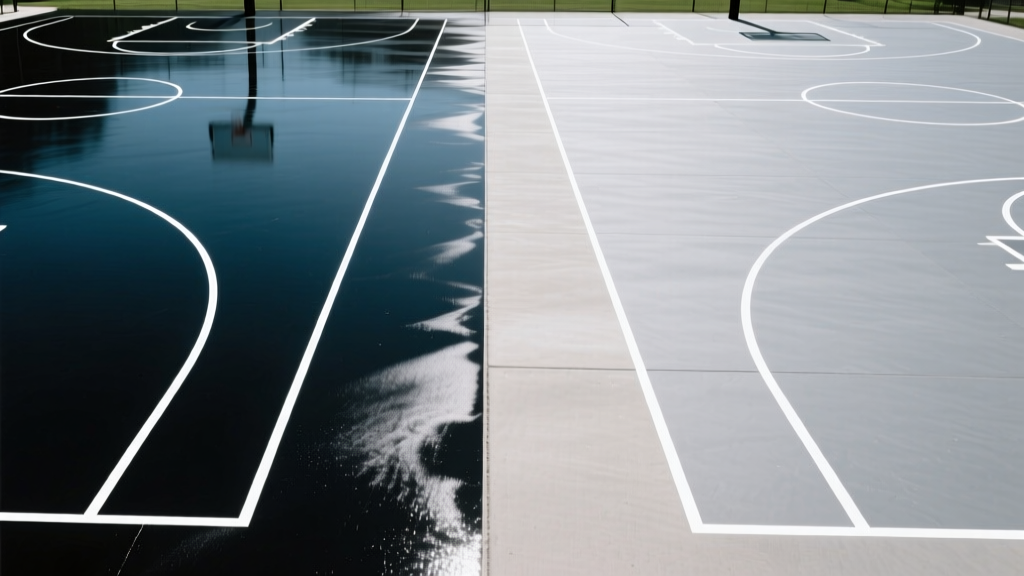
Decision Framework: Which Material Should You Choose?
Use this practical framework to finalize your material selection based on your specific project constraints.
Choose Asphalt If:
- Your upfront budget is strictly capped, and you need to minimize initial capital expenditure.
- Your site features stable, well-draining sandy or loamy soils.
- You are building a casual, low-usage driveway hoop setup rather than a dedicated, tournament-grade sports court.
- You are willing to commit to a strict, ongoing annual maintenance schedule (crack filling and sealcoating).
Choose Concrete If:
- You view the court as a 20+ year permanent property improvement and want to minimize lifetime maintenance.
- Your site has poor soil conditions, heavy clay, or a high water table.
- You are installing premium, high-end surfacing systems (like cushioned DecoTurf) which require a rigid, crack-free substrate to maintain their warranty.
- You live in a region with extreme summer heat or severe freeze-thaw cycles where asphalt degradation is accelerated.
Expert Tips for Hiring a Sports Court Contractor
The material you choose is only as good as the contractor who installs it. General paving contractors rarely understand the tight tolerances required for sports courts. When soliciting bids, enforce the following technical requirements:
- Demand Laser Grading: The ASBA mandates a maximum surface deviation of 1/16 inch in 10 feet. Water must drain off the court at a 1% slope (1/8 inch per foot). If a contractor plans to grade by hand or use standard string lines, disqualify them.
- Verify Joint Placement (Concrete): Control joints must be saw-cut within 12 to 24 hours of pouring to a depth of 25% of the slab thickness. Joints should be spaced in panels no larger than 15x15 feet to control shrinkage cracking.
- Check Surfacing Warranties: Ensure the contractor is a certified installer for major acrylic brands like SportMaster or Plexipave. Manufacturer warranties (often 4 to 5 years against peeling and fading) are voided if applied by non-certified applicators or over improperly cured bases.
Written by
David NakamuraDavid Nakamura is a licensed architect (AIA) and construction technology writer focused on sustainable building methods, mass timber engineering, and high-performance building envelopes. He holds a Master of Architecture from the University of Washington and is a certified Passive House Consultant (CPHC). David spent eight years at the Seattle firm Mithun, where he led the design of three LEED Platinum projects, before founding his own practice specializing in net-zero residential design. He serves on the editorial advisory board of GreenBuilder Magazine and has authored peer-reviewed papers on cross-laminated timber (CLT) connections for the Journal of Structural Engineering. In his spare time, David teaches woodworking at Pratt Fine Arts Center and kayaks the Puget Sound.
More from David Nakamura
View all
Construction Cost
Labor Cost to Build a Deck Per Sq Ft: 2026 Installation Guide
Discover the exact labor cost to build a deck per sq ft in 2026. This installation guide breaks down contractor rates, complexity factors, and hidden fees.
Aug 4, 2026

Construction Cost
How Much Does It Cost to Build a 3 Bedroom House? Financing Guide
Learn exactly how much it costs to build a 3 bedroom house and explore 2026 financing options, construction loan types, and budget frameworks for your build.
Aug 4, 2026

Construction Cost
Cost to Build a Tennis Court: 2026 Guide
How much does it cost to build a tennis court in 2026? Breakdowns for asphalt, concrete, and synthetic surfaces plus fencing and lighting.
Jul 30, 2026