Asphalt vs Concrete Price: 2026 Driveway Installation Cost Guide
Compare the 2026 asphalt vs concrete price for driveways. This installation guide breaks down material costs, prep work, and 30-year lifecycle value.

The True Cost Breakdown: Asphalt vs Concrete Price in 2026
When evaluating the asphalt vs concrete price for a new driveway or parking pad, day-one material costs only tell half the story. The final installed price is heavily dictated by subgrade preparation, structural thickness requirements, and regional labor rates. In 2026, supply chain stabilization has normalized material costs, but specialized finishing and reinforcement continue to drive concrete premiums, while bitumen market fluctuations keep asphalt pricing tied to crude oil indexes.
2026 Quick Cost Snapshot (Per Square Foot Installed)
- Asphalt (Hot Mix): $7.50 – $13.00
- Concrete (Standard Broom Finish): $12.50 – $19.00
- Concrete (Exposed Aggregate/Stamped): $18.00 – $32.00+
- Subgrade Excavation & Base Prep: $2.50 – $5.00 (Required for both)
Site Preparation: Where Hidden Costs Lurk
Both asphalt and concrete fail primarily due to subgrade movement, not surface wear. The Federal Highway Administration (FHWA) emphasizes that a properly compacted aggregate base is non-negotiable for flexible (asphalt) and rigid (concrete) pavements alike.
For standard residential driveways, contractors must excavate 8 to 12 inches of topsoil. If the native soil has a California Bearing Ratio (CBR) below 5, a geotextile separation fabric must be laid before importing a crushed angular aggregate base (typically 3/4-inch minus gravel). This base must be compacted in 2-inch lifts using a vibratory roller to achieve 95% Proctor density. Skipping this step saves roughly $1.50 per square foot upfront but guarantees premature rutting in asphalt and differential cracking in concrete.
Asphalt Installation: Material Specs and Process
Asphalt is a flexible pavement that relies on the structural integrity of the base beneath it. The National Asphalt Pavement Association (NAPA) recommends a two-lift system for driveways to ensure longevity.
Step-by-Step Asphalt Installation
- Tack Coat Application: An SS-1h emulsified asphalt tack coat is sprayed over the compacted aggregate base at a rate of 0.10 to 0.15 gallons per square yard to ensure adhesion.
- Binder Course (Base Lift): A 2-inch layer of coarse Hot Mix Asphalt (HMA) with a larger aggregate size (typically 3/4-inch) is laid and compacted. This layer provides structural strength.
- Surface Course (Top Lift): A 1.5-inch layer of fine-graded HMA (1/2-inch or 3/8-inch aggregate) is applied. This provides a smooth, impermeable riding surface.
- Compaction: Rollers must compact the mat while the internal temperature remains above 185°F. Inadequate compaction leads to premature raveling and water infiltration.
Concrete Installation: Material Specs and Process
Concrete is a rigid pavement; it bridges minor subgrade imperfections but is highly susceptible to tensile stress and frost heave. According to the National Ready Mixed Concrete Association (NRMCA), residential driveways require specific mix designs to withstand freeze-thaw cycles and de-icing salts.
Step-by-Step Concrete Installation
- Vapor Barrier & Formwork: A 6-mil polyethylene vapor retarder is placed over the base to prevent moisture from wicking up into the slab, which can cause flooring adhesives to fail in attached garages or cause surface scaling.
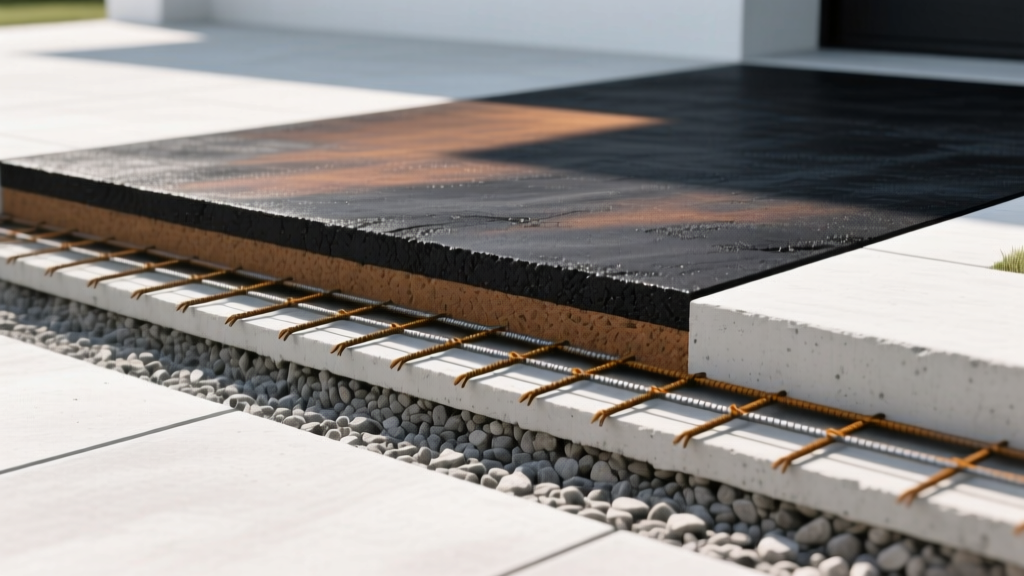
- Reinforcement: While some contractors rely solely on fiber mesh, heavy-duty driveways require 6x6 W1.4xW1.4 welded wire mesh (WWM) elevated to the upper third of the slab, or #4 rebar placed at 24 inches on-center in a grid pattern.
- The Pour: A 4,000 PSI air-entrained mix (5-7% air content) with a low water-cement ratio (0.45 or lower) is placed. The slab must be a minimum of 4 inches thick, increasing to 6 inches at the apron or if parking heavy RVs.
- Control Jointing: Joints must be saw-cut to a depth of one-quarter the slab thickness within 12 hours of pouring. Spacing should not exceed 10 to 12 feet in any direction to control shrinkage cracking.
30-Year Lifecycle Cost Matrix
The initial asphalt vs concrete price gap narrows significantly when maintenance and lifespan are factored into a 30-year ownership model.
| Cost Factor | Asphalt Driveway | Concrete Driveway |
|---|---|---|
| Initial Installation (1,000 sq ft) | $10,000 | $16,000 |
| Sealcoating / Sealing (30 Yrs) | $4,500 (Every 3-5 yrs) | $2,400 (Penetrating sealer) |
| Crack Repair & Patching | $1,500 | $800 (Slab jacking/mudjacking) |
| Expected Lifespan | 15 – 20 Years | 30 – 40+ Years |
| Total 30-Year Cost | $26,000 (Includes 1 overlay) | $19,200 |
Climate & Soil Decision Framework
Choosing between the two materials requires analyzing your specific environmental stressors. Neither material is universally superior; their performance is entirely context-dependent.
When to Choose Asphalt
- Cold Climates with Heavy Snowfall: Asphalt's dark color absorbs solar radiation, accelerating snow and ice melt. Furthermore, asphalt flexes slightly with frost heave, whereas rigid concrete will crack if the subgrade freezes unevenly.
- Expansive Clay Soils: If your soil swells significantly when wet and shrinks when dry, the flexibility of hot mix asphalt will accommodate minor movements without catastrophic failure.
- Budget-Constrained Timelines: Asphalt can be driven on within 48 to 72 hours of installation, whereas concrete requires a minimum 7-day cure time before handling vehicular loads.
When to Choose Concrete
- Hot, Sunny Climates: Asphalt softens in sustained temperatures above 90°F, making it susceptible to tire scuffing and rutting from heavy stationary loads (like RV jacks or trailer hitches). Concrete remains entirely unaffected by high ambient heat.
- Chemical Exposure: If the driveway will be exposed to frequent oil drips, hydraulic fluid, or heavy use of magnesium chloride de-icers, concrete (when properly sealed with a silane/siloxane penetrant) offers superior chemical resistance.
- High Property Value Additions: Stamped, stained, or exposed aggregate concrete provides a high-end aesthetic that consistently yields a higher return on investment in upscale real estate markets compared to standard blacktop.
Expert Warning on De-Icing Salts: Never use ammonium sulfate or ammonium nitrate-based de-icers on concrete. These chemicals cause a catastrophic chemical reaction that scales and spalls the surface paste, exposing the aggregate beneath. Stick to calcium chloride or calcium magnesium acetate (CMA) for winter traction on new concrete.
Permitting, Edge Restraints, and Final Upkeep
Before breaking ground, verify local municipal codes. Many jurisdictions require driveway permits and mandate specific apron thicknesses where the private driveway meets the public right-of-way. Concrete aprons often require 6 inches of thickness and dowel bars tied to the street curb to prevent settling.
For asphalt, edge confinement is critical. Without concrete curbing or heavy timber edge restraints, the outer 6 inches of an asphalt driveway will crumble and ravel over time due to lateral spreading under tire loads. For concrete, ensure the contractor includes a 3/4-inch expansion joint material (like closed-cell polyethylene foam) against any existing structures, such as the garage foundation, to prevent the slab from cracking as it thermally expands during summer months.
Written by
Elena RodriguezElena Rodriguez is a civil engineer and technical writer specializing in concrete technology, masonry systems, and ASTM/ACI compliance. She earned her B.S. in Civil Engineering from Texas A&M University and spent a decade at a materials testing laboratory, performing over 2,000 concrete compressive strength tests and masonry prism evaluations. Elena is an ACI-certified Field Testing Technician (Grade I) and a member of ASTM Committee C12 on Natural Building Stone. She currently consults on forensic engineering cases involving concrete failures and moisture intrusion. Based in San Antonio, TX, Elena is a proud member of the Society of Women Engineers (SWE) and coaches her daughter's FIRST Robotics team.
More from Elena Rodriguez
View all
Walls & Panels
Cost Analysis: Light Gauge Steel Framing Advantages and Disadvantages
Evaluate light gauge steel framing advantages and disadvantages through a strict cost analysis lens, comparing material, labor, and lifecycle expenses.
Aug 4, 2026

Walls & Panels
Gypsum Board Types: Exact Specifications, Thickness & Dimensions
Compare standard, Type X, and moisture-resistant gypsum board types. Get exact specifications, thicknesses, dimensions, and ASTM standards for your project.
Aug 4, 2026

Fire Resistance
Best Fire-Resistant Outdoor Decking Materials: 2026 Buyer Guide
Discover the best fire-resistant outdoor decking materials for 2026. Compare Class A PVC, aluminum, and hardwood options for WUI compliance and safety.
Aug 4, 2026