Types of Mixing of Concrete: On-Site vs Ready-Mix Alternatives
Compare the types of mixing of concrete, evaluating on-site drum and pan mixers against ready-mix and volumetric alternatives for optimal project outcomes.
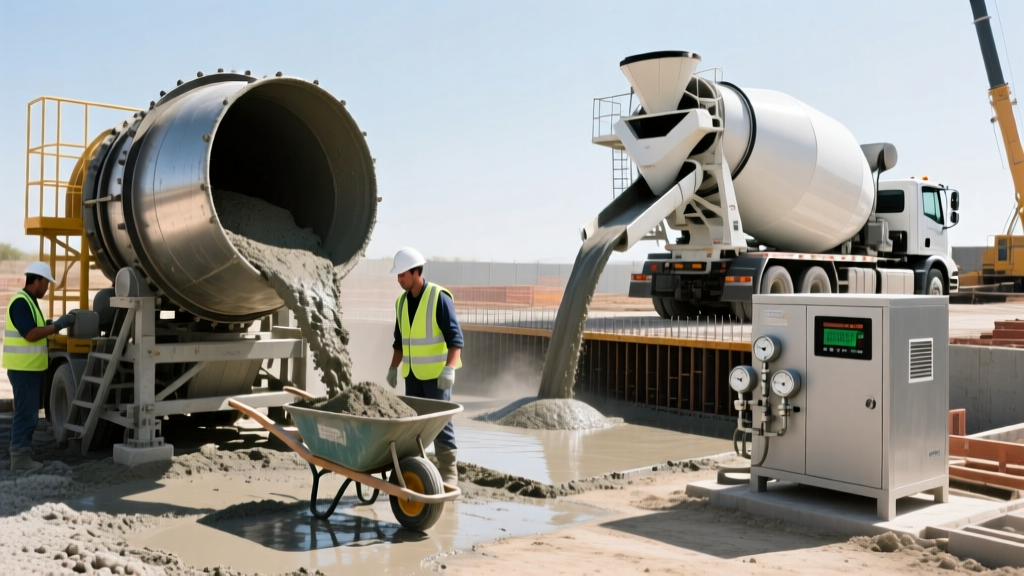
The Economics and Logistics of Concrete Sourcing
Selecting the right concrete delivery and mixing method dictates not only your material costs but also the structural integrity of the final pour. While ready-mix concrete delivered via transit trucks remains the default for large commercial projects, on-site mixing and volumetric alternatives offer distinct advantages for specialized, remote, or small-footprint residential applications. Understanding the various types of mixing of concrete is critical for matching the method to the structural requirement, labor availability, and site access constraints.
In 2026, the national average cost for standard 4,000 PSI ready-mix concrete hovers between $145 and $165 per cubic yard, heavily dependent on regional aggregate availability and fuel surcharges. Conversely, on-site mixing using bulk cement, sand, and coarse aggregate drops the raw material cost to approximately $55 per cubic yard. However, the labor burden and equipment rental fees must be factored in, alongside the severe risk of quality control failures if the water-cement (w/c) ratio is mismanaged.
Evaluating the Types of Mixing of Concrete On-Site
When batch plant delivery is impractical due to narrow lot access, rural distances, or micro-pour requirements, contractors must rely on mechanical on-site mixers. The choice of equipment directly impacts the homogeneity of the aggregate-cement paste.
Hand Mixing
Hand mixing is strictly limited to non-structural applications, such as setting fence posts or small patching jobs under 1 cubic yard. It requires a minimum of three workers to maintain a continuous mixing cycle and achieve a uniform color. The primary failure point in hand mixing is the inability to maintain a w/c ratio below 0.55, as workers inevitably add excess water to reduce the physical strain of turning the heavy aggregate. Never use hand-mixed concrete for structural footings or suspended slabs.
Tilting Drum Mixers
The standard tilting drum mixer (e.g., Multiquip MC94SH) utilizes a conical drum with internal fixed blades. Rotating at 15 to 20 RPM, the blades lift the mixture and drop it, relying on gravity for agitation. These are ideal for standard 3,000 to 4,000 PSI mixes with a 4-inch to 5-inch slump. The tilting mechanism allows for rapid discharge, but the gravity-based action struggles to fully encapsulate coarse aggregate in low-slump or fiber-reinforced mixes, leading to potential balling of synthetic or steel fibers.
Pan and Planetary Mixers
For high-strength (>5,000 PSI), low-slump, or heavily reinforced architectural concrete, pan mixers are mandatory. Models like the Imer Workman II feature a stationary pan with rotating planetary paddles that spin at 30 to 40 RPM. This high-shear action forces the cement paste into the aggregate voids rather than relying on gravity. Pan mixers reduce mixing time by 30% compared to drum mixers and are the only viable on-site option for integrating glass-fiber reinforced concrete (GFRC) or ultra-high-performance concrete (UHPC) dry-cast blends.
A "9-cubic-foot" drum mixer does not yield 9 cubic feet of mixed concrete. The batch capacity is typically 50% to 60% of the total drum volume to allow for material agitation. A 9 cu. ft. mixer will yield approximately 4.5 to 5.5 cubic feet of wet concrete per batch. Overfilling results in unmixed dry pockets and severe aggregate segregation.
Volumetric Mobile Mixers: The Hybrid Alternative
Bridging the gap between central batch plants and portable on-site mixers is the volumetric mobile mixer, governed by ASTM C685 standards. These trucks carry raw ingredients (cement, sand, stone, and water) in separate compartments and meter them continuously onto a mixing auger at the point of discharge.
Volumetric mixers eliminate the "short load" fees associated with transit mixers and prevent the concrete from setting in the drum during traffic delays. They are the premier alternative for projects requiring multiple distinct mix designs in a single day—such as pouring a 3,000 PSI sidewalk followed by a 4,500 PSI structural column—without needing to dispatch multiple transit trucks. The trade-off is a higher mobilization cost and the requirement for a skilled operator to calibrate the metering gates for precise yield.
Decision Matrix: Matching the Mix Method to the Project
| Mixing Method | Ideal Volume | Max PSI Capability | Labor Requirement | Quality Control |
|---|---|---|---|---|
| Hand Mixing | < 1 cu. yd. | 2,500 PSI | High (3+ workers) | Very Poor |
| Tilting Drum | 1 - 5 cu. yd. | 4,000 PSI | Medium (2 workers) | Fair |
| Pan / Planetary | 1 - 10 cu. yd. | 8,000+ PSI (UHPC) | Medium (2 workers) | Excellent |
| Volumetric Truck | 5 - 50 cu. yd. | 6,000 PSI | Low (1 operator) | Very Good |
| Transit Ready-Mix | 10 - 300+ cu. yd. | 10,000+ PSI | Low (Placement crew) | Certified (ASTM C94) |

Critical Failure Modes in On-Site Mixing
According to guidelines published by the American Concrete Institute, on-site mixing introduces variables that batch plants systematically eliminate. When managing on-site types of mixing of concrete, site supervisors must aggressively monitor for the following failure modes:
- Water-Cement Ratio Creep: The most common on-site error is the unauthorized addition of water to the mixer to improve workability. Adding just one gallon of water per cubic yard beyond the design mix can reduce the compressive strength by up to 200 PSI and increase permeability, accelerating rebar corrosion. Always use polycarboxylate-based high-range water reducers (superplasticizers) to increase slump without compromising the w/c ratio.
- Aggregate Segregation and Mortar Striping: In tilting drum mixers, over-mixing or mixing at incorrect RPMs causes the heavier coarse aggregate to settle at the bottom while the cement paste "stripes" the sides of the drum. Limit mixing time to 3 to 5 minutes after all materials are charged; prolonged mixing grinds the aggregate and generates excess heat.
- Moisture Content Miscalculation: Bulk sand and aggregate stored on-site absorb atmospheric moisture. If the mix design calls for 30 gallons of water, but the sand stockpile has a 5% moisture content, the sand is already introducing undocumented water into the batch. Site crews must perform rapid moisture tests (using a calcium carbide gas moisture tester) on aggregates before calculating the batch water volume.
Do not rely on visual estimation for concrete consistency. Invest in a standard ASTM C143 slump cone. For a typical residential driveway, target a 4-inch slump. If the cone collapses to 6 inches or more, the batch is compromised and should be rejected or downgraded to non-structural fill.
Sourcing and Equipment Specifications
For contractors committing to on-site mixing, equipment selection must align with the structural demands of the pour. The Portland Cement Association emphasizes that consistent batch proportions are the foundation of durable concrete. When renting or purchasing mixers, verify the motor torque and gear reduction ratios. Cheap, direct-drive mixers often stall when charged with dense, low-slump mixes containing 3/4-inch crushed gravel.
Furthermore, consider the logistics of material staging. On-site mixing requires dedicated space for bulk aggregate piles, cement silos or palletized bag storage (kept strictly off the ground and wrapped in poly to prevent hydration), and a high-volume water supply capable of delivering 15+ gallons per minute to keep pace with the mixer cycle. If your site lacks the square footage for proper material staging and moisture management, the marginal savings of on-site mixing will quickly be erased by material waste and structural remediation costs, making volumetric or transit ready-mix the superior alternative.
Written by
Elena RodriguezElena Rodriguez is a civil engineer and technical writer specializing in concrete technology, masonry systems, and ASTM/ACI compliance. She earned her B.S. in Civil Engineering from Texas A&M University and spent a decade at a materials testing laboratory, performing over 2,000 concrete compressive strength tests and masonry prism evaluations. Elena is an ACI-certified Field Testing Technician (Grade I) and a member of ASTM Committee C12 on Natural Building Stone. She currently consults on forensic engineering cases involving concrete failures and moisture intrusion. Based in San Antonio, TX, Elena is a proud member of the Society of Women Engineers (SWE) and coaches her daughter's FIRST Robotics team.
More from Elena Rodriguez
View all
Walls & Panels
Cost Analysis: Light Gauge Steel Framing Advantages and Disadvantages
Evaluate light gauge steel framing advantages and disadvantages through a strict cost analysis lens, comparing material, labor, and lifecycle expenses.
Aug 4, 2026

Walls & Panels
Gypsum Board Types: Exact Specifications, Thickness & Dimensions
Compare standard, Type X, and moisture-resistant gypsum board types. Get exact specifications, thicknesses, dimensions, and ASTM standards for your project.
Aug 4, 2026

Fire Resistance
Best Fire-Resistant Outdoor Decking Materials: 2026 Buyer Guide
Discover the best fire-resistant outdoor decking materials for 2026. Compare Class A PVC, aluminum, and hardwood options for WUI compliance and safety.
Aug 4, 2026