Concrete Lifting vs Mudjacking South Carolina: 2026 Comparison
Compare concrete lifting vs mudjacking in South Carolina. Explore 2026 costs, soil compatibility, and technical differences for slab repair.

Sunken, uneven, or cracking concrete slabs are a persistent challenge for property owners across the Palmetto State. When addressing voided subgrades and settled driveways, sidewalks, or pool decks, the two primary repair methodologies are traditional mudjacking and modern polyurethane concrete lifting. While both techniques aim to restore slab elevation without the expense and disruption of full replacement, their material properties, structural impacts, and long-term viability differ drastically—especially when subjected to South Carolina's unique geological and climatic conditions.
This comprehensive guide breaks down the technical specifications, regional soil interactions, and 2026 pricing structures for concrete lifting vs mudjacking in South Carolina, providing the exact data needed to make an informed structural repair decision.
The Soil Factor: South Carolina's Unique Subgrade Challenges
Concrete failure is rarely a problem with the slab itself; it is almost always a failure of the underlying subgrade. South Carolina features three distinct geological regions, each presenting specific hazards for slab support:
- The Coastal Plain (Charleston, Myrtle Beach, Hilton Head): Characterized by loose, sandy soils and a notoriously high water table. Heavy summer downpours and tropical storms easily wash away fine sandy particles, creating voids beneath slabs. Furthermore, the high water table can saturate traditional cementitious repair slurries, compromising their cure and structural integrity.
- The Piedmont (Greenville, Columbia, Spartanburg): Dominated by dense, expansive red clays (saprolite). These soils swell significantly when wet and shrink during droughts. Adding heavy repair materials to an already stressed, expansive clay subgrade can exacerbate differential settlement over time.
- The Blue Ridge Escarpment (Upstate): Rocky, uneven terrain where slabs often span across varying depths of topsoil and bedrock, leading to localized hinging and cracking.
Mudjacking: The Traditional Cementitious Slurry Method
Mudjacking (also known as slabjacking or pressure grouting) has been the industry standard for nearly a century. The process involves drilling large holes (typically 1.5 to 2 inches in diameter) through the sunken concrete and pumping a dense slurry beneath the slab to hydraulically lift it back to grade.
Material Composition and Mechanics
The standard mudjacking slurry is a heavy, non-structural mix consisting of topsoil or washed masonry sand, Portland cement, water, and occasionally bentonite clay to keep the solids in suspension. According to guidelines referenced by the Concrete Network, this slurry typically weighs between 100 and 120 pounds per cubic foot. Once pumped under pressure, the sheer weight and volume of the slurry fill voids and push the slab upward.
Pros and Cons of Mudjacking
- Lower initial material and labor costs.
- Utilizes natural, locally sourced materials (sand, soil, cement).
- Highly effective for massive, deep voids under heavy industrial slabs where foam volume would be cost-prohibitive.
- Excessive Weight: At 120 lbs/cu ft, the slurry adds massive dead load to already failing, expansive Piedmont clays.
- Washout Risk: The water-saturated slurry can erode or wash away in the sandy, high-water-table soils of the Coastal Plain.
- Invasive Drilling: 2-inch holes leave noticeable, difficult-to-hide patches on decorative or stamped concrete.
- Extended Cure Time: Requires 24 to 48 hours before the slab can bear vehicular traffic.
Polyurethane Concrete Lifting: The Modern Foam Alternative
Polyurethane foam jacking represents the modern evolution of slab lifting. Instead of a heavy slurry, technicians inject a two-part, high-density, closed-cell structural polymer beneath the slab through tiny 5/8-inch drill holes.
Material Composition and Mechanics
The injection material consists of two liquid components: a polymeric isocyanate (Part A) and a polyol resin blend (Part B). When mixed at the injection tip, an exothermic chemical reaction occurs, generating carbon dioxide gas. This causes the liquid to expand 20 to 30 times its original volume, transforming into a rigid, closed-cell foam. As detailed in industry analyses by For Construction Pros, this structural foam cures in approximately 15 minutes and weighs a mere 2.5 to 4 pounds per cubic foot. The closed-cell structure makes it entirely impervious to water absorption.
Pros and Cons of Polyurethane Lifting
- Minimal Weight: At 3 lbs/cu ft, it adds virtually zero dead load to expansive clay subgrades.
- Waterproof: Closed-cell structure prevents washout in Coastal Plain sandy soils and resists high water tables.
- Micro-Drilling: 5/8-inch holes are easily concealed with standard concrete caulk or patching compound.
- Rapid Cure: Slabs can support full vehicular traffic in just 15 to 20 minutes post-injection.
- Higher initial cost per square foot compared to mudjacking.
- Requires highly trained technicians and specialized proportioning equipment.
- Less economical for filling massive, multi-foot-deep sinkholes beneath heavy industrial foundations.
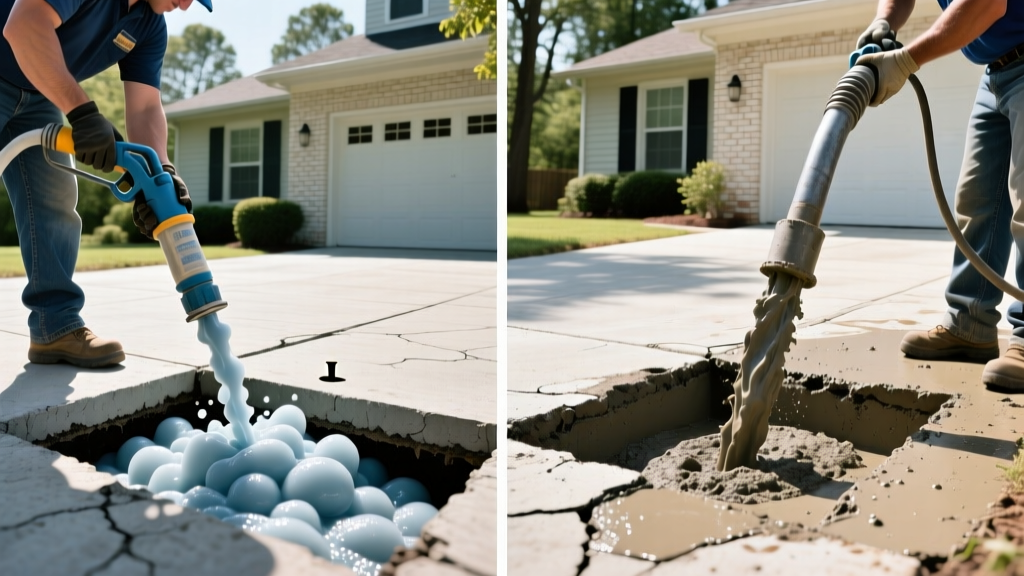
Head-to-Head Comparison Matrix
| Feature | Mudjacking (Slurry) | Polyurethane Lifting (Foam) |
|---|---|---|
| Material Weight | 100 - 120 lbs / cu ft | 2.5 - 4.0 lbs / cu ft |
| Drill Hole Size | 1.5 to 2.0 inches | 5/8 inch |
| Cure / Use Time | 24 - 48 hours | 15 - 20 minutes |
| Water Resistance | Poor (prone to washout) | Excellent (impervious) |
| SC Coastal Suitability | Low (sandy soil washout risk) | High (waterproof stability) |
| SC Piedmont Suitability | Moderate (weight stresses clay) | High (lightweight preserves clay) |
| Expected Lifespan | 5 - 10 years | 10 - 20+ years |
2026 Cost Breakdown for South Carolina Projects
Pricing for slab lifting is dictated by the volume of void space, the severity of the settlement, and site accessibility. Below are the average 2026 market rates for residential and light commercial repairs in South Carolina. Note that most reputable contractors enforce a minimum trip and mobilization charge, typically ranging from $500 to $850.
| Project Scope (Approx. Sq Ft) | Mudjacking Cost (Slurry) | Polyurethane Cost (Foam) |
|---|---|---|
| Small Sidewalk / Steps (100 - 200 sq ft) | $500 - $900 (Min. charge applies) | $800 - $1,400 (Min. charge applies) |
| Standard Driveway (500 - 800 sq ft) | $2,250 - $4,800 | $4,000 - $8,800 |
| Pool Deck / Patio (800 - 1,500 sq ft) | $3,600 - $9,000 | $6,400 - $16,500 |
| Average Cost Per Square Foot | $4.50 - $7.00 / sq ft | $8.00 - $13.00 / sq ft |
Decision Framework: Which Method Fits Your Property?
Choosing between concrete lifting vs mudjacking in South Carolina should not be based on price alone. Use the following decision matrix to determine the most structurally sound method for your specific property conditions:
Choose Polyurethane Concrete Lifting If:
- You live in the Coastal Plain: The waterproof, closed-cell nature of polyurethane is mandatory to prevent washout in sandy soils and areas with high water tables near Charleston or the Grand Strand.
- You have expansive Piedmont clay: The lightweight nature of the foam (3 lbs/cu ft) prevents overloading the weak, expansive red clays found in the Upstate and Midlands, preventing secondary settlement.
- The slab is decorative or stamped: The 5/8-inch drill holes are easily concealed, preserving the aesthetic integrity of expensive stamped concrete patios or exposed aggregate driveways.
- Immediate use is required: Commercial loading docks, busy driveways, or public walkways that cannot afford 48 hours of downtime benefit from the 15-minute cure time.
Choose Mudjacking If:
- You are repairing massive industrial voids: If a heavy machinery slab has dropped several inches due to a massive, multi-foot-deep subgrade washout, the volume of polyurethane required would be cost-prohibitive. Mudjacking slurry is more economical for extreme, deep-volume void filling.
- Budget is the absolute primary constraint: For a non-critical, utilitarian slab (like a remote equipment pad or an alleyway) where aesthetics and long-term soil dynamics are secondary to immediate, low-cost leveling.
Frequently Asked Questions
Will polyurethane foam damage my pool liner or plumbing?
No. The expansion pressure of structural polyurethane foam is carefully controlled by the technician. Furthermore, because it is injected through 5/8-inch ports, it easily navigates around embedded plumbing lines. Its waterproof nature also makes it the preferred choice for sealing leaks around pool skimmers and main drains.
Does mudjacking slurry attract termites or pests?
Traditional mudjacking slurry contains topsoil, sand, and cement. If the topsoil component contains organic matter, it can theoretically retain moisture and create a favorable environment for subterranean termites, which are highly prevalent in South Carolina. Polyurethane foam is entirely synthetic, inorganic, and provides zero nutritional value or moisture retention for pests.
How deep can polyurethane foam be injected?
While standard slab lifting addresses voids in the top 6 to 12 inches of the subgrade, specialized deep-injection techniques using expanding rods can stabilize soils up to 15 feet below the surface. This is particularly useful for stabilizing the deep, loose sandy soils found near South Carolina's coastal inlets and marshlands.
Written by
Marcus ChenMarcus Chen is a licensed structural engineer (PE) and building materials analyst with over 12 years of experience across residential, commercial, and industrial construction. He holds a Master of Science in Civil Engineering from UC Berkeley and spent six years at Thornton Tomasetti before transitioning to independent consulting and technical writing. Marcus specializes in material selection for seismic-prone regions, concrete reinforcement strategies, and lifecycle cost analysis. His work has been cited by the American Concrete Institute (ACI) and the Structural Engineers Association of California (SEAOC). When he is not on a job site or at his desk, you will find him hiking the Sierra Nevada or restoring a 1920s craftsman bungalow in Oakland, CA.
More from Marcus Chen
View all
Construction Cost
How Much Did the Eiffel Tower Cost to Build?
How much did the Eiffel Tower cost to build in 1889? We adjust for inflation and compare its budget to modern skyscraper construction.
Aug 4, 2026

Fire Resistance
What Is a Fire Resistant Material? Testing & Certification Guide
Discover what is a fire resistant material through ASTM and UL testing. Learn how fire ratings, certifications, and assemblies work in construction.
Aug 4, 2026

Construction Cost
How Much Did the Burj Khalifa Cost to Build?
How much did the Burj Khalifa cost to build? We break down the $1.5B project and extract 5 money-saving strategies for your next build.
Jul 30, 2026