Concrete Siding Cost vs Vinyl: Repair & Troubleshooting Analysis
Compare concrete siding cost vs vinyl through a repair lens. Learn troubleshooting steps, failure modes, and true lifetime maintenance expenses.

The Hidden Variable: Initial Install vs. Lifetime Repair Costs
When evaluating the concrete siding cost vs vinyl, most estimates stop at the installation invoice. In 2026, fiber cement (concrete) siding averages $10 to $14 per square foot installed, while vinyl ranges from $5 to $9. However, from a troubleshooting and repair perspective, the lifecycle financial divergence is stark. Concrete siding relies on a rigid Portland cement matrix, while vinyl utilizes flexible polyvinyl chloride (PVC) polymer chains. These distinct material sciences dictate entirely different failure modes, diagnostic protocols, and repair costs over a 30-year lifespan.
This guide bypasses upfront pricing to analyze the true cost of ownership, focusing on how to troubleshoot common failures, execute precise repairs, and calculate the long-term maintenance burden of both materials.
Troubleshooting Concrete (Fiber Cement) Siding Failures
Fiber cement siding, such as James Hardie HardiePlank, is highly resistant to rot, fire, and pests. However, its rigidity and porous nature create specific vulnerabilities that require targeted troubleshooting. For comprehensive installation and repair baselines, always refer to the James Hardie professional guidelines.
Symptom 1: Hairline Cracking at Fastener Points
- Root Cause: Blind-nailing too close to the edge (less than 3/4 inch) or using smooth-shank nails instead of ring-shank. The rigid cement board cannot flex under wind-load deflection, causing stress fractures radiating from the nail head.
- Diagnostic Step: Inspect the windward side of the home. Tap around cracks with a rubber mallet; a hollow sound indicates the board has delaminated from the sheathing.
- Repair Protocol: Do not attempt to drive new nails through the cracked zone. Inject a high-grade elastomeric sealant (e.g., OSI QuadMax) into the crack. For structural blowouts, use a fiber cement shear to cut out the damaged 16-inch section and slide a replacement piece behind the existing overlapping plank, securing it to the stud with 2-inch hot-dipped galvanized ring-shank nails.
- Estimated Repair Cost: $45 to $85 per localized patch (mostly labor minimums).
Symptom 2: Capillary Moisture Wicking and Bottom-Edge Spalling
- Root Cause: Fiber cement acts like a sponge at unsealed cut edges. If installed less than 6 inches above grade or 2 inches above a roofline, capillary action draws moisture upward, freezing and thawing to cause bottom-edge spalling (flaking).
- Diagnostic Step: Check the bottom 2 inches of ground-level courses for a powdery, crumbling texture or horizontal delamination.
- Repair Protocol: Severely spalled boards cannot be patched. You must remove the bottom course entirely. Install Z-flashing or a PVC water-resistive barrier sill pan, then reinstall new fiber cement, ensuring a strict 6-inch ground clearance. Seal all field cuts with a cementitious primer.
- Estimated Repair Cost: $300 to $600 per 20-foot wall section.
Never use a pressure washer exceeding 1,500 PSI on fiber cement siding. High-pressure water forces moisture behind the weather-resistive barrier (WRB) through the lap joints. Use a soft-wash system with a 40-degree nozzle tip and a 5% sodium hypochlorite solution for biological growth removal.
Troubleshooting Vinyl Siding Failures
Vinyl siding is virtually maintenance-free regarding moisture absorption, but its high coefficient of thermal expansion creates mechanical failures. The Vinyl Siding Institute emphasizes that improper fastening is the culprit in 90% of vinyl warranty claims.
Symptom 1: Thermal Buckling and Oil-Canning
- Root Cause: Vinyl expands up to 5/8 inch per 12-foot panel across seasonal temperature swings. If panels were nailed tightly to the sheathing rather than centered in the slotted nailing hems, the material has no room to move, resulting in wavy, buckled profiles (oil-canning).
- Diagnostic Step: Sight down the length of the wall during peak afternoon heat. If panels ripple or emit a popping/cracking sound at night as they cool, they are over-driven.
- Repair Protocol: Use a vinyl zip tool to unhook the bottom lip of the buckled panel. Pull the panel down to expose the nailing hem. Remove the tight nails, and re-fasten using 1-1/2 inch aluminum roofing nails driven precisely in the center of the slot, leaving a 1/32-inch gap between the nail head and the vinyl to allow lateral sliding.
- Estimated Repair Cost: $100 to $200 per wall elevation.
Symptom 2: UV Degradation and Impact Brittleness
- Root Cause: Prolonged UV exposure breaks down the plasticizers in older PVC formulations, making the siding brittle. Lawn equipment or hail impacts that would previously bounce off will now shatter the panel.
- Diagnostic Step: Press firmly on south-facing panels. If they feel rigid and lack their characteristic flex, or if hairline spider-cracks appear around impact zones, UV degradation has occurred.
- Repair Protocol: Unzip the damaged panel. Because vinyl fades over time, a brand-new replacement panel will starkly contrast with the existing wall. You must either source reclaimed siding from a hidden area (like the back of a dormer) or paint the new panel with a vinyl-safe acrylic latex paint (e.g., Sherwin-Williams VinylSafe technology) to match the faded surrounding area.
- Estimated Repair Cost: $150 to $300 (factoring in custom color-matching and painting).
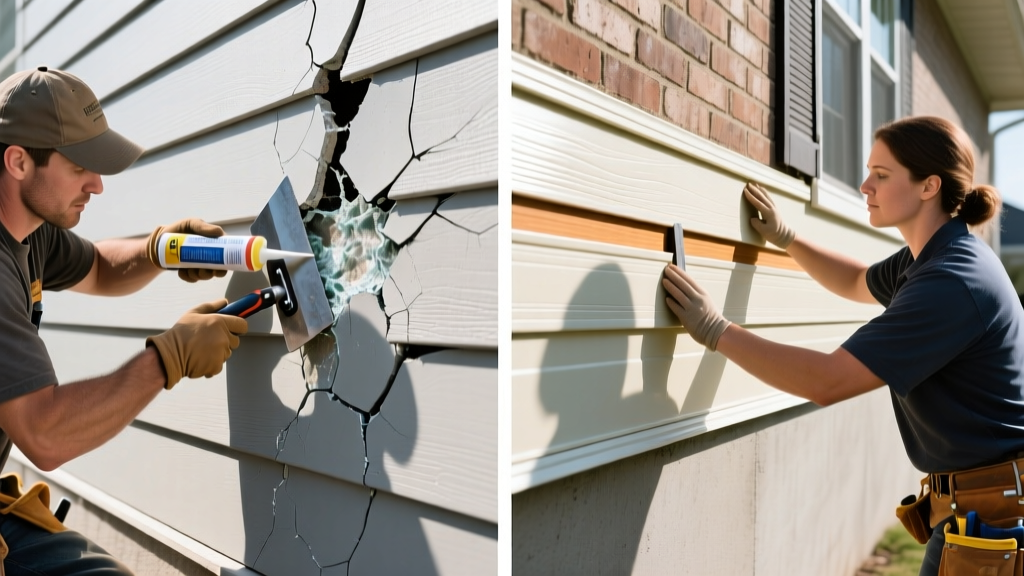
Head-to-Head: Concrete Siding Cost vs Vinyl Repair Matrix
The table below breaks down the 2026 average costs and complexity metrics for standard repair scenarios, providing a clear financial comparison for lifecycle budgeting.
| Failure Mode | Material | Repair Complexity | Avg. Cost (2026) | Color Match Difficulty |
|---|---|---|---|---|
| Impact Damage | Concrete (Fiber Cement) | Moderate (Requires shear & blind-nailing) | $125 - $175 | High (Requires priming & painting) |
| Impact Damage | Vinyl (PVC) | Low (Zip tool extraction) | $75 - $125 | Extreme (Fading makes exact match rare) |
| Thermal Movement | Concrete (Fiber Cement) | N/A (Material does not expand significantly) | $0 | N/A |
| Thermal Movement | Vinyl (PVC) | Low (Re-slotting and re-nailing) | $150 - $250 | None (Existing panel is reused) |
| Moisture Intrusion | Concrete (Fiber Cement) | High (Flashing & bottom course replacement) | $400 - $700 | Moderate (Factory pre-finished available) |
| Moisture Intrusion | Vinyl (PVC) | N/A (Material is impervious to water rot) | $0 (Panels drain freely) | N/A |
Advanced Diagnostic Framework: When to Repair vs. Replace
Use this decision matrix to determine whether a localized repair is financially viable or if a full wall replacement is required. According to lifecycle data tracked by the National Association of Home Builders (NAHB), fiber cement carries a 50-year life expectancy, while vinyl averages 30 to 40 years, heavily influencing the replace threshold.
- Assess the Damage Footprint: If damage is isolated to less than 10% of a single wall elevation, proceed with spot repair. If spalling (concrete) or widespread UV brittleness (vinyl) affects more than 20%, the labor cost of individual board swaps will exceed the cost of a full tear-off and replacement.
- Evaluate the Substrate: Remove a damaged section to inspect the weather-resistive barrier (WRB) and sheathing. If moisture has bypassed the siding and rotted the OSB/plywood sheathing, spot-repairing the siding is useless. You must replace the sheathing, upgrade to a modern fluid-applied WRB, and reinstall new siding.
- Calculate the Color-Match Penalty: For vinyl siding older than 12 years, UV fading guarantees that new replacement panels will be visually jarring. Factor in the $3 to $5 per square foot cost of painting the entire wall elevation with vinyl-safe paint to achieve uniformity. If this pushes the repair cost above $1,200 per wall, replacement is the superior ROI.
Expert Verdict: Which Material Wins on Long-Term Maintenance?
The debate over concrete siding cost vs vinyl ultimately hinges on the homeowner's tolerance for specific types of maintenance. Vinyl wins on routine, low-stakes repairs; a zip tool and a replacement panel cost under $100, and the material never requires painting. However, when vinyl fails structurally via thermal buckling or severe UV degradation, the lack of color-matching options often forces premature full-wall replacements.
Concrete (fiber cement) siding demands higher upfront repair costs and specialized tools (fiber cement shears, elastomeric sealants, cementitious primers). Yet, because it does not warp, melt, or suffer from thermal expansion, the frequency of required repairs is significantly lower. For homeowners prioritizing a 40+ year lifecycle with minimal aesthetic degradation, the higher per-incident repair cost of concrete siding is offset by the sheer rarity of those incidents.
Written by
David NakamuraDavid Nakamura is a licensed architect (AIA) and construction technology writer focused on sustainable building methods, mass timber engineering, and high-performance building envelopes. He holds a Master of Architecture from the University of Washington and is a certified Passive House Consultant (CPHC). David spent eight years at the Seattle firm Mithun, where he led the design of three LEED Platinum projects, before founding his own practice specializing in net-zero residential design. He serves on the editorial advisory board of GreenBuilder Magazine and has authored peer-reviewed papers on cross-laminated timber (CLT) connections for the Journal of Structural Engineering. In his spare time, David teaches woodworking at Pratt Fine Arts Center and kayaks the Puget Sound.
More from David Nakamura
View all
Construction Cost
Labor Cost to Build a Deck Per Sq Ft: 2026 Installation Guide
Discover the exact labor cost to build a deck per sq ft in 2026. This installation guide breaks down contractor rates, complexity factors, and hidden fees.
Aug 4, 2026

Construction Cost
How Much Does It Cost to Build a 3 Bedroom House? Financing Guide
Learn exactly how much it costs to build a 3 bedroom house and explore 2026 financing options, construction loan types, and budget frameworks for your build.
Aug 4, 2026

Construction Cost
Cost to Build a Tennis Court: 2026 Guide
How much does it cost to build a tennis court in 2026? Breakdowns for asphalt, concrete, and synthetic surfaces plus fencing and lighting.
Jul 30, 2026