Fiberglass Inground Pool vs Concrete: 2026 Cost Breakdown
Analyze the true cost of a fiberglass inground pool vs concrete. We break down 2026 installation pricing, long-term maintenance, and structural economics.

The Core Dilemma: Customization vs. Predictability
When evaluating a fiberglass inground pool vs concrete, the decision ultimately hinges on how you weigh upfront capital expenditure against long-term maintenance liabilities. Concrete pools (specifically pneumatically applied gunite or shotcrete) offer limitless geometric customization and structural permanence, but they demand rigorous, ongoing chemical and structural maintenance. Fiberglass pools provide a non-porous, factory-engineered gelcoat finish with predictable installation timelines, but they are constrained by manufacturing molds, shipping logistics, and strict backfill requirements.
This 2026 cost breakdown moves beyond superficial estimates. We analyze the exact material specifications, labor variables, and 15-year total cost of ownership (TCO) to help builders and homeowners make an economically sound decision.
Initial Installation Cost Matrix
The following matrix compares the baseline costs for a standard 14x28 foot inground pool (approximately 392 square feet of water surface area) in a region with standard soil conditions and average 2026 labor rates. Data is synthesized from recent industry benchmarks and Angi's inground pool cost guide.
| Cost Category | Concrete (Gunite/Shotcrete) | Fiberglass Shell |
|---|---|---|
| Shell Material & Fabrication | $22,000 - $35,000 | $20,000 - $38,000 |
| Excavation & Soil Hauling | $4,500 - $8,000 | $4,500 - $8,000 |
| Steel Reinforcement / Rigging | $6,000 - $9,500 (Rebar grid) | $2,500 - $5,000 (Crane rental) |
| Plumbing, Electrical & Equipment | $8,000 - $14,000 | $8,000 - $14,000 |
| Interior Finish (Plaster vs. Gelcoat) | $7,500 - $18,000 | Included in shell |
| Backfill Material | $800 - $1,500 (Native/Sand) | $2,500 - $4,500 (Clean gravel) |
| Total Base Estimate | $65,000 - $110,000+ | $55,000 - $90,000 |
Deep Dive: Concrete (Gunite) Material & Labor Economics
Concrete pools are built on-site using a steel rebar cage and pneumatically projected concrete. According to the American Concrete Institute (ACI) guidelines for environmental structures, the concrete mix must achieve a compressive strength of 4,000 to 6,000 PSI.
The Hidden Cost of Rebound and Over-Excavation
When applying dry-mix gunite, the high-velocity impact causes a phenomenon known as "rebound." Approximately 10% to 15% of the aggregate and cement bounces off the rebar grid and pools at the floor of the excavation. This rebound material must be completely removed and discarded. If a nozzleman improperly incorporates rebound into the structural shell, it creates weak planes that lead to delamination and catastrophic leaks later. This waste factor means you are paying for 15% more raw material than actually ends up in the cured pool shell.
Furthermore, concrete pools require an 8- to 12-inch thick shell. The structural grid typically utilizes #4 (1/2-inch) rebar tied at 10 inches on center (O.C.). The labor intensity of tying this cage, combined with the specialized nozzleman crew, drives the structural shell cost 20% to 30% higher than the factory-molded equivalent.
Interior Finish Variables
The concrete shell is merely the structural vessel; it requires an interior waterproofing finish. Your choice here drastically alters the final budget:
- Standard Marcite (White Plaster): $5.00 - $7.00 per sq. ft. Lasts 7-10 years. Highly porous, requiring aggressive chemical balancing.
- Quartz Aggregate: $8.00 - $11.00 per sq. ft. Lasts 12-15 years. Moderate porosity.
- PebbleTec / Exposed Aggregate: $14.00 - $20.00+ per sq. ft. Lasts 20+ years. Highly durable but rough on bare feet and requires specialized acid-washing protocols.
Deep Dive: Fiberglass Shell & Logistics Costs
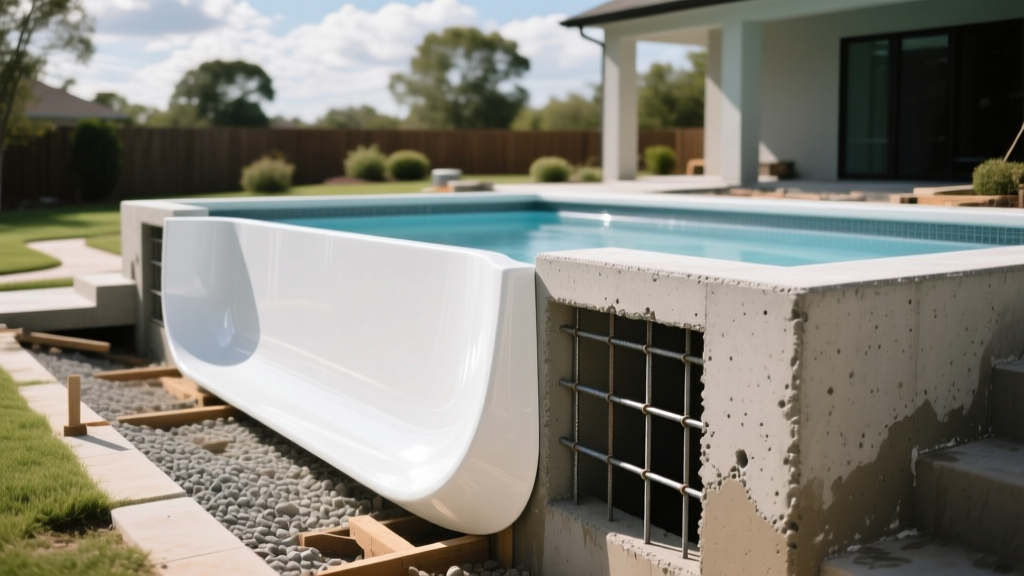
Fiberglass pools are manufactured in a controlled environment using ISO-certified molds. The structural integrity relies on a 30- to 40-mil thick gelcoat surface, backed by multiple layers of chopped fiberglass roving and vinyl ester resin to prevent osmotic blistering.
Logistics and Rigging Premiums
While the shell itself might seem competitively priced, the logistics of delivering a massive, single-piece structure introduce severe cost variables. A standard 14x28 pool shell weighs between 3,500 and 5,000 pounds and requires a wide-load escort for highway transport. Once on-site, a 100-ton mobile crane is required to lift the shell over the house or trees into the excavation. Crane rentals in 2026 average $2,500 to $4,000 per day, and if overhead power lines or tight property setbacks require a larger boom reach, costs can easily double.
The Critical Backfill Requirement
Unlike concrete pools, which can often be backfilled with native soil or sand, fiberglass pools must be backfilled with clean, 3/8-inch crushed stone (chip gravel). This gravel creates a free-draining matrix that prevents hydrostatic pressure from building up against the shell walls. If a contractor attempts to save $2,000 by backfilling a fiberglass pool with expansive native clay, the lateral pressure will cause the pool walls to bow inward, voiding the manufacturer's warranty and requiring a $15,000+ structural excavation to fix.
⚠️ Site Condition Warning: High Water Tables
If your property has a high water table or is located in a flood plain, a fiberglass pool acts like a boat. If the pool is drained for maintenance while the ground is saturated, hydrostatic pressure will literally push the empty fiberglass shell out of the ground (a "pop-up" event), destroying the plumbing and decking. Concrete pools are significantly heavier and can be engineered with deep grade beams and hydrostatic relief valves to mitigate this risk. Always conduct a percolation and water-table test before selecting fiberglass.
The Hidden Long-Term Cost of Ownership (15-Year Projection)
The true financial divergence between a fiberglass inground pool vs concrete occurs in years 5 through 15. The Pool & Hot Tub Alliance (PHTA) notes that surface porosity dictates chemical consumption and resurfacing schedules.
Concrete Pool Maintenance Economics
Concrete and plaster are inherently alkaline and porous. During the first 12 months, a new plaster pool will continuously leach calcium hydroxide into the water, requiring frequent additions of muriatic acid to prevent scale formation. Over a 15-year period, a concrete pool will consume roughly 35% more chlorine and acid than a fiberglass pool. Furthermore, at year 12-15, the plaster will inevitably degrade, requiring a complete chip-out and resurfacing job costing $12,000 to $22,000 depending on the finish selected.
Fiberglass Pool Maintenance Economics
The non-porous gelcoat surface of a fiberglass pool does not leach chemicals or harbor algae in microscopic pores. Chemical consumption drops significantly, saving an average of $400 to $700 annually on sanitizers and pH balancers. However, fiberglass is susceptible to UV degradation and "spider cracking" if the underlying ground shifts. While it never needs replastering, a gelcoat refresh or buffing may be required around year 15, costing roughly $2,500 to $4,500.
Structural Failure Modes & Repair Economics
Understanding how each material fails is critical for risk assessment.
Concrete Failure: Structural vs. Shrinkage Cracks
Concrete pools frequently develop hairline shrinkage cracks during the 28-day curing process. These are cosmetic and sealed by the plaster. However, structural cracks—typically running horizontally across the deep end or radiating from the skimmer throat—indicate ground settlement or inadequate rebar engineering. Repairing a structural concrete leak requires draining the pool, routing the crack, and injecting it with high-modulus epoxy or polyurethane resin, costing $1,200 to $2,500 per occurrence.
Fiberglass Failure: Osmotic Blistering and Flex Cracking
If a fiberglass pool is manufactured with trapped moisture or improper resin-to-catalyst ratios, it can develop osmotic blisters (bubbles under the gelcoat) within the first 3 to 5 years. While reputable manufacturers warranty this, the repair involves draining, grinding down the blisters, applying a vinyl ester patch, and re-spraying gelcoat. If the pool shell flexes due to improper gravel backfill, it will develop flex cracks at the coves (where the floor meets the wall), requiring structural shoring from the outside—a highly invasive and expensive repair.
Decision Framework: Which Material Fits Your Budget?
Use this framework to finalize your material selection based on your specific project constraints:
- Choose Concrete (Gunite) If:
- You require a custom shape, infinity edge, or integrated spa that exceeds standard fiberglass mold dimensions (typically maxing out at 16 feet wide by 40 feet long).
- Your site has poor access, making a 100-ton crane deployment impossible or prohibitively expensive.
- You are building in an area with highly expansive clay soils and need the sheer mass and engineered grade-beam capabilities of reinforced concrete to resist soil movement.
- Choose Fiberglass If:
- You want a predictable, fixed-price installation with a rapid timeline (shell installation takes one day; total project completion in 3-5 weeks vs. 3-4 months for concrete).
- You want to minimize the 15-year total cost of ownership by avoiding the inevitable $15,000+ replastering expense.
- Your site has excellent crane access, standard soil conditions, and you are satisfied with a pre-designed geometric shape.
Ultimately, the choice between a fiberglass inground pool vs concrete is not just about the initial check written to the contractor. It is a decision between paying for heavy civil engineering and ongoing chemical maintenance (concrete) versus paying for advanced manufacturing logistics and strict backfill compliance (fiberglass). Evaluate your site conditions, long-term holding plans, and design requirements against the 2026 cost data above to ensure your investment remains structurally and financially sound.
Written by
Marcus ChenMarcus Chen is a licensed structural engineer (PE) and building materials analyst with over 12 years of experience across residential, commercial, and industrial construction. He holds a Master of Science in Civil Engineering from UC Berkeley and spent six years at Thornton Tomasetti before transitioning to independent consulting and technical writing. Marcus specializes in material selection for seismic-prone regions, concrete reinforcement strategies, and lifecycle cost analysis. His work has been cited by the American Concrete Institute (ACI) and the Structural Engineers Association of California (SEAOC). When he is not on a job site or at his desk, you will find him hiking the Sierra Nevada or restoring a 1920s craftsman bungalow in Oakland, CA.
More from Marcus Chen
View all
Construction Cost
How Much Did the Eiffel Tower Cost to Build?
How much did the Eiffel Tower cost to build in 1889? We adjust for inflation and compare its budget to modern skyscraper construction.
Aug 4, 2026

Fire Resistance
What Is a Fire Resistant Material? Testing & Certification Guide
Discover what is a fire resistant material through ASTM and UL testing. Learn how fire ratings, certifications, and assemblies work in construction.
Aug 4, 2026

Construction Cost
How Much Did the Burj Khalifa Cost to Build?
How much did the Burj Khalifa cost to build? We break down the $1.5B project and extract 5 money-saving strategies for your next build.
Jul 30, 2026