Fiberglass vs Concrete vs Vinyl Pools: Technical Specs & Shell Strength
Compare fiberglass vs concrete vs vinyl pools through technical specs. Analyze shell thickness, PSI strength, thermal mass, and structural longevity.

The Engineering of Inground Pool Shells
An inground swimming pool is essentially a liquid-containing concrete structure subjected to complex, multi-directional forces. The shell must resist internal hydrostatic pressure from the water, external lateral earth pressure from the surrounding soil, and vertical loads from the deck and coping. When evaluating fiberglass vs concrete vs vinyl pools from a structural engineering perspective, the primary differentiator is how each material manages these tensile and compressive loads. While aesthetic and maintenance factors dominate consumer discussions, the underlying technical specifications—compressive strength, wall thickness, modulus of elasticity, and thermal conductivity—dictate the long-term structural viability of the installation.
Concrete (Gunite/Shotcrete) Pool Specifications
Concrete pools represent the heaviest and most structurally rigid option. The shell is typically constructed using pneumatically applied concrete, governed by the American Concrete Institute (ACI) Committee 506 guidelines. The industry frequently conflates gunite and shotcrete, but the technical distinction is critical for structural integrity.
Technical Distinction: Dry-Mix vs. Wet-Mix
Gunite (Dry-Mix): A pre-blended mixture of sand and cement is blown through a hose, with water injected at the nozzle. It requires highly skilled nozzle operators to maintain the correct water-to-cement (w/c) ratio, typically targeting 0.40 to 0.45. Improper hydration leads to high rebound rates and porous, structurally deficient layers.
Shotcrete (Wet-Mix): All ingredients, including water and often a 3/8-inch pea gravel aggregate, are pre-mixed before entering the hose. This guarantees a consistent w/c ratio and typically yields higher compressive strengths (5,000 to 7,000 PSI at 28 days) with significantly less rebound.
A standard structural concrete pool shell requires a minimum nominal thickness of 8 inches, though 10 to 12 inches is specified in high-load zones (such as deep ends or areas supporting cantilevered decks). The concrete is reinforced with a continuous grid of ASTM A615 Grade 60 deformed steel rebar. Standard engineering practice dictates #3 (3/8-inch) or #4 (1/2-inch) rebar spaced at 10 to 12 inches on-center, both horizontally and vertically. The compressive strength of the cured shell generally ranges from 4,000 to 5,000 PSI, providing immense resistance to external soil pressures and eliminating the risk of wall deflection.
Fiberglass Composite Shell Mechanics
Fiberglass pools rely on composite material mechanics rather than mass. The shell is manufactured using a contact molding process, governed by standards similar to those outlined by the Pool & Hot Tub Alliance (PHTA). The structural integrity of a fiberglass shell depends on the resin matrix and the glass fiber reinforcement architecture.
- Gelcoat Layer: The interior surface is a 15 to 25-mil layer of pigmented polyester or vinylester gelcoat. This provides UV resistance and a non-porous finish but contributes zero structural strength.
- Corrosion Barrier: High-end manufacturers apply a layer of vinylester resin mixed with chopped strand mat (CSM). Vinylester is highly resistant to water penetration, preventing osmotic blistering (the primary failure mode of older polyester-based fiberglass pools).
- Structural Laminate: The load-bearing layer consists of alternating layers of woven roving and chopped strand fiberglass, saturated with polyester or vinylester resin.
The total wall thickness of a structural fiberglass pool typically ranges from 3/8 inch to 1/2 inch (approx. 9.5mm to 12.7mm). Despite its thin profile, the tensile strength of the woven roving fiberglass matrix allows the shell to flex slightly under hydrostatic loads without fracturing. However, because the shell lacks mass, it is highly dependent on the backfill material. Clean, angular 3/8-inch crushed stone (gravel) must be used as backfill to provide lateral support and facilitate drainage; using native soil can lead to wall deflection and structural spider-cracking under hydrostatic pressure.
Vinyl Liner Structural Realities
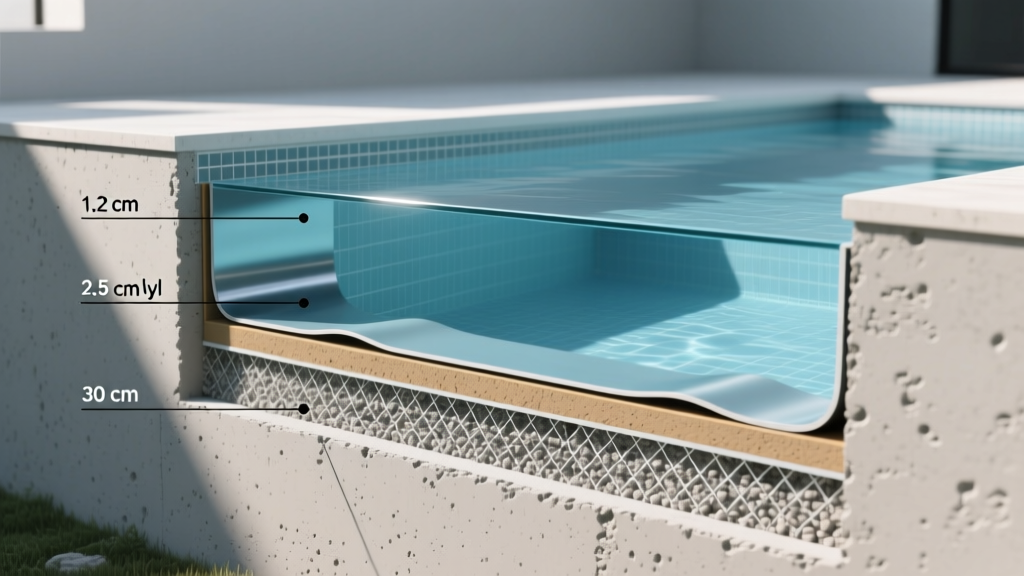
From an engineering standpoint, a vinyl pool is not a single structural entity but a composite system. The vinyl liner itself—typically a 20, 27, or 30-mil thick sheet of polyvinyl chloride (PVC)—is entirely non-structural. It serves solely as a waterproof membrane. The structural loads are borne entirely by the perimeter wall panels and the floor substrate.
Perimeter walls are constructed from either 14-gauge galvanized steel, structural polymer panels, or extruded aluminum. Steel panels must be treated with anti-corrosion coatings to prevent oxidation from the constant moisture environment. The floor of a vinyl pool is not a structural slab; it is a 2-inch to 3-inch thick screed of vermiculite mixed with Portland cement, or a specialized pool grout, troweled directly over the native earth. This floor provides a smooth substrate but offers no resistance to hydrostatic uplift. Consequently, vinyl pools require aggressive groundwater management, often necessitating a perimeter French drain system and an automated hydrostatic relief valve in the deep end sump to prevent the entire pool structure from buoying out of the ground during heavy rainfall.
Comparative Technical Matrix
| Specification | Concrete (Shotcrete) | Fiberglass Composite | Vinyl Liner System |
|---|---|---|---|
| Nominal Wall Thickness | 8" - 12" (200 - 300 mm) | 3/8" - 1/2" (9.5 - 12.7 mm) | 20 - 30 mil membrane (non-structural) |
| Compressive / Tensile Strength | 4,000 - 5,000 PSI (Compressive) | 15,000 - 25,000 PSI (Tensile) | Dependent on steel/polymer frame |
| Hydrostatic Relief Requirement | Moderate (Mass resists uplift) | High (Lightweight shell) | Critical (Zero uplift resistance) |
| Thermal Conductivity | High (Acts as heat sink to soil) | Low (Provides slight thermal break) | Very High (Thin membrane) |
| Interior Finish Lifespan | 10 - 15 years (Plaster/Pebble) | 25 - 30+ years (Gelcoat) | 7 - 10 years (PVC Liner) |
Thermal Mass and Heat Retention Physics
The thermal dynamics of pool shells significantly impact operational heating costs. Concrete possesses high thermal mass but also high thermal conductivity. A shotcrete shell acts as a thermal bridge, absorbing heat from the pool water and transferring it directly into the surrounding cooler earth. To mitigate this, modern concrete pool specifications often include a 1-inch layer of closed-cell rigid foam insulation applied to the exterior of the shell before backfilling.
Fiberglass composites inherently trap microscopic air pockets within the resin matrix, giving the shell a lower thermal conductivity than concrete. While the difference in heat loss is marginal (typically a 2°F to 4°F variance over a 24-hour period without a heater), the fiberglass shell acts as a slight thermal break. Vinyl liners, being only 30 mils thick, offer virtually zero thermal resistance. The vermiculite floor substrate is highly porous and conducts heat rapidly into the water table below, making vinyl pools the most thermally inefficient option without the addition of specialized insulating floor underlayments.
Failure Modes and Edge Cases
Understanding how each material fails under extreme conditions is critical for site-specific engineering. The National Plasterers Council (NPC) and structural engineers frequently document the following failure mechanisms:
Concrete: Spalling and Structural Cracking
The most common structural failure in concrete pools is not total collapse, but localized spalling and delamination caused by trapped rebound (dry, unhydrated concrete material that bounces off the rebar during application). If rebound is not physically chipped away during construction, it creates a porous, weak slip-plane within the shell. Furthermore, in regions with expansive clay soils, the immense lateral pressure can exceed the tensile strength of the steel reinforcement, leading to structural horizontal cracking along the pool walls.
Fiberglass: Osmotic Blistering and Wall Deflection
Historically, fiberglass pools suffered from osmotic blistering, a chemical reaction where water molecules penetrate the gelcoat and react with unreacted styrene in the polyester resin, forming fluid-filled blisters. Modern 2026 manufacturing standards have largely eliminated this by mandating vinylester resin corrosion barriers. The more prevalent modern failure mode is wall deflection or "spider cracking" in the gelcoat, caused by improper backfill compaction or the use of expansive native clay soils that shift against the flexible shell.
Vinyl: Liner Stretching and Panel Corrosion
Vinyl liners are susceptible to plasticizer migration, a process where the chemicals that keep the PVC flexible slowly leach out into the pool water, causing the liner to become brittle and tear. Additionally, if the groundwater table rises and the hydrostatic relief valve fails, the upward pressure can cause the vermiculite floor to heave and crack, or in extreme cases, push the entire steel-wall structure upward, permanently distorting the pool geometry.
Decision Framework for Structural Environments
Selecting the correct pool shell requires matching the material's technical specifications to the site's geotechnical report.
- High Water Table / Coastal Zones: Concrete is the superior choice. The sheer mass of an 80,000-pound concrete shell naturally resists hydrostatic uplift. Fiberglass and vinyl require extensive, expensive dewatering systems and specialized gravel bedding to prevent the shell from floating out of the excavation.
- Expansive Clay Soils: Concrete with engineered over-excavation and gravel backfill, or fiberglass with strict crushed-stone backfill protocols. Vinyl wall panels are highly susceptible to bowing under the lateral pressure of wet, expanding clay.
- Seismic Zones: Shotcrete pools, when engineered with continuous #4 rebar and proper seismic detailing at the coping bond beam, perform exceptionally well due to their monolithic nature and ductility. Fiberglass shells can flex during minor seismic events, but rigid plumbing connections may fracture if not fitted with flexible unions.
Ultimately, the choice between fiberglass vs concrete vs vinyl pools transcends surface-level aesthetics. It requires a rigorous evaluation of compressive strength, thermal dynamics, and geotechnical compatibility to ensure the structural longevity of the installation.
Written by
David NakamuraDavid Nakamura is a licensed architect (AIA) and construction technology writer focused on sustainable building methods, mass timber engineering, and high-performance building envelopes. He holds a Master of Architecture from the University of Washington and is a certified Passive House Consultant (CPHC). David spent eight years at the Seattle firm Mithun, where he led the design of three LEED Platinum projects, before founding his own practice specializing in net-zero residential design. He serves on the editorial advisory board of GreenBuilder Magazine and has authored peer-reviewed papers on cross-laminated timber (CLT) connections for the Journal of Structural Engineering. In his spare time, David teaches woodworking at Pratt Fine Arts Center and kayaks the Puget Sound.
More from David Nakamura
View all
Construction Cost
Labor Cost to Build a Deck Per Sq Ft: 2026 Installation Guide
Discover the exact labor cost to build a deck per sq ft in 2026. This installation guide breaks down contractor rates, complexity factors, and hidden fees.
Aug 4, 2026

Construction Cost
How Much Does It Cost to Build a 3 Bedroom House? Financing Guide
Learn exactly how much it costs to build a 3 bedroom house and explore 2026 financing options, construction loan types, and budget frameworks for your build.
Aug 4, 2026

Construction Cost
Cost to Build a Tennis Court: 2026 Guide
How much does it cost to build a tennis court in 2026? Breakdowns for asphalt, concrete, and synthetic surfaces plus fencing and lighting.
Jul 30, 2026