Pool Liner vs Concrete Pools: 2026 Cost Breakdown
Compare pool liner vs concrete costs in 2026. Detailed breakdown of installation, 20-year lifecycle expenses, maintenance, and ROI to guide your build.

The Upfront Capital: Initial Installation Costs
When evaluating a pool liner vs concrete build, the initial price tag is the most immediate differentiator. In 2026, material inflation and specialized labor shortages have widened the gap between vinyl liner and gunite/shotcrete installations. A standard 16x32-foot rectangular vinyl liner pool typically costs between $55,000 and $75,000. By contrast, a concrete pool of the exact same dimensions ranges from $85,000 to $125,000, according to current industry data from Forbes Home Improvement.
The cost disparity stems from the structural engineering required. Concrete pools demand extensive steel rebar tying (typically #3 or #4 rebar on a 10-inch grid) and the application of 4,000 PSI shotcrete or gunite. Vinyl liner pools utilize pre-fabricated steel or structural polymer walls, backfilled with gravel, and a floor composed of a vermiculite-cement or sand mix. While the polymer walls are highly resistant to corrosion, they lack the sheer structural mass of a monolithic concrete shell.
Itemized Installation Comparison (16x32 ft. Standard)
| Cost Category | Vinyl Liner Pool | Concrete (Gunite) Pool |
|---|---|---|
| Excavation & Soil Removal | $4,500 - $6,000 | $5,500 - $8,000 |
| Shell Construction (Walls/Floor) | $12,000 - $16,000 (Polymer/Vermiculite) | $28,000 - $38,000 (Rebar/Shotcrete) |
| Plumbing & Electrical | $8,000 - $11,000 | $9,500 - $13,000 |
| Interior Finish (Liner vs. Plaster/Pebble) | $4,000 - $6,500 (30-mil Virgin Vinyl) | $12,000 - $22,000 (Pebble Tec/Quartz) |
| Decking (Standard Broom Concrete) | $8,000 - $12,000 | $10,000 - $15,000 |
| Total Estimated Range | $55,000 - $75,000 | $85,000 - $125,000 |
The 20-Year Lifecycle: Maintenance and Replacement
The true financial divergence between a pool liner vs concrete occurs during the second decade of ownership. Upfront savings on a vinyl pool are frequently offset by mandatory liner replacements and higher chemical consumption.
Vinyl Liner Replacement Cycles
Modern virgin vinyl liners (27-mil to 30-mil thickness) are highly durable against tearing but remain susceptible to UV degradation and chemical bleaching. In a climate with high sun exposure, a liner will typically require replacement every 8 to 12 years. A 2026 liner replacement for a 16x32 pool, including draining, track repair, and refilling, costs between $4,500 and $6,500. Over a 20-year period, you will likely pay for one full replacement, adding roughly $5,500 to your lifecycle cost.
Furthermore, the vermiculite floor beneath the liner is a hidden vulnerability. If the liner develops a micro-leak, water can wash out the vermiculite sub-floor, creating divots and uneven surfaces that require expensive troweling repairs before a new liner can be installed.
Concrete Resurfacing and Acid Washing
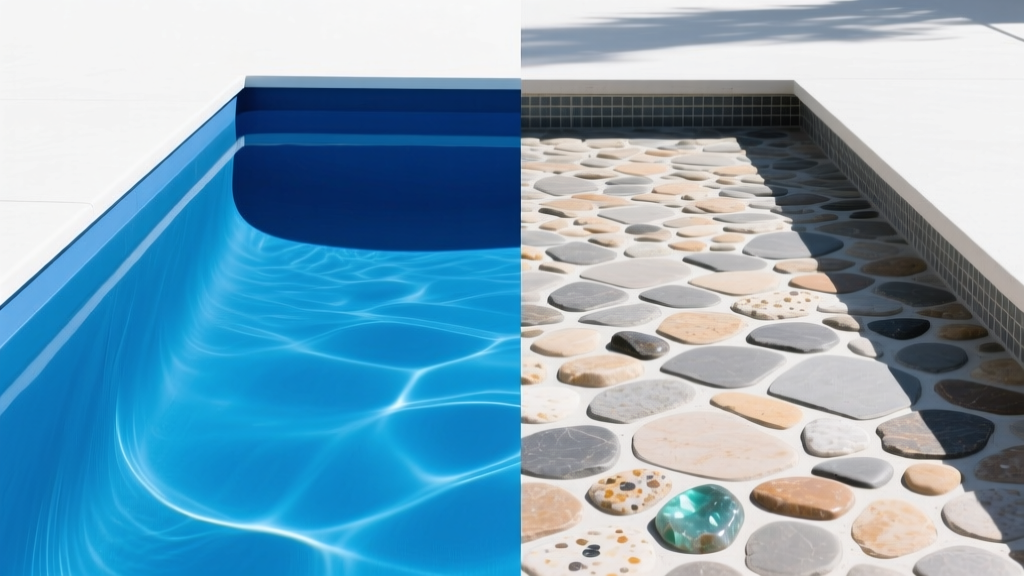
Concrete pools do not require total shell replacement, but their interior finishes have strict lifespans. Standard white marcite (plaster) lasts 7 to 10 years before it becomes rough, stains, or leaches calcium. Upgrading to an exposed aggregate finish like Pebble Tec extends this lifespan to 15 to 20 years. When resurfacing is required, draining, chipping out the old plaster, and applying a new aggregate finish costs between $9,000 and $15,000. While this is more expensive than a liner swap, it occurs less frequently if premium materials are used.
Chemical and Heating Discrepancies
Concrete is inherently porous and highly alkaline. A newly plastered concrete pool requires aggressive acid washing and frequent pH balancing (often daily in the first month) to prevent calcium scaling. Over a 20-year lifespan, concrete pools consume roughly 15% to 20% more chlorine and muriatic acid than the inert, non-porous surface of a vinyl liner. Additionally, concrete acts as a thermal sink, drawing heat out of the water into the surrounding earth. If you plan to heat your pool, expect monthly heating bills to be 10% to 15% higher for a concrete shell unless you install rigid foam insulation beneath the shotcrete during the initial build.
Hidden Structural Costs: Soil, Water, and Climate
Geotechnical conditions dictate long-term structural viability. Ignoring your local soil composition when choosing between a pool liner vs concrete can result in catastrophic failure modes.
- High Water Tables: In coastal or low-lying areas, groundwater exerts immense hydrostatic pressure. A vinyl liner pool, which is essentially a lightweight box, can literally 'float' out of the ground or suffer severe wall bowing if the groundwater rises and the pool is drained for maintenance. Concrete pools, weighing upwards of 40,000 pounds empty, resist this buoyancy naturally, though they still require hydrostatic relief valves in the main drain to prevent floor cracking.
- Expansive Clay Soils: Regions with heavy clay experience significant soil swelling during wet seasons. While structural polymer walls can flex slightly without rupturing, rigid concrete shells are prone to structural cracking if not engineered with deep grade beams and specialized soil compaction. Repairing a structural crack in a gunite shell requires epoxy injection and structural staples, costing $2,500 to $5,000 per fissure.
- Freeze-Thaw Cycles: In northern climates, water trapped behind a concrete pool wall can freeze and expand, causing 'frost heave' that pushes the pool coping upward. Vinyl pools with gravel backfill drain water away more efficiently, reducing frost-related damage to the surrounding hardscape.
Resale Value and ROI Analysis
According to real estate appraisers and data compiled by Angi, the type of pool you build significantly impacts your home's resale value, particularly in luxury markets. A well-maintained concrete pool with a modern pebble finish and automated sanitation is generally viewed as a permanent, high-end architectural feature. It can increase property value by 5% to 8% in upscale neighborhoods.
Conversely, vinyl liner pools are often viewed by prospective buyers as a looming liability. If a homebuyer discovers the vinyl liner is 9 years old, they will immediately factor a $6,000 replacement cost into their offer, often demanding a credit at closing. In premium real estate markets, a vinyl liner pool may yield a return on investment (ROI) of only 30% to 40% of its initial cost, whereas a concrete pool can recoup 50% to 70%, depending on the integration with the surrounding landscape.
The Final Decision Matrix
Use the framework below to align your specific financial parameters, geographic location, and usage goals with the correct material.
| Decision Factor | Choose Vinyl Liner If... | Choose Concrete If... |
|---|---|---|
| Initial Budget | Strictly capped under $80,000. | Flexible budget allowing $100,000+ for premium finishes. |
| Installation Timeline | You need the pool completed in 4 to 6 weeks. | You can accommodate an 8 to 12-week curing and plastering schedule. |
| Soil & Water Table | Stable, well-draining soil with a low water table. | High water table, rocky terrain, or expansive clay requiring structural mass. |
| Customization | Standard geometric shapes (rectangles, simple curves) are acceptable. | You require custom freeform shapes, integrated spas, or infinity edges. |
| Maintenance Tolerance | You prefer lower chemical usage and a smooth, algae-resistant surface. | You are willing to manage higher chemical loads for a permanent, luxury finish. |
| Long-Term Horizon | You plan to sell the home within 7 to 10 years. | This is your forever home and you want a multi-generational asset. |
Ultimately, the pool liner vs concrete debate is not about which material is universally superior, but which financial model aligns with your property and timeline. Vinyl offers a lower barrier to entry and cheaper daily maintenance, while concrete demands a premium upfront but delivers unmatched structural permanence, customization, and long-term equity retention.
Written by
Sarah WhitfieldSarah Whitfield is a chartered quantity surveyor (MRICS) and construction cost analyst with 15 years of experience in material pricing, procurement strategy, and project budgeting. She earned her degree in Construction Management from the University of Reading (UK) and has worked on projects ranging from $2M custom homes to $180M mixed-use developments across North America and Europe. Sarah currently leads cost estimating for BuildMat Insight, maintaining a proprietary database of 4,000+ material price points updated quarterly. She is a frequent contributor to RSMeans cost data panels and has presented at the International Cost Engineering Council (ICEC) congress. Based in Denver, CO, Sarah is an avid trail runner and volunteer mentor for Women in Construction.
More from Sarah Whitfield
View all
Wood & Lumber
What Are the Different Types of Wood? A Builder's Guide
Compare structural softwoods, finish hardwoods, and engineered lumber. Analyze Janka ratings, MOE values, and 2026 pricing for construction.
Aug 4, 2026

Walls & Panels
Steel Framing vs Wood Framing: Corrosion and Moisture Defense
Compare steel framing vs wood framing for moisture resistance. Learn about galvanized coatings, condensation risks, and corrosion protection strategies.
Jul 21, 2026

Stone & Masonry
How to Cut Stone Veneer: Wet Saw vs Grinder Comparison
Compare the best tools for cutting stone veneer. We review wet saws, angle grinders, and chop saws to help you achieve clean, chip-free cuts.
Jul 21, 2026