Stucco vs Concrete Siding: 2026 Cost Breakdown & Installation
Compare stucco vs concrete siding costs in 2026. Detailed breakdown of material, labor, maintenance, and ROI for fiber cement and traditional stucco.

The Core Distinction: Traditional Stucco vs. Fiber Cement Siding
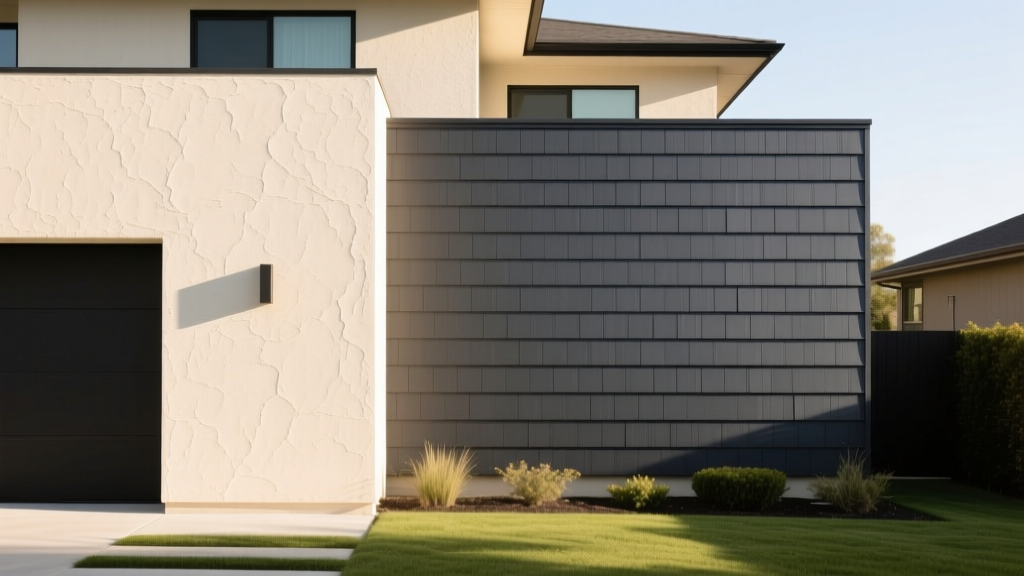
In residential and light commercial construction, the debate of stucco vs concrete siding often stems from a terminology overlap. True 'concrete siding' in the residential market almost exclusively refers to fiber cement siding (popularized by brands like James Hardie), which is composed of Portland cement, sand, and cellulose fibers. Architectural precast concrete panels exist but are generally reserved for high-end commercial builds due to extreme weight and cost. Traditional stucco, conversely, is a Portland cement-based plaster applied directly over a wall assembly in a multi-coat system.
Understanding this distinction is critical for accurate budgeting. While both materials share a cementitious base, their installation methodologies, structural requirements, and long-term maintenance profiles diverge significantly. This 2026 cost analysis breaks down the exact material, labor, and lifecycle expenses to help you make an informed cladding decision.
2026 Upfront Cost Breakdown: Material and Labor
The installed cost of exterior cladding is heavily influenced by regional labor rates and the complexity of the architectural elevations. Below is the current 2026 pricing matrix for a standard 2,500-square-foot exterior envelope.
| Cladding Type | Material Cost (per sq. ft.) | Labor Cost (per sq. ft.) | Total Installed (per sq. ft.) | Estimated Lifespan |
|---|---|---|---|---|
| Traditional 3-Coat Stucco | $2.50 - $4.50 | $7.00 - $11.00 | $9.50 - $15.50 | 50+ years |
| Synthetic Stucco (EIFS) | $3.00 - $5.00 | $5.50 - $8.50 | $8.50 - $13.50 | 30 - 50 years |
| Fiber Cement Lap (e.g., HardiePlank) | $3.50 - $6.50 | $6.50 - $11.50 | $10.00 - $18.00 | 50 years |
| Fiber Cement Vertical Panels | $4.50 - $8.00 | $8.00 - $14.00 | $12.50 - $22.00 | 50 years |
Traditional Three-Coat Stucco Cost Variables
According to the Portland Cement Association, a compliant traditional stucco system requires a 7/8-inch thick, three-coat application (scratch, brown, and finish coats) over metal lath and a weather-resistant barrier. The high labor cost is driven by the mandatory curing times between coats and the specialized masonry skills required. In 2026, experienced stucco masons command between $75 and $110 per hour. Furthermore, complex rooflines with multiple dormers or arches will increase labor costs by 20% to 35% due to the intricate lath cutting and corner bead installation required.
Fiber Cement Siding Cost Variables
Fiber cement siding is installed by carpenters rather than masons. While hourly carpentry rates are slightly lower ($55 to $85 per hour), the material itself is more expensive than raw stucco ingredients. The cost of fiber cement fluctuates based on the profile (lap, shingle, or vertical panel) and the finish. Pre-finished boards with factory-applied acrylic coatings (such as James Hardie's ColorPlus Technology) add $2.00 to $3.50 per square foot to the material cost but eliminate the need for immediate on-site painting, often resulting in a net-neutral total project cost.
When comparing stucco vs concrete siding, contractors often omit scaffolding costs in initial estimates. Traditional stucco requires continuous, fully enclosed scaffolding for the duration of the multi-day application and curing process. Fiber cement siding can often be installed using rolling Baker scaffolds or pneumatic lifts, reducing equipment rental costs by up to 40% on two-story builds.
Critical Installation Nuances and Failure Modes
The longevity of both materials relies entirely on moisture management. Cutting corners during installation transforms a 50-year cladding into a 10-year liability.
- Stucco Weep Screeds: ASTM C926 mandates the use of a weep screed at the base of all stucco walls. This metal flashing must be installed a minimum of 2 inches above rooflines and 4 inches above grade. Omitting the weep screed traps water behind the paper, leading to wood rot and structural framing failure.
- Fiber Cement Clearances: The James Hardie installation guidelines strictly require a minimum 6-inch clearance between the bottom edge of the siding and the final grade, and a 2-inch clearance above rooflines. Failure to maintain this gap results in capillary action, where the fiber cement wicks ground moisture, leading to edge swelling, delamination, and voided warranties.
- Fastener Corrosion: Fiber cement is highly alkaline. Using standard electroplated nails will result in rapid corrosion and rust streaking. Installers must use hot-dipped galvanized or stainless steel fasteners. Blind-nailing techniques must be strictly followed to prevent over-driving, which fractures the cementitious matrix.
Long-Term Maintenance and Lifecycle Costs
Upfront installation is only half the financial equation. Evaluating the 50-year lifecycle cost reveals distinct maintenance trajectories for stucco and fiber cement.
Stucco Maintenance Profile
Traditional stucco is exceptionally durable but prone to hairline cracking due to structural settling and thermal expansion. While hairline cracks are cosmetic, structural cracks (wider than 1/16 inch) require routing and sealing with polyurethane caulk to prevent water intrusion. If the stucco is painted, expect to repaint every 10 to 15 years. Alternatively, using an integral color in the finish coat eliminates the need for painting, though it limits future color changes without expensive elastomeric coatings.
Fiber Cement Maintenance Profile
Fiber cement does not crack from structural settling, making it superior in regions with expansive clay soils. However, the factory-applied finish on pre-colored boards typically carries a 15-year fade warranty. After 15 to 20 years, the siding will require repainting. Field-painted fiber cement (painted after installation) requires repainting much sooner, typically every 7 to 10 years, as field conditions rarely match the controlled curing environment of a factory finish.
Climate Suitability and Environmental Impact
The geographical location of your build heavily dictates which material will perform best and yield the highest return on investment.
Best for Stucco
Arid, Hot, and Mild Climates: Stucco excels in the American Southwest and Mediterranean climates. Its high thermal mass helps regulate indoor temperatures by absorbing heat during the day and releasing it at night. It is highly resistant to UV degradation and performs exceptionally well in areas with minimal freeze-thaw cycles.
Best for Fiber Cement
Humid, Coastal, and Freeze-Thaw Zones: Fiber cement is impervious to salt spray, making it ideal for coastal builds. Unlike wood, it does not rot, and unlike stucco, it is not brittle when subjected to the expansion and contraction of harsh freeze-thaw cycles. It is also completely immune to termite and woodpecker damage.
ROI and Resale Value Impact
Exterior cladding significantly influences curb appeal and appraisal values. According to historical data tracked by the National Association of Home Builders (NAHB), both stucco and fiber cement are viewed as premium cladding options compared to vinyl. Fiber cement siding consistently yields a high cost-to-value ratio, often recouping 75% to 85% of its installation cost at resale, largely due to its widespread recognition for durability and low maintenance. Stucco commands a premium in specific regional markets (like California, Arizona, and Florida) but can sometimes be viewed with skepticism in the Pacific Northwest or Midwest due to historical issues with poorly installed synthetic stucco (EIFS) in the 1990s.
Decision Matrix: Which Should You Choose?
Use this framework to finalize your material selection based on your specific project parameters:
- Choose Traditional Stucco if: You are building in a dry, arid climate; your architectural design features curved walls, arches, or seamless Mediterranean/Spanish aesthetics; and you have access to highly rated, certified masonry contractors who strictly adhere to ASTM C926 standards.
- Choose Fiber Cement Siding if: You are building in a region with heavy rainfall, high humidity, or severe freeze-thaw cycles; your design utilizes sharp, modern lines or traditional lap profiles; and you prioritize a material that resists impact, pests, and salt air without the risk of brittle cracking.
- Consider Precast Concrete Panels if: You are executing a high-budget commercial or ultra-modern luxury residential build where the architectural vision demands massive, seamless, structural concrete facades, and your budget can accommodate $35+ per square foot installed.
Ultimately, the choice between stucco and concrete siding is not just about the initial invoice. It is about matching the material's physical properties to your local microclimate and ensuring your contractor respects the strict moisture-management tolerances required by both systems.
Written by
Marcus ChenMarcus Chen is a licensed structural engineer (PE) and building materials analyst with over 12 years of experience across residential, commercial, and industrial construction. He holds a Master of Science in Civil Engineering from UC Berkeley and spent six years at Thornton Tomasetti before transitioning to independent consulting and technical writing. Marcus specializes in material selection for seismic-prone regions, concrete reinforcement strategies, and lifecycle cost analysis. His work has been cited by the American Concrete Institute (ACI) and the Structural Engineers Association of California (SEAOC). When he is not on a job site or at his desk, you will find him hiking the Sierra Nevada or restoring a 1920s craftsman bungalow in Oakland, CA.
More from Marcus Chen
View all
Construction Cost
How Much Did the Eiffel Tower Cost to Build?
How much did the Eiffel Tower cost to build in 1889? We adjust for inflation and compare its budget to modern skyscraper construction.
Aug 4, 2026

Fire Resistance
What Is a Fire Resistant Material? Testing & Certification Guide
Discover what is a fire resistant material through ASTM and UL testing. Learn how fire ratings, certifications, and assemblies work in construction.
Aug 4, 2026

Construction Cost
How Much Did the Burj Khalifa Cost to Build?
How much did the Burj Khalifa cost to build? We break down the $1.5B project and extract 5 money-saving strategies for your next build.
Jul 30, 2026