Masonry vs Concrete Cost Breakdown: 2026 Wall Pricing
Compare masonry vs concrete costs in 2026. Detailed breakdown of material, labor, and lifecycle pricing for CMU, brick, and poured walls.

The True Cost of Wall Systems: Beyond the Price Tag
Choosing between masonry and poured concrete for structural walls requires looking past the initial material quote. In 2026, the divergence in skilled labor availability and formwork technology has fundamentally altered the cost dynamics of these two systems. While concrete masonry units (CMUs) remain cheap to manufacture, the skilled labor required to lay them has become a premium expense. Conversely, poured concrete benefits from rapid mechanized placement, though it carries high upfront formwork and pumping costs.
Executive Cost Summary (Per Square Foot of Wall Area)
- Standard Poured Concrete: $11.50 – $16.00 / sq. ft.
- Concrete Masonry Units (CMU): $14.00 – $21.50 / sq. ft.
- Insulated Concrete Forms (ICF): $22.00 – $28.50 / sq. ft.
- Structural Brick Masonry: $24.00 – $38.00 / sq. ft.
Note: Pricing reflects 2026 national averages for 8-inch thick structural walls, including materials, standard reinforcement, and labor, but excludes exterior finishes and deep excavation.
Direct Material and Formwork Costs
The material cost for masonry is deceptively low. A standard 8x8x16 inch CMU block costs between $2.80 and $3.50 in 2026. However, a block is only a fraction of the material requirement. You must factor in Type S or Type N mortar, vertical and horizontal joint reinforcement (Durawall or Truss-type), and the grout and rebar required to meet modern seismic and wind-load codes.
Poured concrete material costs are driven by the ready-mix price per cubic yard (averaging $145–$175 per yard for 4,000 PSI mix in 2026) and the steel rebar grid. The massive variable in poured concrete is formwork. Renting aluminum or engineered wood panel forms, along with the snap ties, walers, and release agents, can account for up to 40% of the total poured wall budget.
| System Type | Material Cost / Sq. Ft. | Formwork / Equipment | Total Material / Sq. Ft. |
|---|---|---|---|
| Poured Concrete (8") | $4.50 - $5.50 | $2.50 - $4.00 (Rental) | $7.00 - $9.50 |
| CMU Block (8" + Grout) | $6.00 - $8.50 | $0.50 - $1.00 (Scaffolding) | $6.50 - $9.50 |
| ICF Blocks (e.g., Fox Blocks) | $12.00 - $14.50 | $1.00 - $1.50 (Bracing) | $13.00 - $16.00 |
Labor and Installation: Where the Budget Really Shifts
The most critical financial differentiator in the masonry vs concrete debate is labor. According to the National Association of Home Builders (NAHB), skilled masonry labor has seen wage inflation outpace general construction labor over the last four years due to a shrinking workforce of certified bricklayers and block masons.
The Poured Concrete Advantage: Speed and Mechanization
Poured concrete walls are typically formed and poured in a single day for a standard residential foundation or commercial first-story wall. A concrete pump truck ($1,200–$1,800 per day) allows a crew of four to place 100+ cubic yards rapidly. The labor cost per square foot for poured walls generally ranges from $4.50 to $6.50.
The Masonry Reality: Precision Takes Time
A skilled mason can lay approximately 90 to 120 standard blocks in an 8-hour shift. When you add the time required for hoisting blocks, mixing mortar, installing rebar, and pumping grout into the cells, the labor cost for CMU walls jumps to $7.50 to $12.00 per square foot. For complex architectural masonry or structural brick, labor can exceed $20.00 per square foot.
"When bidding a commercial retaining wall over 12 feet high, the scaffolding requirements and OSHA fall-protection protocols for masons drastically increase the CMU labor multiplier. Poured concrete allows the crew to work primarily from the ground level using crane-lifted form panels."
Hidden Costs: Waterproofing, Insulation, and Finishing
A raw structural wall is rarely the final expense. The secondary costs required to make the wall habitable and code-compliant heavily influence the final ledger.
Waterproofing Below Grade
Poured concrete walls have significantly fewer cold joints and structural seams than CMU walls. Because CMU walls rely on mortar joints—which are highly susceptible to micro-cracking and hydrostatic pressure—they require a more robust waterproofing approach.
- Poured Concrete: Standard spray-applied asphalt dampproofing or a dimpled drainage membrane ($1.50 – $2.50 / sq. ft.).
- CMU Walls: Requires a parge coat (a thin layer of Portland cement) to smooth the block joints before applying a fluid-applied rubberized membrane ($3.50 – $5.50 / sq. ft.).
Thermal Performance and Insulation
Both standard poured concrete and CMU have poor inherent R-values (typically R-1.5 to R-2.5 for an 8-inch wall). To meet the Department of Energy's modern insulation standards, both require added insulation.
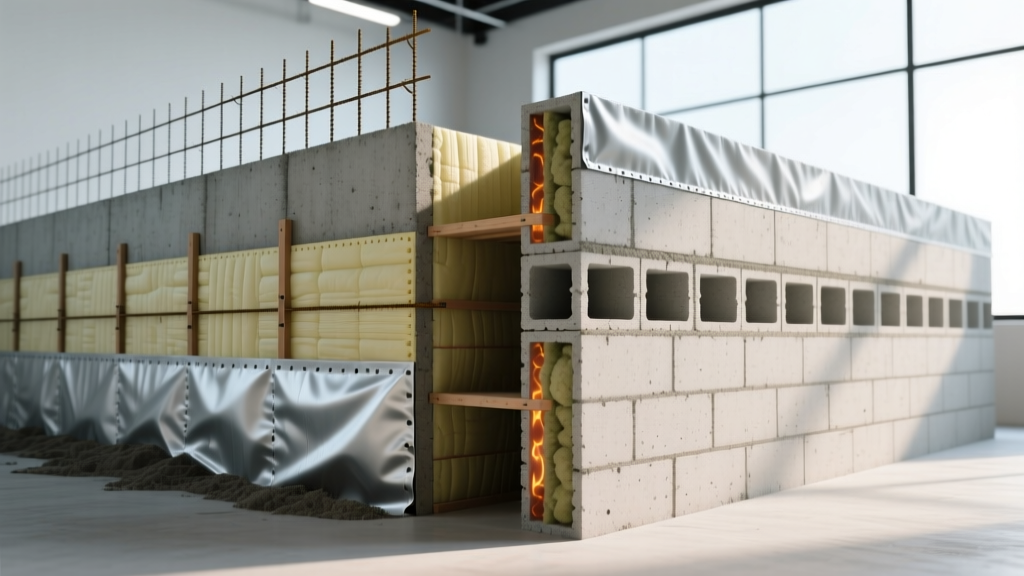
With CMU, you must frame the interior with wood or steel studs to hold batt insulation, or apply rigid continuous exterior insulation. This adds $4.00 to $7.00 per square foot. Poured concrete can utilize Insulated Concrete Forms (ICFs), which integrate the EPS foam insulation directly into the forming process. While ICF material costs are higher, it eliminates the secondary framing and insulation labor steps, often resulting in a lower total installed cost for above-grade, climate-controlled spaces.
Lifecycle and Maintenance: The 50-Year Projection
Evaluating the masonry vs concrete cost breakdown requires a lifecycle perspective. Both systems are highly durable, but their failure modes and maintenance schedules differ.
Poured Concrete Lifecycle
Primary Vulnerability: Shrinkage cracking during the curing process.
Maintenance: Minimal. Requires epoxy injection if structural cracks exceed 1/8 inch. Form tie holes must be properly patched during construction to prevent localized rust stains and water ingress.
Lifespan: 100+ years for the structural core.
Masonry (CMU/Brick) Lifecycle
Primary Vulnerability: Mortar joint degradation and efflorescence.
Maintenance: Moderate. Mortar joints typically require tuckpointing every 25 to 40 years. Weep holes must be kept clear to prevent moisture buildup inside the block cells.
Lifespan: 100+ years for the block; 25-40 years for the mortar matrix.
Decision Framework: When to Choose Which
Use this practical matrix to determine which system yields the highest return on investment for your specific project parameters.
Choose Poured Concrete When:
- Timeline is critical: You need the foundation or first-floor walls dried-in within 48 hours to allow follow-on trades to begin.
- High hydrostatic pressure is present: The site has a high water table or poor drainage, making the monolithic, joint-free nature of poured concrete vastly superior for basement walls.
- Curved or complex geometries are required: Radius walls are significantly cheaper to form and pour than attempting to cut and lay wedge-shaped masonry blocks.
Choose Masonry (CMU) When:
- Heavy point-loads are expected: Ungrouted or partially grouted CMU provides excellent compressive strength for load-bearing interior partition walls in commercial warehouses.
- Equipment access is restricted: If a concrete pump truck cannot reach the back of the lot, hand-carrying blocks and mixing mortar in a wheelbarrow is the only viable alternative.
- Aesthetic exposure is desired: Architectural split-face or ground-face CMU blocks provide a finished interior or exterior look without requiring drywall, paint, or exterior cladding.
Frequently Asked Questions
Is it cheaper to build a retaining wall out of CMU or poured concrete?
For retaining walls under 6 feet, CMU is generally 15% to 20% cheaper because it avoids the high cost of custom formwork and concrete pump rentals. However, for walls exceeding 8 feet, the engineering requirements for CMU (which demand extensive vertical rebar and solid grouting) erase the material savings, making poured concrete the more cost-effective choice.
Do masonry walls require more expensive foundations than poured walls?
Yes. Because masonry is highly intolerant of differential settlement, the footing beneath a CMU or brick wall must be perfectly level and heavily reinforced. Poured concrete walls can bridge minor footing imperfections better than rigid mortar joints, which will step-crack if the footing shifts even a fraction of an inch.
How does the Brick Industry Association view structural brick vs. concrete block costs?
True structural brick (wythe construction) is largely considered a premium, high-cost application in modern commercial building. Most modern masonry walls utilize CMU for the structural backup, with a brick veneer tied to the outside for aesthetics. Comparing structural brick directly to poured concrete is rarely done in 2026 due to the extreme labor costs of multi-wythe bricklaying.
Written by
Sarah WhitfieldSarah Whitfield is a chartered quantity surveyor (MRICS) and construction cost analyst with 15 years of experience in material pricing, procurement strategy, and project budgeting. She earned her degree in Construction Management from the University of Reading (UK) and has worked on projects ranging from $2M custom homes to $180M mixed-use developments across North America and Europe. Sarah currently leads cost estimating for BuildMat Insight, maintaining a proprietary database of 4,000+ material price points updated quarterly. She is a frequent contributor to RSMeans cost data panels and has presented at the International Cost Engineering Council (ICEC) congress. Based in Denver, CO, Sarah is an avid trail runner and volunteer mentor for Women in Construction.
More from Sarah Whitfield
View all
Wood & Lumber
What Are the Different Types of Wood? A Builder's Guide
Compare structural softwoods, finish hardwoods, and engineered lumber. Analyze Janka ratings, MOE values, and 2026 pricing for construction.
Aug 4, 2026

Walls & Panels
Steel Framing vs Wood Framing: Corrosion and Moisture Defense
Compare steel framing vs wood framing for moisture resistance. Learn about galvanized coatings, condensation risks, and corrosion protection strategies.
Jul 21, 2026

Stone & Masonry
How to Cut Stone Veneer: Wet Saw vs Grinder Comparison
Compare the best tools for cutting stone veneer. We review wet saws, angle grinders, and chop saws to help you achieve clean, chip-free cuts.
Jul 21, 2026