How Much Does It Cost to Build a Software Size & Scope Calculator?
Discover exactly how much it costs to build a software size and scope calculator for construction estimating, including tech stack, API, and MVP pricing.

The True Cost Breakdown of a Custom Construction Calculator
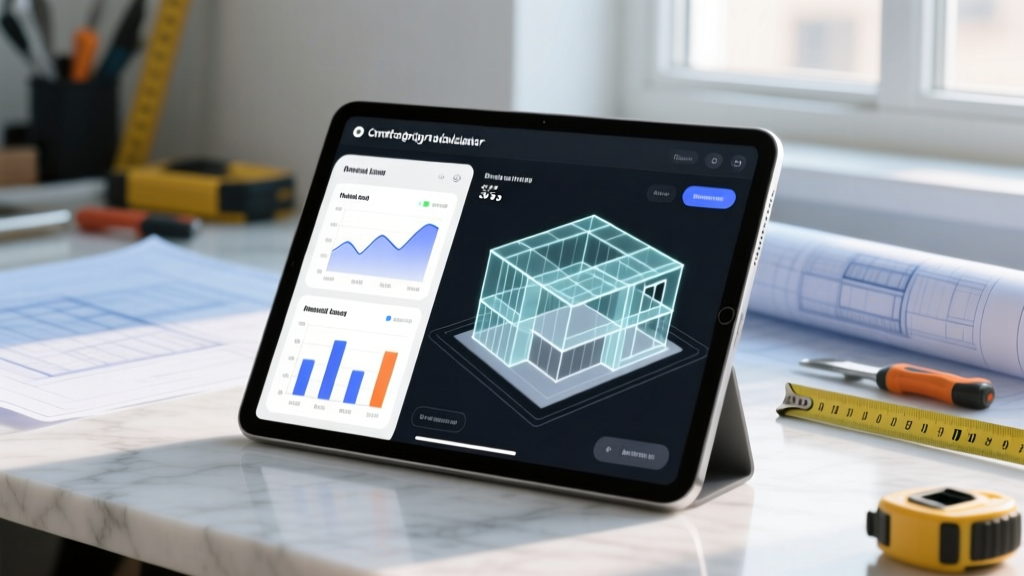
Building a custom size and scope calculator for construction estimating requires bridging complex mathematical logic with intuitive, field-ready interfaces. General contractors, lumber suppliers, and SaaS founders often underestimate the backend complexity required to execute accurate material takeoffs. A basic calculator that multiplies length by width is trivial; a professional-grade application that accounts for roof pitch, concrete footing volumes, framing waste factors, and localized labor rates is a sophisticated engineering project.
For a fully functional Minimum Viable Product (MVP) targeting residential and light commercial estimating, development costs in 2026 typically range from $48,000 to $85,000. This assumes a US-based or nearshore development team billing between $110 and $160 per hour. Enterprise-grade platforms featuring 3D BIM (Building Information Modeling) integration, multi-user collaboration, and ERP syncing can easily exceed $250,000. According to industry benchmarks tracked by the Clutch app development directory, specialized B2B calculation tools require 30% more backend engineering hours than standard CRUD applications due to the necessity of floating-point precision and complex conditional logic.
Core Feature Modules & Pricing Matrix
The cost of your software is directly tied to the depth of its estimating logic. Below is a breakdown of the core modules required for a professional construction scope calculator, including technical complexity and estimated pricing.
| Module | Technical Complexity | Estimated Cost (USD) | Timeframe |
|---|---|---|---|
| Dimensional Input UI (2D Canvas) | High (Requires touch-optimized drawing tools, snap-to-grid, and roof pitch calculators) | $12,000 - $18,000 | 3-4 Weeks |
| Material Takeoff Logic Engine | Very High (Must handle conditional waste factors, e.g., 12% for standard lumber, 4% for engineered I-joists) | $15,000 - $24,000 | 4-6 Weeks |
| Cost Database API Integration | Medium (Connecting to RSMeans, Craftsman, or proprietary SQL databases with regional modifiers) | $8,000 - $14,000 | 2-3 Weeks |
| Geospatial Lot Mapping | Medium (Integrating Mapbox/Google Maps API for automated perimeter and square footage extraction) | $5,000 - $9,000 | 2 Weeks |
| PDF/CSV Export & Client Portal | Low/Medium (Generating branded, multi-page PDF proposals with dynamic charts) | $6,000 - $10,000 | 2-3 Weeks |
Tech Stack Selection: Cross-Platform vs. Native vs. Web
The choice of technology stack dictates not only your initial development cost but also your long-term maintenance burn rate. For a size and scope calculator, the application must perform heavy client-side calculations without lagging, even when offline on a remote job site.
Cross-Platform Mobile (React Native / Flutter)
For most construction SaaS startups, Flutter or React Native is the optimal choice in 2026. Flutter's rendering engine (Skia) is particularly well-suited for drawing 2D floor plans and interactive scope diagrams directly on the canvas. Developing a cross-platform app allows you to deploy to both iOS (for field superintendents) and Android (for budget-conscious subcontractors) from a single codebase, reducing frontend development costs by approximately 35%. Expect to utilize libraries like flutter_map for site plotting and sqflite for local offline data caching.
Native Development (Swift / Kotlin)
Native development is only justified if your calculator requires deep hardware integration, such as utilizing the iPad's LiDAR scanner to automatically measure room dimensions and generate a 3D point cloud for scope verification. Native development will increase your MVP budget by 60% to 80% because you must maintain two distinct codebases. Unless LiDAR-driven automated takeoffs are your core value proposition, avoid native development for V1.
Progressive Web App (PWA)
If your target audience consists primarily of desktop-based estimators working in the office rather than field personnel, a React.js or Vue.js PWA is the most cost-effective route. A PWA eliminates app store friction and reduces initial development costs to the $35,000–$50,000 range. However, PWAs struggle with complex offline caching and heavy client-side 2D rendering compared to compiled mobile applications.
⚠️ Hidden Costs: Data Licensing and Algorithmic Edge Cases
Software development costs are only half the equation. The Construction Industry Institute emphasizes that standardized data is critical for reliable estimating. If your software relies on third-party cost data (like Gordian's RSMeans), you must budget for enterprise API licensing, which can range from $15,000 to $40,000 annually depending on call volume and user seats.
Furthermore, algorithmic edge cases destroy estimating credibility. Your logic engine must account for real-world construction physics. For example, calculating concrete volume for a slab-on-grade is not simply Length × Width × Thickness. The software must calculate the thickened edge footing (perimeter linear footage × footing cross-section) and add a 5% to 8% waste factor for over-excavation and spillage. Failing to program these domain-specific nuances will result in inaccurate estimates, leading to immediate user churn.
Step-by-Step Development Timeline & Burn Rate
A disciplined approach to the development lifecycle prevents scope creep, which is the primary reason custom software projects exceed their budgets. A standard MVP timeline for a construction scope calculator spans 14 to 18 weeks.
- Weeks 1-3: Discovery & Architecture. Defining the database schema (PostgreSQL with PostGIS for geospatial lot queries), mapping out the material waste logic trees, and finalizing UI/UX wireframes. Burn rate: $12,000.
- Weeks 4-8: Core Logic & Backend. Building the Node.js/Python backend, integrating the cost database APIs, and programming the mathematical takeoff engines. This phase requires senior engineers to ensure floating-point math errors do not compound across large commercial estimates. Burn rate: $28,000.
- Weeks 9-13: Frontend & Canvas Rendering. Developing the interactive UI where users input dimensions, draw rooflines, and assign material assemblies. Implementing offline-sync capabilities using local SQLite databases. Burn rate: $25,000.
- Weeks 14-16: QA, Beta Testing & Deployment. Rigorous testing against historical, manually-calculated estimates to verify algorithmic accuracy. Stress-testing the PDF generation engine. Burn rate: $10,000.
Off-the-Shelf vs. Custom Build: The ROI Decision Framework
Before committing $75,000 to custom development, evaluate whether a white-label solution or an existing API wrapper meets your business needs. If your goal is simply to provide a lead-generation tool on your lumber yard's website, embedding a configurable calculator from a SaaS provider like Clear Estimates or Houzz Pro via iframe or API is vastly superior. These solutions cost between $150 and $400 per month and shift the burden of updating material costs and building codes to the vendor.
However, you must build custom software if your competitive advantage relies on proprietary estimating logic. For instance, if you are a specialized post-frame building contractor with a unique, patented truss-spacing algorithm that reduces lumber costs by 14%, no off-the-shelf software will accommodate your proprietary math. In this scenario, a custom size and scope calculator transitions from an operational expense to a core intellectual property asset that directly drives sales conversion.
Frequently Asked Questions
How much does it cost to maintain the software annually?
Expect to spend 15% to 20% of your initial development cost annually on maintenance. For an $80,000 MVP, budget $12,000 to $16,000 per year for cloud hosting (AWS/GCP), third-party API subscriptions (mapping and cost data), OS compatibility updates, and bug fixes.
Can we use AI to automatically generate material takeoffs from blueprints?
While computer vision and AI models for blueprint reading are advancing rapidly in 2026, they are not yet reliable enough for automated, binding material takeoffs without human verification. Integrating an AI PDF-parsing module to extract basic room dimensions will add $20,000 to $35,000 to your development budget and requires extensive training data.
What cloud infrastructure is best for handling heavy calculation loads?
For a calculator that processes complex structural loads or extensive material assemblies, utilize serverless architecture like AWS Lambda or Google Cloud Functions. This ensures you only pay for compute time during active calculations, keeping baseline hosting costs under $50/month for early-stage SaaS products while allowing instantaneous scaling during peak bidding seasons.
Written by
Marcus ChenMarcus Chen is a licensed structural engineer (PE) and building materials analyst with over 12 years of experience across residential, commercial, and industrial construction. He holds a Master of Science in Civil Engineering from UC Berkeley and spent six years at Thornton Tomasetti before transitioning to independent consulting and technical writing. Marcus specializes in material selection for seismic-prone regions, concrete reinforcement strategies, and lifecycle cost analysis. His work has been cited by the American Concrete Institute (ACI) and the Structural Engineers Association of California (SEAOC). When he is not on a job site or at his desk, you will find him hiking the Sierra Nevada or restoring a 1920s craftsman bungalow in Oakland, CA.
More from Marcus Chen
View all
Construction Cost
How Much Did the Eiffel Tower Cost to Build?
How much did the Eiffel Tower cost to build in 1889? We adjust for inflation and compare its budget to modern skyscraper construction.
Aug 4, 2026

Fire Resistance
What Is a Fire Resistant Material? Testing & Certification Guide
Discover what is a fire resistant material through ASTM and UL testing. Learn how fire ratings, certifications, and assemblies work in construction.
Aug 4, 2026

Construction Cost
How Much Did the Burj Khalifa Cost to Build?
How much did the Burj Khalifa cost to build? We break down the $1.5B project and extract 5 money-saving strategies for your next build.
Jul 30, 2026