Cost to Build a Cinder Block Building: Complete Guide
Discover the exact cost to build a cinder block building, including CMU pricing, labor rates, rebar, and grout expenses for commercial and residential projects.

Core Cost Breakdown: CMU, Mortar, and Labor
Calculating the precise cost to build a cinder block building requires moving beyond generic per-square-foot averages. Concrete Masonry Units (CMUs), commonly referred to as cinder blocks, are governed by ASTM C90 standards for loadbearing capacity. The total installed cost for a standard 8-inch CMU wall ranges from $22 to $38 per square foot of wall area, encompassing materials, reinforcement, grout, and skilled masonry labor.
Quick Cost Snapshot (Per Square Foot of Wall Area)
- Standard Gray CMU (8-inch): $4.50 - $6.00
- Architectural Face Block: $8.00 - $14.00
- Mortar, Grout & Rebar: $3.50 - $5.50
- Skilled Masonry Labor: $14.00 - $22.00
- Total Installed Cost: $22.00 - $38.00+
Material Specifications and Pricing Matrix
The term 'cinder block' is a historical misnomer; modern blocks are manufactured from Portland cement and aggregates. Selecting the correct CMU weight class and finish directly impacts both structural performance and material costs. Lightweight blocks (using expanded shale or slate aggregates) cost approximately 15% more than normal-weight blocks but reduce dead load on the foundation and improve thermal resistance.
| CMU Type | Nominal Size | Weight Class | Cost Per Block | Cost Per Sq Ft (Material Only) |
|---|---|---|---|---|
| Standard Gray | 8x8x16 | Normal (38-42 lbs) | $1.65 - $2.25 | $1.50 - $2.00 |
| Lightweight Loadbearing | 8x8x16 | Light (25-28 lbs) | $2.10 - $2.80 | $1.90 - $2.50 |
| Split-Face Architectural | 8x8x16 | Normal (40+ lbs) | $3.50 - $4.75 | $3.15 - $4.25 |
| Glazed / Polished Face | 8x8x16 | Normal | $6.50 - $9.00 | $5.85 - $8.10 |
Hidden Material Costs: Mortar, Grout, and Reinforcement
Estimators frequently underbudget for the 'invisible' materials that hold a CMU wall together. According to the Concrete Masonry Association, proper reinforcement and grouting are non-negotiable for structural integrity, particularly in multi-story or commercial builds.
- Mortar: Use Type S mortar (minimum 1,800 psi compressive strength) for exterior and below-grade walls, and Type N (minimum 750 psi) for interior non-loadbearing partitions. An 80lb bag of Type S masonry cement costs $7.50 - $9.00 and yields enough mortar to lay approximately 30 standard blocks with 3/8-inch joints.
- Core-Fill Grout: Grout must be high-slump and flowable. As an industry rule of thumb, fully grouting an 8-inch CMU wall requires 1.1 to 1.25 cubic yards of grout per 100 square feet of wall area. Expect to pay $140 - $180 per cubic yard for ready-mix fine grout.
- Rebar & Joint Reinforcement: Vertical #4 (1/2-inch) or #5 (5/8-inch) rebar is typically spaced 16 to 48 inches on-center depending on engineering loads. Horizontal wire joint reinforcement (Truss or Ladder type) is placed every two courses (16 inches) to control shrinkage cracking. Rebar costs average $0.85 per linear foot, while joint wire runs $0.45 per linear foot.
Labor Rates and Crew Productivity
Labor accounts for 55% to 65% of the total cost to build a cinder block building. Masonry is highly skilled labor, and productivity fluctuates based on wall complexity, weather, and site access.
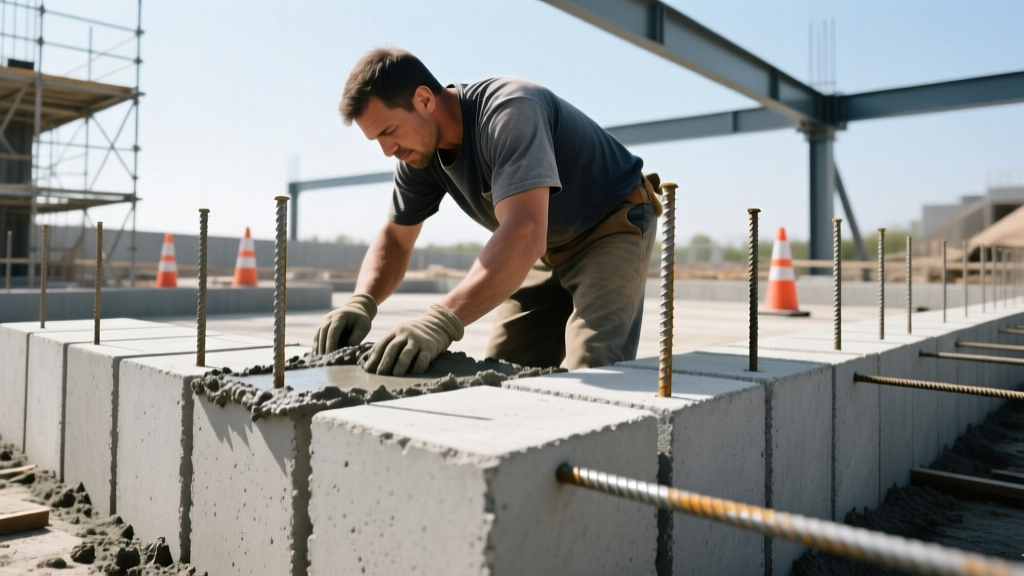
Productivity Benchmark: A journeyman mason working with one laborer (tender) can typically lay 90 to 130 standard 8x8x16 blocks per 8-hour day on straight, unobstructed walls. Complex walls with numerous window bucks, corners, and bond beams will drop productivity to 60-80 blocks per day.
Current masonry labor rates range from $75 to $125 per hour for a standard crew (one mason, one tender). When bidding by the block, masons charge $2.50 to $4.50 per block laid, which scales to $14.00 - $22.00 per square foot of wall. Scaffolding erection, material hoisting, and site cleanup add an additional 10% to 15% to the labor subtotal.
Structural Variables That Spike Your Budget
The baseline costs above assume a standard, low-rise commercial or residential structure in a moderate climate. The following variables require specialized engineering and will increase your budget significantly:
1. High Wind and Seismic Zones
Buildings in hurricane-prone coastal areas or active seismic zones require denser rebar spacing and deeper bond beams. According to FEMA guidelines for safe rooms and high-wind construction, CMU walls in 150+ mph wind zones often require #6 rebar spaced at 16 inches on-center in both directions, alongside fully grouted cores. This can increase reinforcement and grout costs by 40% to 60%.
2. Continuous Insulation (CI) Requirements
Modern energy codes (such as the IECC) mandate Continuous Insulation for commercial CMU buildings to prevent thermal bridging through the concrete web. Rigid foam board insulation (XPS or Polyiso) applied to the exterior or interior, or specialized pre-insulated CMU blocks with foam inserts, adds $3.50 to $6.00 per square foot to the wall assembly cost.
3. Finishes and Weatherproofing
Standard gray block requires a finish for weather resistance and aesthetics. Parging (a thin coat of cementitious stucco) costs $4.00 - $6.00 per square foot. Elastomeric masonry paint, which bridges hairline cracks and prevents water intrusion, costs $1.50 - $2.50 per square foot but must be reapplied every 7 to 10 years.
Cinder Block vs. Alternative Structural Systems
When evaluating the cost to build a cinder block building, it is critical to compare it against alternative structural systems to ensure CMU is the most economical choice for your specific footprint and site conditions. Data from the National Association of Home Builders highlights how material choices shift based on regional labor availability.
| System | Avg. Cost Per Sq Ft (Wall) | Speed of Erection | Fire Rating | Best Use Case |
|---|---|---|---|---|
| 8-inch CMU Block | $22 - $38 | Moderate (100 blocks/day) | 2 to 4 Hours | Warehouses, schools, retaining walls, multi-family |
| Tilt-Up Concrete | $18 - $28 | Fast (crane-set panels) | 2 to 4 Hours | Large footprint big-box retail, distribution centers |
| Wood Framing (2x6) | $15 - $24 | Fast | 1 Hour (with Type X GWB) | Residential, low-rise commercial, interior partitions |
| Insulated Concrete Forms (ICF) | $28 - $45 | Moderate | 3 to 4 Hours | High-end residential, noise-sensitive commercial |
Step-by-Step Estimation Framework
To generate an accurate estimate for your specific project, follow this sequential calculation framework:
- Calculate Gross Wall Area: Multiply the total linear footage of the exterior walls by the wall height. (e.g., 200 linear feet x 12 feet high = 2,400 sq ft).
- Deduct Openings: Subtract the square footage of all doors, windows, and overhead roll-up doors. (e.g., deduct 400 sq ft for openings = 2,000 net sq ft of CMU).
- Estimate Block Count: There are 1.125 standard 8x8x16 blocks per square foot of wall. Multiply net wall area by 1.125, then add 5% for breakage and cuts. (2,000 x 1.125 = 2,250 blocks + 5% = 2,362 blocks).
- Calculate Mortar: Divide total blocks by 30 (yield per 80lb bag). (2,362 / 30 = 79 bags of Type S mortar).
- Calculate Grout Volume: Multiply net wall area by 0.012 (to get cubic yards for fully grouted 8-inch walls). (2,000 x 0.012 = 24 cubic yards of fine grout).
- Apply Labor Multiplier: Multiply the total material cost by 1.5 to 1.8 to account for skilled masonry labor, scaffolding, and equipment rental.
Written by
Sarah WhitfieldSarah Whitfield is a chartered quantity surveyor (MRICS) and construction cost analyst with 15 years of experience in material pricing, procurement strategy, and project budgeting. She earned her degree in Construction Management from the University of Reading (UK) and has worked on projects ranging from $2M custom homes to $180M mixed-use developments across North America and Europe. Sarah currently leads cost estimating for BuildMat Insight, maintaining a proprietary database of 4,000+ material price points updated quarterly. She is a frequent contributor to RSMeans cost data panels and has presented at the International Cost Engineering Council (ICEC) congress. Based in Denver, CO, Sarah is an avid trail runner and volunteer mentor for Women in Construction.
More from Sarah Whitfield
View all
Wood & Lumber
What Are the Different Types of Wood? A Builder's Guide
Compare structural softwoods, finish hardwoods, and engineered lumber. Analyze Janka ratings, MOE values, and 2026 pricing for construction.
Aug 4, 2026

Walls & Panels
Steel Framing vs Wood Framing: Corrosion and Moisture Defense
Compare steel framing vs wood framing for moisture resistance. Learn about galvanized coatings, condensation risks, and corrosion protection strategies.
Jul 21, 2026

Stone & Masonry
How to Cut Stone Veneer: Wet Saw vs Grinder Comparison
Compare the best tools for cutting stone veneer. We review wet saws, angle grinders, and chop saws to help you achieve clean, chip-free cuts.
Jul 21, 2026