How Much Does It Cost to Build a Sports Complex? 2026 Regional Guide
Discover how much it costs to build a sports complex in 2026. We break down regional pricing, material choices, and hidden site-work expenses.

The True Baseline: National Averages vs. Regional Realities
When developers and municipal planners ask how much does it cost to build a sports complex, the national baseline for a standard 15-acre, four-field facility with a basic fieldhouse and parking sits between $14.5 million and $28 million in 2026. However, relying on a national average is a critical estimating error. The final ledger is heavily dictated by regional geology, local labor union density, state environmental mandates, and climate-driven material requirements.
Quick Regional Variance Snapshot
Northeast: +22% above national average (driven by bedrock excavation and prevailing wage laws).
Southeast: -12% below national average (favorable labor rates, but high drainage requirements).
West Coast: +35% above national average (seismic engineering, CEQA environmental reviews).
Texas/Southwest: -5% below national average (expansive soil mitigation, strict water-use mandates favoring synthetic turf).
To build an accurate pro forma, you must deconstruct the project into site-work, vertical construction, and specialized sports surfacing, then apply localized multipliers. According to the U.S. Census Bureau Construction Cost Index, regional material and labor disparities have widened significantly over the last three years, making localized estimating non-negotiable.
Regional Cost Matrix: Breaking Down the Geography
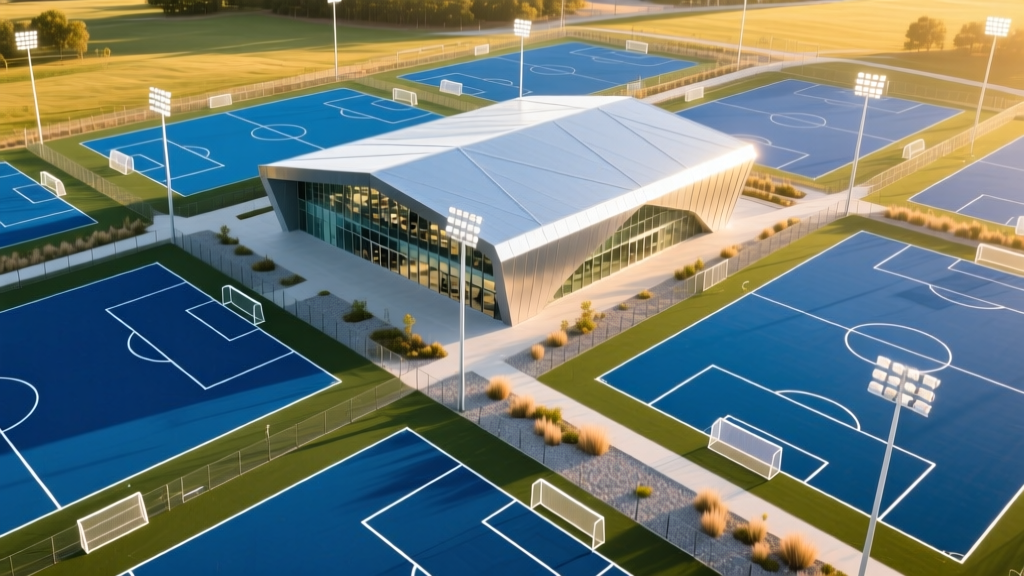
The following matrix illustrates the estimated total capital expenditure for a standardized 15-acre, multi-field sports complex (including four synthetic turf fields, one natural grass championship field, 500-space parking, and a 4,000 sq. ft. steel-framed fieldhouse) across major U.S. regions.
| Region | Est. Total Cost (2026) | Primary Cost Driver | Site-Work Multiplier |
|---|---|---|---|
| Northeast (MA, NY, NJ) | $24.5M - $31.2M | Bedrock blasting, union labor | 1.35x |
| Southeast (GA, FL, NC) | $16.8M - $21.5M | High water table drainage, clay | 0.95x |
| Midwest (OH, IL, MI) | $18.2M - $23.4M | Frost-heave mitigation, snow loads | 1.05x |
| West Coast (CA, OR, WA) | $28.5M - $38.0M | Seismic codes, environmental review | 1.45x |
| Texas / Southwest | $17.5M - $22.8M | Expansive soils, water restrictions | 1.10x |
Material & Labor Variances Driving Regional Spikes
The delta between a $16 million complex in Georgia and a $35 million complex in California is rarely found in the architectural design; it is buried in the dirt and the local codebook.
The Earthwork and Geology Factor
In the Northeast and parts of the Pacific Northwest, encountering glacial till or solid bedrock is a near certainty. Excavating standard topsoil costs between $2.50 and $4.00 per cubic yard. However, mechanical hammering or blasting bedrock pushes costs to $45 to $85 per cubic yard. A 15-acre site requiring just two feet of rock removal can instantly add $1.5 million to the site-work budget.
Conversely, the Southeast and Texas struggle with expansive clays (like the Beaumont Formation in Texas) and high water tables. Here, the cost isn't removing rock; it's stabilizing soil. Lime or fly-ash stabilization adds $1.20 to $2.50 per square yard. Furthermore, fields in high-water-table zones require aggressive sub-surface drainage. Specifying a herringbone trench drain system using 4-inch perforated PVC wrapped in ASTM D4491 non-woven geotextile fabric adds approximately $85,000 per field but prevents catastrophic base failures during spring rains.
The Turf Equation: Synthetic vs. Natural by Climate
The choice between natural grass and synthetic turf is heavily influenced by regional water mandates and maintenance labor costs. According to the Synthetic Turf Council, modern infill systems have evolved to address regional heat islands, but the upfront capital remains high.
- Premium Synthetic (e.g., FieldTurf CORE or Tarkett XF): Costs $8.50 to $12.00 per square foot installed. In the Southwest, where the EPA WaterSense guidelines and local municipal codes severely restrict potable water use for irrigation, synthetic turf is often mandated for new commercial complexes, despite the higher initial capital.
- Natural Grass (Tifway 419 Bermuda or Kentucky Bluegrass): Costs $1.50 to $3.50 per square foot installed. While cheaper upfront, natural grass in the Southeast requires intense aerification, top-dressing, and fungicide applications, adding $35,000 to $50,000 annually in maintenance per field.
Vertical Construction: The Fieldhouse and Lighting
The fieldhouse (restrooms, concessions, locker rooms) and stadium lighting represent the most heavily regulated vertical elements.
Lighting and Seismic Bracing
Modern sports complexes utilize LED lighting systems, such as the Musco Light-Structure Green, which cost between $180,000 and $250,000 per field (including poles, fixtures, and controls). In California and the Pacific Northwest, Title 24 energy compliance and strict dark-sky light spill ordinances require specialized shielding and automated dimming controls, adding 15% to the lighting package. Furthermore, West Coast projects require seismic bracing for 80-foot light poles, requiring deeper concrete pier foundations that cost an additional $12,000 per pole compared to standard Midwest frost-footings.
Fieldhouse Structural Nuances
A 4,000 sq. ft. pre-engineered steel fieldhouse costs roughly $225 to $310 per square foot nationally. However, in regions with heavy snow loads (Midwest/Northeast), the structural steel gauge must be increased to support 30-50 PSF snow loads, pushing the cost toward $350 per square foot. In coastal zones (Florida, Carolinas), the building envelope must be engineered for 150+ MPH wind uplift, requiring specialized impact-resistant glazing and reinforced masonry shear walls.
Warning: Prevailing Wage Traps
If your sports complex receives any municipal bonding, state grants, or federal funding, it will likely trigger Davis-Bacon Act prevailing wage requirements. In states like New York, Illinois, and California, prevailing wage rates can be 40% to 60% higher than standard open-shop commercial rates. Always verify funding stipulations before finalizing your labor estimates, as this single factor can blow a 10% contingency budget in weeks.
Decision Framework: Optimizing Your Site Selection
When evaluating land parcels for a sports complex, developers should use the following weighted matrix to avoid hidden regional costs:
- Geotechnical Borings (Weight: 30%): Never purchase land without a minimum of 8 soil borings across the 15-acre footprint. A single undocumented peat bog or bedrock shelf can alter the site-work budget by millions.
- Utility Tap Fees (Weight: 25%): Rural parcels appear cheap but often lack municipal sewer and high-capacity water mains. Extending a 12-inch water main 1,500 feet to the site can cost $150,000+, negating the land discount.
- Zoning and Environmental Overlays (Weight: 25%): Check for wetland buffers and endangered species habitats. In the Northeast and West Coast, environmental impact studies can delay permitting by 12-18 months, carrying massive debt-service costs.
- Access and Traffic Impact (Weight: 20%): State DOTs may require you to fund a new traffic light or deceleration lane if the complex generates over a specific threshold of daily trips. A new signalized intersection can cost $250,000 to $400,000.
Frequently Asked Questions
How much does an indoor sports complex cost compared to outdoor?
Enclosing a sports complex in a steel-supported air structure (bubble) adds $18 to $25 per square foot. A permanent clear-span steel building with HVAC for indoor turf pushes costs to $140 to $220 per square foot, largely driven by the massive HVAC loads required to dehumidify and cool large volumes of air over synthetic turf.
What is the ROI timeline for a regional sports complex?
Well-located regional complexes generating weekend tournament traffic typically see a stabilized ROI timeline of 7 to 12 years. Facilities that integrate high-margin amenities like indoor batting cages, esports lounges, and premium sports medicine clinics can compress this timeline to 5 to 7 years.
Can I phase the construction to manage upfront capital?
Yes. A standard phasing strategy involves completing all master site-work (grading, stormwater retention, utility mains) in Phase 1, building two fields and the core fieldhouse in Phase 2, and adding the remaining fields and stadium seating in Phase 3 as tournament revenue scales. Ensure your initial site-plan approves the full master footprint to avoid re-triggering environmental reviews later.
Written by
Sarah WhitfieldSarah Whitfield is a chartered quantity surveyor (MRICS) and construction cost analyst with 15 years of experience in material pricing, procurement strategy, and project budgeting. She earned her degree in Construction Management from the University of Reading (UK) and has worked on projects ranging from $2M custom homes to $180M mixed-use developments across North America and Europe. Sarah currently leads cost estimating for BuildMat Insight, maintaining a proprietary database of 4,000+ material price points updated quarterly. She is a frequent contributor to RSMeans cost data panels and has presented at the International Cost Engineering Council (ICEC) congress. Based in Denver, CO, Sarah is an avid trail runner and volunteer mentor for Women in Construction.
More from Sarah Whitfield
View all
Wood & Lumber
What Are the Different Types of Wood? A Builder's Guide
Compare structural softwoods, finish hardwoods, and engineered lumber. Analyze Janka ratings, MOE values, and 2026 pricing for construction.
Aug 4, 2026

Walls & Panels
Steel Framing vs Wood Framing: Corrosion and Moisture Defense
Compare steel framing vs wood framing for moisture resistance. Learn about galvanized coatings, condensation risks, and corrosion protection strategies.
Jul 21, 2026

Stone & Masonry
How to Cut Stone Veneer: Wet Saw vs Grinder Comparison
Compare the best tools for cutting stone veneer. We review wet saws, angle grinders, and chop saws to help you achieve clean, chip-free cuts.
Jul 21, 2026