Your Complete 8x16 Deck Material List: Wood vs. Composite Comparison
Compare exact costs and quantities with our comprehensive 8x16 deck material list. Breakdowns for pressure-treated wood vs. composite for 128 sq ft.

The Anatomy of a 128-Square-Foot Deck
Building a 16-foot wide by 8-foot deep deck (128 square feet) is the most common residential footprint. It provides enough space for a standard dining set and a small lounge area while typically falling under the threshold that requires complex engineered stamped plans in many municipalities. However, a simple footprint does not mean simple material estimation. Miscalculating your 8x16 deck material list by even 10% can result in delayed projects, mismatched dye-lots for composite boards, or emergency trips to the lumberyard.
To build this structure to modern International Residential Code (IRC) standards, we assume the deck is attached to the house via a ledger board, with joists spanning 8 feet outward, supported by a double-ply beam at the outer edge. The framing will utilize pressure-treated (PT) Southern Yellow Pine, while the surface decking will be compared across two primary options: 5/4x6 PT Wood and Capped Wood-Plastic Composite.
Material Showdown: Pressure-Treated Pine vs. Capped Composite
The surface material dictates not only the aesthetic but the long-term maintenance and initial capital required. According to the USDA Forest Products Laboratory, pressure-treated lumber remains the most cost-effective upfront option, but capped composites have drastically closed the performance gap regarding moisture resistance and UV fading.
Head-to-Head Surface Comparison
| Feature | 5/4x6 Pressure-Treated Wood | Capped Composite (e.g., Trex Enhance) |
|---|---|---|
| Material Cost (2026) | $2.80 - $3.50 / linear ft | $5.50 - $7.20 / linear ft |
| Total Decking Cost (128 sq ft) | $760 - $950 | $1,500 - $1,960 |
| Lifespan | 10 - 15 years | 25 - 30+ years |
| Maintenance | Annual cleaning, bi-annual sealing | Soap and water wash only |
| Fastening Method | Face screws (T-25 Torx) | Hidden edge clips or face screws |
The Exact 8x16 Deck Material List (Bill of Materials)
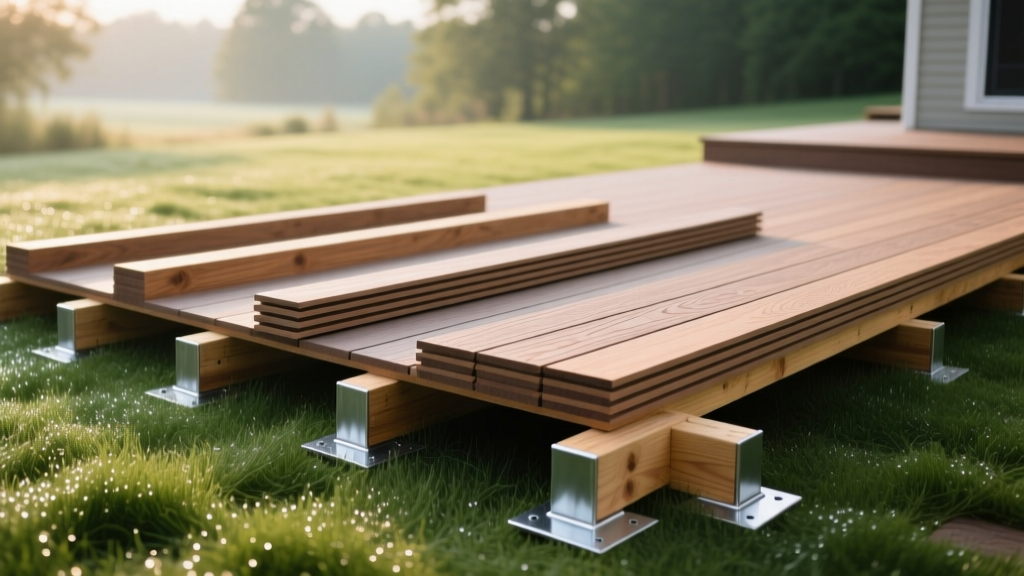
The following bill of materials is calculated specifically for a 16' x 8' deck. The decking boards run parallel to the house (16-foot lengths), perpendicular to the 8-foot joists.
Surface and Framing Quantities
| Component | Specification | Quantity Required | Notes |
|---|---|---|---|
| Decking Boards | 5/4x6x16' (Wood or Composite) | 19 boards | Includes 10% waste factor |
| Joists | 2x8x8' PT SPF | 13 boards | Spaced 16" on-center (OC) |
| Ledger Board | 2x10x16' PT SPF | 1 board | Bolted to house rim joist |
| Outer Beam | 2x10x16' PT SPF | 2 boards | Double-ply, spliced at posts |
| Posts | 6x6x8' PT SPF | 3 posts | Supports the outer beam |
| Fascia/Trim | 1x8x16' (PT or Composite) | 3 boards | Covers outer rim joists |
Framing, Footings, and Hardware Breakdown
The surface boards get all the visual attention, but the substructure determines whether your deck survives the next decade. The American Wood Council's DCA-6 Prescriptive Residential Wood Deck Construction Guide provides the definitive standard for framing connections and footing depths.
Concrete and Footing Math
For a 16-foot wide beam, you need three 6x6 support posts to prevent deflection, assuming a 40 psf live load and 10 psf dead load. If your local frost line is 36 inches, you will dig three holes, each 12 inches in diameter and 42 inches deep.
- Volume per hole: 3.14 x (0.5 ft radius)^2 x 3.5 ft depth = 2.74 cubic feet.
- Total volume for 3 holes: 8.22 cubic feet (0.30 cubic yards).
- Bagged Concrete Requirement: A 60-lb bag yields 0.45 cubic feet. You need exactly 19 bags. Always purchase 22 bags to account for spillage and over-excavation.
Structural Connectors and Fasteners
Never rely on toe-nailing for structural connections. You must use galvanized or stainless steel hardware rated for modern ACQ or MCQ pressure-treated lumber, which is highly corrosive to standard zinc.
Hardware Shopping List:
- Joist Hangers: 13 units (e.g., Simpson LUS28-2Z for 2x8 joists).
- Joist Hanger Nails: 1.5" galvanized joist hanger nails (approx. 150 nails for the ledger side).
- Post Bases: 3 adjustable standoff post bases (e.g., Simpson ABA66Z) to keep the 6x6 posts elevated above the concrete to prevent rot.
- Beam-to-Post Connectors: 3 structural post caps (e.g., Simpson EPC46Z).
- Decking Screws (Wood): 3" polymer-coated star-drive screws. Calculate 3 fasteners per joist intersection (17 boards x 13 joists x 3 = 663 screws). Buy a 700-count box.
- Hidden Fasteners (Composite): Edge clips spaced 16" OC. 17 boards x 13 joists = 221 clips. Buy a 250-count box, plus 13 starter clips for the first row.
The 'Hidden' Cost Multipliers
When budgeting your 8x16 deck material list, contractors often omit the ancillary items that protect the investment. According to industry data from the North American Decking and Railing Association (NADRA), premature deck failure is almost always tied to moisture trapping in the substructure, not the surface boards.
Joist Tape and Rim Joist Protection
Applying butyl-based joist tape (such as Trex Protect or Grace Vycor) to the top edge of every joist and the ledger board is non-negotiable for composite decks. Composite boards trap moisture against the wood framing, accelerating rot.
Requirement: 13 joists (8 ft each) + 1 ledger (16 ft) + 2 rim joists (16 ft each) = 152 linear feet of joist tape. Purchase four 50-foot rolls.
Railing Systems
If your deck is more than 30 inches above grade at any point within 36 inches of the perimeter, code requires a 36-inch high guardrail. For an 8x16 deck attached to a house, you need railing for the two 8-foot sides and the 16-foot front (32 linear feet total).
Material Note: Aluminum balustrade systems cost roughly $65-$90 per linear foot, while composite railings run $80-$120 per linear foot. Budget an additional $2,200 to $3,500 just for the railing materials, posts, and mounting hardware.
Final Cost Verdict and Procurement Strategy
Building a 128-square-foot deck requires precise procurement. For a fully framed, code-compliant 8x16 deck using pressure-treated wood for both framing and decking, expect to spend between $1,800 and $2,400 on raw materials (excluding railings and tools). If you upgrade the surface and fascia to a mid-tier capped composite while keeping the PT substructure, your material cost will rise to $3,100 - $3,800.
Procurement Tip: When ordering composite decking, ensure all 19 surface boards and 3 fascia boards are pulled from the same manufacturing dye-lot batch. Big-box stores often mix batches on the shelf, which can result in noticeable color banding across your 16-foot span once the sun hits it. Have the pro-desk pull the order directly from the back warehouse.
By utilizing this exact 8x16 deck material list, you eliminate the guesswork from your supply run, ensuring that when the concrete cures and the framing is squared, you have the exact hardware, fasteners, and linear footage required to close out the project without delays.
Written by
Elena RodriguezElena Rodriguez is a civil engineer and technical writer specializing in concrete technology, masonry systems, and ASTM/ACI compliance. She earned her B.S. in Civil Engineering from Texas A&M University and spent a decade at a materials testing laboratory, performing over 2,000 concrete compressive strength tests and masonry prism evaluations. Elena is an ACI-certified Field Testing Technician (Grade I) and a member of ASTM Committee C12 on Natural Building Stone. She currently consults on forensic engineering cases involving concrete failures and moisture intrusion. Based in San Antonio, TX, Elena is a proud member of the Society of Women Engineers (SWE) and coaches her daughter's FIRST Robotics team.
More from Elena Rodriguez
View all
Walls & Panels
Cost Analysis: Light Gauge Steel Framing Advantages and Disadvantages
Evaluate light gauge steel framing advantages and disadvantages through a strict cost analysis lens, comparing material, labor, and lifecycle expenses.
Aug 4, 2026

Walls & Panels
Gypsum Board Types: Exact Specifications, Thickness & Dimensions
Compare standard, Type X, and moisture-resistant gypsum board types. Get exact specifications, thicknesses, dimensions, and ASTM standards for your project.
Aug 4, 2026

Fire Resistance
Best Fire-Resistant Outdoor Decking Materials: 2026 Buyer Guide
Discover the best fire-resistant outdoor decking materials for 2026. Compare Class A PVC, aluminum, and hardwood options for WUI compliance and safety.
Aug 4, 2026