Top Swimming Pool Deck Materials for Heat Resistance & Safety
Compare top swimming pool deck materials for heat resistance and slip safety. Explore costs and design tips for travertine, concrete, and composites.

The Physics of Pool Decks: Why Heat and Slip Resistance Dictate Material Choice
Designing a pool environment requires navigating a harsh microclimate. Unlike standard patios, swimming pool deck materials must endure constant chemical exposure (chlorine, salt, muriatic acid), perpetual moisture, and intense solar radiation. When planning your deck, two physical properties must drive your material selection: thermal effusivity (how hot the surface gets underfoot) and the Dynamic Coefficient of Friction (DCOF).
The DCOF Safety Standard
While standard interior tile requires a DCOF of 0.42 per ANSI A137.1, barefoot wet environments demand a minimum wet DCOF of 0.60 to prevent slip-and-fall injuries. According to the Centers for Disease Control and Prevention (CDC), pool decks are primary zones for recreational water injuries. Always request wet-DCOF test data from your material supplier before finalizing your design.
Material Matrix: Comparing the Top 4 Swimming Pool Deck Materials
The table below synthesizes 2026 market data, comparing installed costs, thermal performance on a 95°F summer day, and safety metrics for the most prevalent pool decking options.
| Material Type | Installed Cost (per sq. ft.) | Peak Surface Temp (95°F Day) | Wet DCOF | Expected Lifespan |
|---|---|---|---|---|
| Tumbled Travertine | $18 - $28 | ~95°F (Ambient) | 0.65 - 0.75 | 50+ Years |
| Acrylic Knockdown Overlay | $9 - $15 | ~105°F | 0.60 - 0.65 | 15 - 20 Years |
| Broom-Finished Concrete | $10 - $16 | ~125°F | 0.55 - 0.60 | 30+ Years |
| Light-Colored PVC Decking | $22 - $35 | ~115°F | 0.50 - 0.55 | 25 - 30 Years |
Deep Dive: Natural Stone (The Cool-Touch Champion)
Travertine: The Gold Standard for Barefoot Comfort
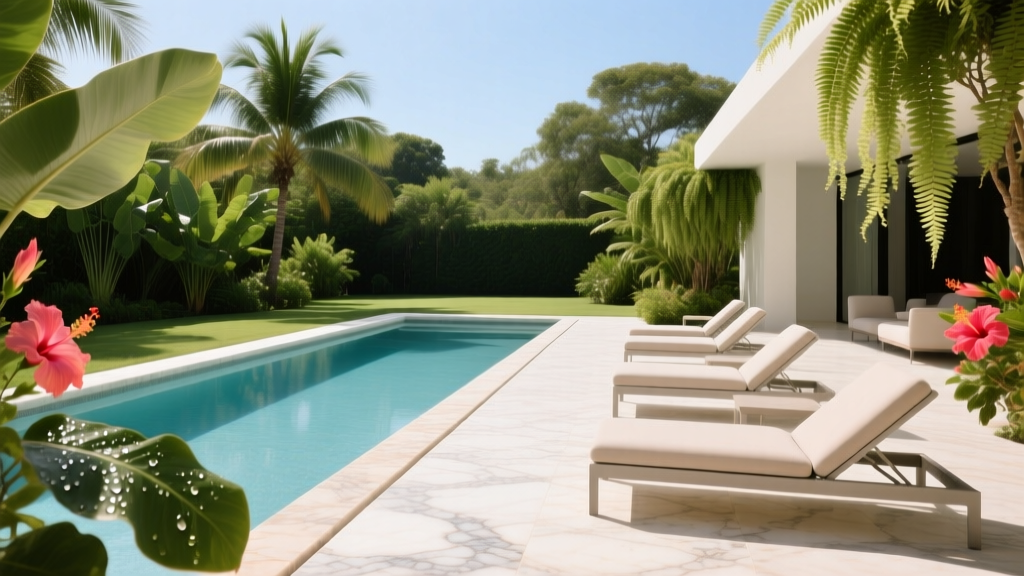
Travertine remains the premier choice for high-end pool decks due to its unique cellular structure. The stone is riddled with microscopic air pockets that act as natural insulation, preventing the stone from absorbing and retaining solar heat. On a blistering 100°F afternoon, tumbled travertine will remain within a few degrees of the ambient air temperature, whereas standard concrete can exceed 130°F and cause second-degree burns.
Specification Tip: Always specify tumbled or brushed finishes for pool coping and decking. Honed or polished travertine becomes dangerously slick when wet. Furthermore, avoid topical acrylic sealers, which fill the stone's natural pores, trap moisture, and destroy the DCOF. Instead, use a penetrating silane/siloxane sealer (like Prosoco Siloxa-Tek 8505) which repels water and chlorine stains without altering the surface texture.
Flagstone and Quartzite: The Rustic Alternatives
For a more naturalistic landscape design, dense sandstones and quartzites offer excellent durability. However, unlike travertine, these stones have high thermal mass. If you choose flagstone, opt for lighter color palettes (such as Pennsylvania Bluestone in 'lilac' or 'green' rather than dark browns) to minimize heat absorption. Ensure the stone is thermally cleft rather than sawn to maintain adequate surface friction.
Engineered Options: Concrete and Acrylic Overlays
Acrylic Spray Coatings (Knockdown Texture)
Often referred to generically by the legacy brand name "Kool Deck," modern acrylic knockdown overlays are a highly effective retrofit for existing concrete slabs. The application involves spraying a polymer-modified cementitious mix and then 'knocking down' the peaks with a trowel. This creates a textured, porous surface that reduces the contact area with bare feet, making it feel significantly cooler and providing excellent slip resistance.
Warning: The Stamped Concrete Trap
Stamped concrete is visually stunning but notoriously hazardous around water. The stamping process compresses the surface, and the required topical UV sealers create a plastic-like film that turns into an ice rink when wet. If you must use stamped concrete, your contractor must broadcast an anti-slip aggregate (such as SureCrete SureGrip or aluminum oxide) directly into the wet sealer during application. Do not rely on 'textured' sealers alone.
What About Composite and PVC Decking?
Wood-plastic composites (WPC) and cellular PVC are dominant in standard deck building, but they require careful consideration in pool environments. Standard WPC contains wood flour, which can absorb chlorinated water over time, leading to swelling, mold, and degradation. For poolside applications, cellular PVC (such as AZEK Landmark or Fiberon Promenade) is vastly superior because it is 100% waterproof and impervious to pool chemicals.
The Heat Problem: Dark-colored composite and PVC boards can reach surface temperatures of 150°F in direct sunlight. If you desire a wood-look deck around your pool, you are strictly limited to light-colored PVC boards (e.g., sea salt gray, pale oak, or white). Even with light colors, PVC will run warmer than travertine or acrylic overlays, so plan for integrated shade structures like pergolas or cantilever umbrellas.
Design Framework: Matching Material to Microclimate
Selecting the right material requires evaluating your specific site conditions. Use this decision framework to guide your planning:
- High Sun / Extreme Heat (AZ, TX, FL): Prioritize thermal effusivity. Tumbled travertine or light-colored acrylic knockdown overlays are mandatory to prevent foot burns.
- Freeze-Thaw Cycles (Midwest, Northeast): Prioritize low water absorption. Natural stone must be high-density (like bluestone or quartzite) and set on a fully compacted, frost-protected aggregate base with permeable polymeric sand joints to prevent frost heave. Avoid standard concrete overlays, which will spall and delaminate after 3-5 freeze-thaw cycles.
- Saltwater Pools: Avoid soft limestones and low-grade sandstones, which will pit and erode from salt splash. Stick to dense quartzite, PVC decking, or properly sealed concrete.
- Elevated Decks / Rooftop Pools: Weight is the primary constraint. Skip the heavy stone and concrete. Utilize aluminum framing (like Trex Elevations) with lightweight cellular PVC decking or porcelain pavers on adjustable pedestal systems.
Installation & Drainage: The Hidden Cost Factors
The most expensive swimming pool deck materials will fail prematurely if the sub-base and drainage are poorly executed. According to guidelines supported by the American Concrete Institute (ACI) and the Association of Pool & Spa Professionals (APSP), positive drainage is non-negotiable.
"All pool decks must be sloped a minimum of 1/4 inch per foot (2%) away from the pool coping to prevent chlorinated water from back-washing into the pool or undermining the sub-base."
For large, expansive decks, standard surface sloping can create noticeable, uncomfortable gradients. In these scenarios, integrate linear trench drains (such as ACO Drain systems) flush with the deck surface. Trench drains allow you to maintain a level walking plane while efficiently capturing and redirecting massive volumes of splash-out and rainwater away from the pool equipment pads and foundation.
Ultimately, your budget should allocate at least 30% of the total deck cost to site preparation, base compaction, and drainage infrastructure. A $30-per-square-foot travertine deck laid over an improperly graded, clay-heavy sub-base will crack and settle within two seasons, rendering your premium material investment useless.
Written by
Sarah WhitfieldSarah Whitfield is a chartered quantity surveyor (MRICS) and construction cost analyst with 15 years of experience in material pricing, procurement strategy, and project budgeting. She earned her degree in Construction Management from the University of Reading (UK) and has worked on projects ranging from $2M custom homes to $180M mixed-use developments across North America and Europe. Sarah currently leads cost estimating for BuildMat Insight, maintaining a proprietary database of 4,000+ material price points updated quarterly. She is a frequent contributor to RSMeans cost data panels and has presented at the International Cost Engineering Council (ICEC) congress. Based in Denver, CO, Sarah is an avid trail runner and volunteer mentor for Women in Construction.
More from Sarah Whitfield
View all
Wood & Lumber
What Are the Different Types of Wood? A Builder's Guide
Compare structural softwoods, finish hardwoods, and engineered lumber. Analyze Janka ratings, MOE values, and 2026 pricing for construction.
Aug 4, 2026

Walls & Panels
Steel Framing vs Wood Framing: Corrosion and Moisture Defense
Compare steel framing vs wood framing for moisture resistance. Learn about galvanized coatings, condensation risks, and corrosion protection strategies.
Jul 21, 2026

Stone & Masonry
How to Cut Stone Veneer: Wet Saw vs Grinder Comparison
Compare the best tools for cutting stone veneer. We review wet saws, angle grinders, and chop saws to help you achieve clean, chip-free cuts.
Jul 21, 2026