How Much Does It Cost to Build a Patio? 2026 Pricing
Discover exactly how much it costs to build a patio in 2026. Get real material prices, labor rates, and hidden site prep cost breakdowns.

Answering the question of how much does it cost to build a patio requires looking beyond basic square-footage multipliers. In 2026, the national average for a professionally installed patio ranges from $2,800 to $7,500, with most homeowners spending approximately $4,200 for a standard 288-square-foot (12x24) concrete paver installation. However, high-end natural stone patios with integrated drainage and custom lighting routinely exceed $15,000. This guide breaks down the exact material costs, labor rates, and hidden site-prep variables that dictate your final invoice.
The True Cost to Build a Patio: 2026 National Averages
2026 Average Total Installed Cost
$4,200
Typical Range: $2,800 (Basic Poured Concrete) — $7,500 (Premium Pavers)
Based on a 288 sq. ft. footprint (12x24) with standard excavation and base prep.
When calculating your budget, you must separate material costs from labor and site preparation. Materials typically account for 30% to 40% of the total project cost, while labor and heavy equipment rental make up the remaining 60% to 70%. According to Angi's 2026 landscaping cost data, regional labor variations can swing your total price by up to 35%, with coastal and major metropolitan areas commanding $85 to $130 per hour for specialized hardscape masons, compared to $45 to $75 per hour in rural regions.
Material Cost Breakdown by Patio Type
The surface material you select is the most visible cost driver. Below is a comparison matrix of the most common patio materials, detailing both the raw material cost and the fully installed price per square foot.
| Material Type | Material Only (per sq. ft.) | Total Installed (per sq. ft.) | Lifespan | Maintenance |
|---|---|---|---|---|
| Poured Concrete (Broom Finish) | $3.00 - $5.00 | $8.00 - $14.00 | 25-30 Years | Low |
| Stamped / Stained Concrete | $7.00 - $11.00 | $15.00 - $24.00 | 25-30 Years | Medium (Seal every 2 yrs) |
| Concrete Pavers | $4.00 - $9.00 | $14.00 - $22.00 | 25-50 Years | Medium (Weed control) |
| Clay Brick Pavers | $6.00 - $12.00 | $16.00 - $28.00 | 50+ Years | Medium |
| Flagstone / Natural Stone | $15.00 - $30.00 | $28.00 - $48.00 | 50+ Years | Low |
| Decomposed Granite (DG) | $1.50 - $3.00 | $4.00 - $7.00 | 10-15 Years | High (Raking/Topping) |
Expert Insight: If choosing poured concrete, specify a minimum compressive strength of 3,000 PSI (pounds per square inch) with a 4-inch thickness for foot traffic, or 4,000 PSI at 5 inches if you plan to place a heavy hot tub or outdoor kitchen on the slab. For pavers, ensure the manufacturer meets ASTM C936 standards for solid interlocking concrete paving units, which guarantees freeze-thaw durability.
The Sub-Base: Where Patios Actually Fail
Critical Engineering Warning
Over 80% of patio failures (cracking, heaving, and pooling) are caused by inadequate sub-base preparation, not the surface material itself. Never allow a contractor to lay pavers or pour concrete directly on native topsoil.
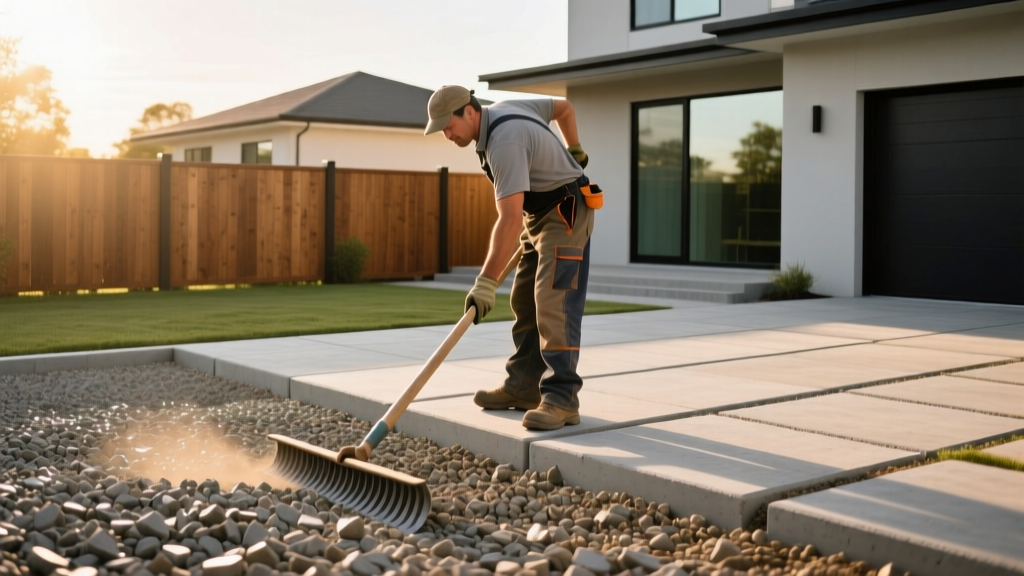
A proper hardscape base requires the removal of 6 to 10 inches of native soil, followed by the installation of a non-woven geotextile fabric (essential for expansive clay soils to prevent aggregate migration). The base must consist of 4 to 6 inches of angular, crushed aggregate (such as 3/4-inch minus crushed stone) compacted in 2-inch lifts using a vibratory plate compactor. Rounded river rock is unacceptable for a sub-base because the smooth stones roll against each other and fail to lock into a rigid matrix. Budget an additional $2.50 to $4.50 per square foot strictly for excavation, geotextile fabric, aggregate delivery, and mechanical compaction.
Hidden Labor and Site Prep Costs Most Guides Ignore
When asking how much does it cost to build a patio, homeowners frequently overlook the logistical hurdles of the site itself. If your backyard presents any of the following conditions, expect these line-item additions:
- Utility Line Locating (811): Free, but mandatory. Failing to call 811 before excavation can result in tens of thousands of dollars in damage and severe legal liability.
- Tree Root Mitigation: If building within the drip line of mature trees, hand-digging to preserve structural roots adds $500 to $1,500 to labor costs. Heavy machinery will sever roots and kill the tree.
- Drainage Integration: If the patio ties into an existing French drain or requires a new catch basin and PVC runoff line to the street, add $1,800 to $3,500. Patios must slope away from the home's foundation at a strict minimum grade of 1/4 inch per foot.
- Permitting and HOA Fees: Municipal permits for impermeable hardscapes over 400 square feet typically cost $150 to $450. Some municipalities now mandate permeable paver systems or retention credits for large footprints to manage stormwater runoff.
Size and Shape Multipliers: Calculating Your Exact Footprint
Economies of scale apply heavily to patio construction. The fixed costs of mobilizing equipment (skid steers, dump trucks, compactors) and delivering bulk materials mean that smaller patios cost significantly more per square foot than larger ones.
Small Patio (100 sq. ft. / 10x10)
Ideal for a basic bistro set or small grill station. Expect to pay $1,500 to $3,200. The high per-square-foot cost is driven by minimum delivery fees for gravel and concrete, which do not decrease for small loads.
Medium Patio (288 sq. ft. / 12x24)
The standard size for a dining table, lounge chairs, and a fire pit. Expect to pay $3,800 to $7,500. This size optimizes material pallets and allows contractors to work efficiently without excessive repositioning of heavy materials.
Large Entertainment Patio (600 sq. ft. / 20x30)
Designed for outdoor kitchens, pergolas, and large gatherings. Expect to pay $8,500 to $18,000+. At this scale, complex shapes with curves or diagonal cuts will increase material waste from 5% to over 15%, driving up your final material invoice.
Upgrades and Add-Ons That Inflate the Budget
A bare patio is rarely the final vision. Integrating functional hardscape features requires specialized labor and distinct material sourcing:
| Upgrade Feature | Average Cost Range | Installation Notes |
|---|---|---|
| Gas Fire Pit (Built-in) | $2,500 - $6,000 | Requires licensed plumber for gas line trenching. |
| Low-Voltage LED Lighting | $800 - $2,200 | Best installed before base gravel is laid to hide wiring. |
| Retaining Wall / Seating Wall | $40 - $85 per linear ft. | Walls over 3 feet require engineering permits and geogrid. |
| Pergola (Aluminum or Cedar) | $3,500 - $9,000 | Requires concrete sonotube footings below the frost line. |
ROI and Resale Value: Is It Worth the Investment?
From a strict financial perspective, outdoor living spaces offer some of the highest returns on investment in residential remodeling. According to the National Association of Realtors (NAR) Remodeling Impact Report, well-designed outdoor living areas, including patios with fire features and landscaping, can recover up to 100% of their cost at resale, while also significantly reducing the home's time on the market. However, a basic, unadorned poured concrete slab in a neighborhood where composite decks and paver patios are the norm may only recoup 50% to 60% of its cost. To maximize ROI, ensure the patio's aesthetic matches the architectural style of the home and integrates seamlessly with the surrounding landscape grading.
Expert Tips to Reduce Patio Costs Without Sacrificing Quality
- Opt for Standard Shapes: Rectangular or square patios require 95% of materials to be used without cutting. Curves, circles, and diagonal patterns generate up to 15% in offcut waste and double the labor time for edge-cutting.
- Use Polymeric Sand Correctly: If installing pavers, do not skip polymeric sand for the joints. While traditional masonry sand costs $30 a ton, polymeric sand costs roughly $35 per 50-lb bag. However, it hardens like grout, preventing weed growth and ant infestations, saving you hundreds in annual maintenance and joint-replenishment.
- Phase the Project: If your budget is tight, pay the contractor to execute the full excavation, sub-base preparation, and retaining walls for the ultimate planned footprint, but only install the surface pavers on a smaller phase-one section. Expanding the patio later is vastly cheaper when the heavy machinery and base prep are already completed.
- Source Local Stone: Natural stone is incredibly heavy. Shipping flagstone from a quarry in Pennsylvania to a job site in California will double your material costs. Always specify locally quarried stone to eliminate exorbitant freight surcharges.
Written by
Sarah WhitfieldSarah Whitfield is a chartered quantity surveyor (MRICS) and construction cost analyst with 15 years of experience in material pricing, procurement strategy, and project budgeting. She earned her degree in Construction Management from the University of Reading (UK) and has worked on projects ranging from $2M custom homes to $180M mixed-use developments across North America and Europe. Sarah currently leads cost estimating for BuildMat Insight, maintaining a proprietary database of 4,000+ material price points updated quarterly. She is a frequent contributor to RSMeans cost data panels and has presented at the International Cost Engineering Council (ICEC) congress. Based in Denver, CO, Sarah is an avid trail runner and volunteer mentor for Women in Construction.
More from Sarah Whitfield
View all
Wood & Lumber
What Are the Different Types of Wood? A Builder's Guide
Compare structural softwoods, finish hardwoods, and engineered lumber. Analyze Janka ratings, MOE values, and 2026 pricing for construction.
Aug 4, 2026

Walls & Panels
Steel Framing vs Wood Framing: Corrosion and Moisture Defense
Compare steel framing vs wood framing for moisture resistance. Learn about galvanized coatings, condensation risks, and corrosion protection strategies.
Jul 21, 2026

Stone & Masonry
How to Cut Stone Veneer: Wet Saw vs Grinder Comparison
Compare the best tools for cutting stone veneer. We review wet saws, angle grinders, and chop saws to help you achieve clean, chip-free cuts.
Jul 21, 2026