Material Cost to Build a Deck Per Sq Ft: 2026 Pricing Guide
Discover the exact material cost to build a deck per sq ft in 2026. Compare wood, composite, and aluminum pricing with our complete budgeting guide.

The Baseline: Average Material Cost to Build a Deck Per Sq Ft
Calculating the precise material cost to build a deck per sq ft requires moving beyond generic online calculators. In 2026, supply chain stabilization has normalized lumber prices, but advanced polymer composites and marine-grade aluminum continue to command premium rates. When isolating materials alone—excluding labor, permits, and site preparation—the national average for deck materials ranges from $6.50 to $18.00 per square foot.
However, this baseline fluctuates wildly based on your substructure choices, fastener systems, and railing integrations. According to Angi's comprehensive deck cost database, homeowners who fail to account for hidden hardware and structural framing often see their material budgets inflate by 22% to 35% mid-project.
• Economy (Pressure-Treated Wood): $4.00 - $6.50 / sq ft
• Mid-Range (Capped Composite): $8.50 - $12.50 / sq ft
• Premium (Advanced PVC / Aluminum): $13.00 - $22.00 / sq ft
Decking Surface Materials: A Deep-Dive Comparison
The surface boards dictate the visual appeal and maintenance requirements of your outdoor space. Below is a structural and financial comparison of the three dominant decking categories available in 2026.
| Material Type | Specific Product Lines | Cost Per Sq Ft | Lifespan |
|---|---|---|---|
| Pressure-Treated Pine | #2 SYP (ACQ or CA-C treated) | $3.50 - $5.00 | 15-20 Years |
| Capped Composite | Trex Transcend Lineage, TimberTech Prime+ | $8.50 - $11.50 | 25-30 Years |
| Advanced PVC | AZEK Vintage, TimberTech Landmark | $11.00 - $14.00 | 30-50 Years |
| Extruded Aluminum | Wahoo Decks Ariddek, Knotswood | $15.00 - $22.00 | 50+ Years |
Pressure-Treated Lumber: The Budget Standard
For the lowest material cost to build a deck per sq ft, #2 Southern Yellow Pine (SYP) remains the undisputed baseline. Modern treatments utilize Alkaline Copper Quaternary (ACQ) or Copper Azole (CA-C), which are less corrosive to standard fasteners than older CCA treatments. However, wood requires immediate sealing upon installation and annual maintenance. If you choose SYP, budget an additional $0.75 per square foot for high-quality penetrating oil sealers like Cabot Australian Timber Oil.
Composite and PVC: The Long-Term ROI
Manufacturers like Trex and AZEK have heavily engineered their 2026 capped composite and PVC lines to resist thermal expansion and UV fading. While the upfront material cost is nearly triple that of wood, the elimination of annual staining and the 25-to-50-year fade warranties shift the lifecycle cost in favor of synthetics. When installing composite, you must factor in specialized hidden fastener systems—such as the TigerClaw TC-G or Simpson Strong-Tie Deck Drive—which add roughly $1.15 to $1.50 per square foot to your material total.
Aluminum Decking: The Specialized Solution
Aluminum decking, such as Wahoo Decks' Ariddek system, features interlocking watertight joints. This makes it the premier choice for second-story decks where keeping the under-deck area dry is required without installing aftermarket gutter systems. The material cost is steep, but it completely eliminates the need for sub-deck flashing and joist tape.
The Hidden Substructure: Framing and Footing Costs
The most critical mistake in deck budgeting is calculating only the surface square footage. The substructure accounts for 35% to 50% of your total material costs. According to guidelines from the American Wood Council, structural integrity relies on properly sized joists and beams, which vary by local snow and live-load codes.
If you are installing composite or PVC over pressure-treated framing, you must apply butyl joist tape (e.g., Trex Protect or Grace Vycor). This prevents moisture from trapping against the joists, which causes premature rot and voids composite warranties. Budget $0.40 per linear foot for tape.
Framing Material Breakdown (Per Sq Ft of Deck Area):
- Pressure-Treated Joists & Beams (2x8, 2x10): $2.50 - $4.00 / sq ft
- Steel Framing (e.g., Trex Elevations): $6.00 - $9.00 / sq ft (Provides perfectly flat surfaces for synthetic boards and resists warping).
- Concrete Footings & Sonotubes: $1.20 - $2.50 / sq ft (Highly dependent on frost-line depth; deeper frost lines require more concrete and rebar).
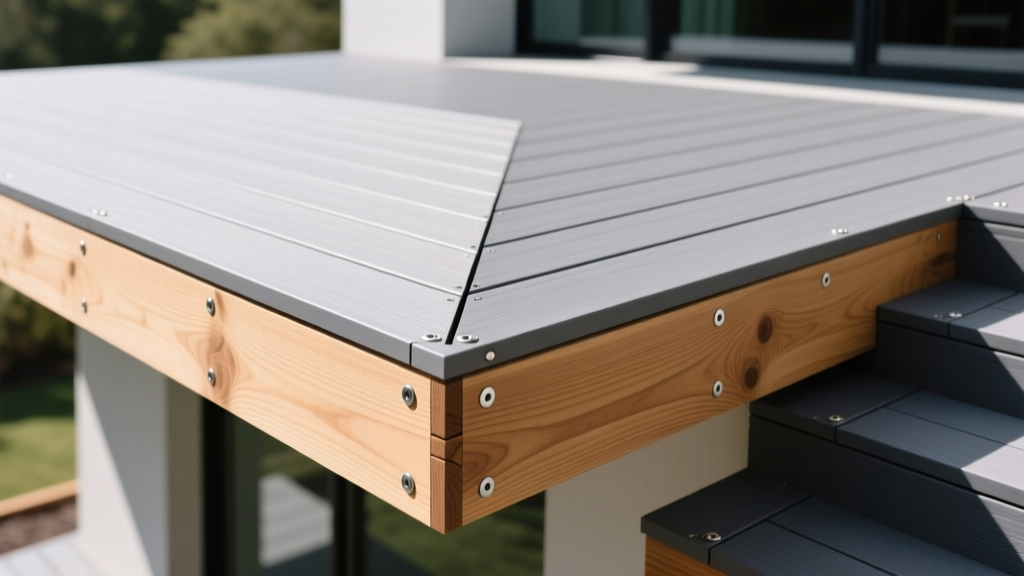
Decision Framework: Matching Material to Your Scenario
Selecting the right material requires aligning your budget, climate, and maintenance tolerance. Use this framework to finalize your material list:
- If your budget is strictly under $7.00/sq ft and you enjoy weekend projects: Choose #2 Pressure-Treated Pine. Pair it with face-screwing using coated deck screws (e.g., GRK Fasteners RSS) to avoid the cost of hidden clips.
- If you want a 25-year lifespan with minimal upkeep and have a mid-range budget: Choose Capped Composite (Trex Select or TimberTech Prime+). Use grooved boards with hidden fasteners for a clean, splinter-free surface.
- If you are building in a high-moisture coastal zone or over a living space: Choose Advanced PVC or Aluminum. PVC resists salt-air degradation, while aluminum's interlocking channels manage heavy rain runoff natively.
- If you are installing a fire-pit or outdoor kitchen: Check local fire codes. Many WUI (Wildland-Urban Interface) zones require non-combustible materials like aluminum or specific fire-rated composites.
Sourcing Strategies to Optimize Your 2026 Budget
To minimize the material cost to build a deck per sq ft, avoid purchasing pre-packaged kit decks from big-box retailers, which often include premium markups on generic hardware. Instead, source your structural lumber from local wholesale yards, where you can hand-pick straight #2 SYP boards and reject warped pieces that inevitably end up in retail bundles.
For composite and PVC, look for contractor-grade overstock or 'off-color' batches from local distributors. Furthermore, buying fasteners in bulk boxes (e.g., 1,750-count buckets of hidden clips) rather than small 50-count retail bags can reduce your hardware costs by up to 40%. By meticulously itemizing every board, joist hanger, and screw, you transform an abstract square-foot estimate into a precise, actionable procurement list.
Written by
Elena RodriguezElena Rodriguez is a civil engineer and technical writer specializing in concrete technology, masonry systems, and ASTM/ACI compliance. She earned her B.S. in Civil Engineering from Texas A&M University and spent a decade at a materials testing laboratory, performing over 2,000 concrete compressive strength tests and masonry prism evaluations. Elena is an ACI-certified Field Testing Technician (Grade I) and a member of ASTM Committee C12 on Natural Building Stone. She currently consults on forensic engineering cases involving concrete failures and moisture intrusion. Based in San Antonio, TX, Elena is a proud member of the Society of Women Engineers (SWE) and coaches her daughter's FIRST Robotics team.
More from Elena Rodriguez
View all
Walls & Panels
Cost Analysis: Light Gauge Steel Framing Advantages and Disadvantages
Evaluate light gauge steel framing advantages and disadvantages through a strict cost analysis lens, comparing material, labor, and lifecycle expenses.
Aug 4, 2026

Walls & Panels
Gypsum Board Types: Exact Specifications, Thickness & Dimensions
Compare standard, Type X, and moisture-resistant gypsum board types. Get exact specifications, thicknesses, dimensions, and ASTM standards for your project.
Aug 4, 2026

Fire Resistance
Best Fire-Resistant Outdoor Decking Materials: 2026 Buyer Guide
Discover the best fire-resistant outdoor decking materials for 2026. Compare Class A PVC, aluminum, and hardwood options for WUI compliance and safety.
Aug 4, 2026