Cost to Build Deck Stairs: 2026 Pricing & Selection Framework
Calculate the true cost to build deck stairs in 2026. Compare wood, composite, and aluminum pricing, labor rates, and hidden code-compliance expenses.
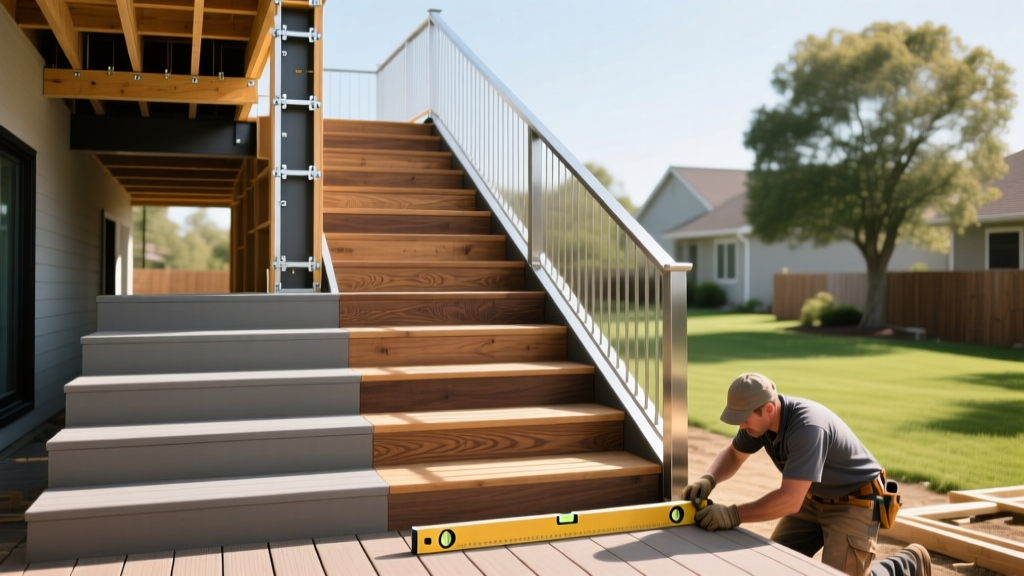
The Deck Stair Cost Matrix: What You Are Actually Paying For
Calculating the cost to build deck stairs requires moving beyond simple per-step averages. In 2026, material supply chain stabilization has normalized lumber prices, but composite manufacturing and specialized steel hardware have seen targeted price increases. To build an accurate budget, you must deconstruct the stair assembly into its core cost drivers: stringers, treads, risers, fasteners, and landing footings.
- Pressure-Treated Pine (PTP): $35 – $55 per step
- Capped Composite (e.g., Trex, Fiberon): $95 – $160 per step
- Prefabricated Aluminum: $250 – $450 per step
- Professional Installation Labor: $120 – $280 per step
The selection framework below dictates how to allocate your budget based on structural longevity, maintenance tolerance, and local building code requirements. According to the American Wood Council's Prescriptive Residential Deck Construction Guide, stair failures are predominantly linked to improper stringer notching and inadequate landing support, making hardware and footing costs non-negotiable line items.
Material Selection Framework: Wood vs. Composite vs. Aluminum
Your primary cost variable is the tread and riser material. The framework for selecting between wood, composite, and aluminum hinges on the "Value-to-Longevity Matrix"—matching the stair material to the expected lifespan of the primary deck surface and the homeowner's maintenance willingness.
| Material Category | Tread Cost (Per Step) | Riser/Fascia Cost | Lifespan & Maintenance |
|---|---|---|---|
| Pressure-Treated Pine | $8 – $12 (5/4x6) | $6 – $9 (1x8) | 10-15 years; requires annual sealing |
| Composite (Trex Enhance) | $35 – $45 | $25 – $30 | 25-30 years; wash-and-wear |
| Composite (Fiberon Promenade) | $50 – $65 | $35 – $45 | 50 years; premium PVC cap |
| Aluminum (Prefabricated) | Bundled in system | Bundled in system | Lifetime; zero rot/rust |
The Stringer Dilemma: Dimensional Lumber vs. Steel Brackets
Traditional stair building involves cutting "sawtooth" notches into 2x12 pressure-treated stringers. This removes up to 60% of the wood's cross-sectional strength at the throat of the cut. In 2026, high-end builds and commercial applications increasingly utilize steel stair brackets (like the EZ Stair system or Simpson Strong-Tie LSC4Z adjustable connectors). While steel brackets add $12 to $18 per step in hardware costs, they allow the use of un-notched 2x6 or 2x8 stringers, drastically reducing the risk of structural splitting and speeding up framing labor by 40%.
Design Multipliers: Landings, Winders, and Code Compliance
The cost to build deck stairs scales non-linearly when design complexity or code mandates intervene. The International Residential Code (IRC) enforces strict geometric parameters that directly impact material counts. As outlined by Fine Homebuilding's code compliance guide, the maximum riser height is 7-3/4 inches, and the minimum tread depth is 10 inches.
Critical Code Trigger: If your deck height exceeds 147 inches (12 feet, 3 inches), IRC Section R311.7.6 mandates a mid-landing. This landing must be at least 36 inches in the direction of travel, requiring an additional structural footing, framing lumber, and decking material, instantly adding $350 to $600 to the total stair cost.
Hidden Cost: The Bottom Landing Footing
Stairs cannot simply rest on bare dirt or grass. Code requires a stable, frost-resistant landing at the base. Pouring a 12-inch diameter Sonotube footing below the local frost line, filling it with Quikrete 5000, and mounting a Simpson Strong-Tie ABA44Z post base adds approximately $65 to $90 per landing. If your soil requires bell-bottom piers or helical piles due to expansive clay, this footing cost can triple.
Labor vs. DIY: A Financial Decision Tree
Stair framing is widely considered the most technically demanding aspect of deck construction. Calculating the exact rise and run, accounting for the thickness of the top tread, and ensuring the bottom landing aligns perfectly requires advanced carpentry math. Use this decision tree to determine if the labor savings justify the DIY risk:
- Path A: DIY Pressure-Treated Wood Stairs. Financial Impact: Saves $400 - $800. Prerequisite: You understand how to use a framing square, account for the 1-inch tread thickness drop on the first step, and can cut precise stringer notches without over-cutting the throat.
- Path B: DIY Composite with Steel Brackets. Financial Impact: Saves $600 - $1,200. Prerequisite: You purchase pre-cut steel brackets (e.g., EZ Stair). This eliminates the complex stringer math, reducing the project to measuring overall height and bolting brackets to un-notched 2x6 stringers. Highly recommended for competent DIYers using composite.
- Path C: Hire a Professional. Financial Impact: Adds $120 - $280 per step. Trigger: You are building spiral stairs, winder stairs (which require complex geometric blocking), or stairs exceeding 8 risers where a mid-landing is required. According to Angi's 2026 stair cost data, complex landings and custom composite picture-framing can push professional labor rates to the higher end of the spectrum.
Step-by-Step Budgeting Formula
To generate a precise estimate for your specific project, apply this sequential formula:
- Calculate Total Steps: Measure the exact distance from the deck joist top to the ground. Divide by 7.5 (target riser height). Round to the nearest whole number. (e.g., 45 inches / 7.5 = 6 steps).
- Base Material Cost: Multiply the number of steps by your chosen material's per-step cost (from the matrix above). Multiply by 2 if using dual outer stringers and a center stringer for stairs wider than 36 inches.
- Hardware & Fasteners: Add $15 per step for structural screws (e.g., GRK RSS or FastenMaster TimberLOK) and joist hangers. Add $25 per step if using hidden composite fastener systems like Trex Hideaway.
- Footing & Landing: Add $85 for the bottom landing concrete and hardware. Add $450 if a mid-landing is triggered by code.
- Labor (If Applicable): Multiply total steps by $180 (average 2026 composite stair installation rate).
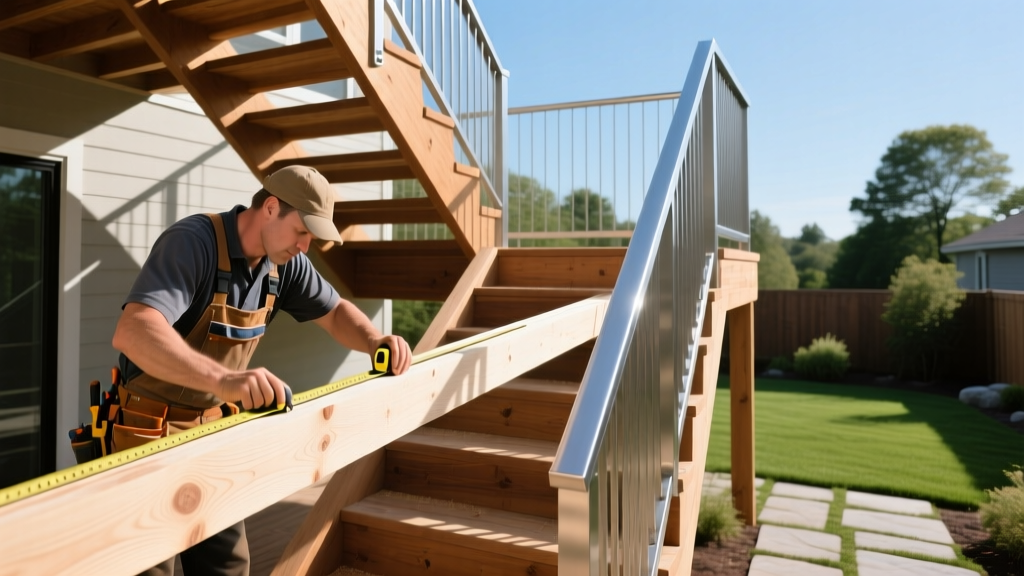
Frequently Asked Questions
Does adding composite stair lighting significantly increase the cost?
Yes. Integrating low-voltage LED riser lights (like the Trex DeckLight) adds approximately $25 to $35 per step for the fixtures, plus $150 to $300 for the transformer and wiring labor. For a 6-step stairway, expect a $300 to $500 premium for a fully illuminated riser system.
Are pre-fabricated aluminum stairs worth the premium over composite?
Prefabricated aluminum stairs (such as those from Versa-Lok or Ultra-Tech) cost between $250 and $450 per step installed. They are highly recommended for commercial properties, multi-family rentals, or coastal homes where salt spray destroys wood and composite substructures. For standard residential applications, the 300% cost premium over composite is rarely justified unless zero-maintenance is the absolute highest priority.
Can I use 2x10 lumber instead of 2x12 for stringers to save money?
No. A standard 2x10 does not provide enough vertical depth to accommodate a 10-inch tread run and a 7.75-inch riser while leaving the required minimum 3.5 inches of solid wood at the throat of the cut. Using 2x10s will result in a failed building inspection and a structurally compromised stairway. Always use 2x12s for notched wood stringers.
Written by
Marcus ChenMarcus Chen is a licensed structural engineer (PE) and building materials analyst with over 12 years of experience across residential, commercial, and industrial construction. He holds a Master of Science in Civil Engineering from UC Berkeley and spent six years at Thornton Tomasetti before transitioning to independent consulting and technical writing. Marcus specializes in material selection for seismic-prone regions, concrete reinforcement strategies, and lifecycle cost analysis. His work has been cited by the American Concrete Institute (ACI) and the Structural Engineers Association of California (SEAOC). When he is not on a job site or at his desk, you will find him hiking the Sierra Nevada or restoring a 1920s craftsman bungalow in Oakland, CA.
More from Marcus Chen
View all
Construction Cost
How Much Did the Eiffel Tower Cost to Build?
How much did the Eiffel Tower cost to build in 1889? We adjust for inflation and compare its budget to modern skyscraper construction.
Aug 4, 2026

Fire Resistance
What Is a Fire Resistant Material? Testing & Certification Guide
Discover what is a fire resistant material through ASTM and UL testing. Learn how fire ratings, certifications, and assemblies work in construction.
Aug 4, 2026

Construction Cost
How Much Did the Burj Khalifa Cost to Build?
How much did the Burj Khalifa cost to build? We break down the $1.5B project and extract 5 money-saving strategies for your next build.
Jul 30, 2026