Deck Material Barnstable: 2026 Coastal Selection Guide
Evaluate deck materials for Barnstable's coastal climate. Our 2026 framework compares PVC, composite, and Ipe costs, durability, and local zoning rules.

The Barnstable Environmental Stress Test
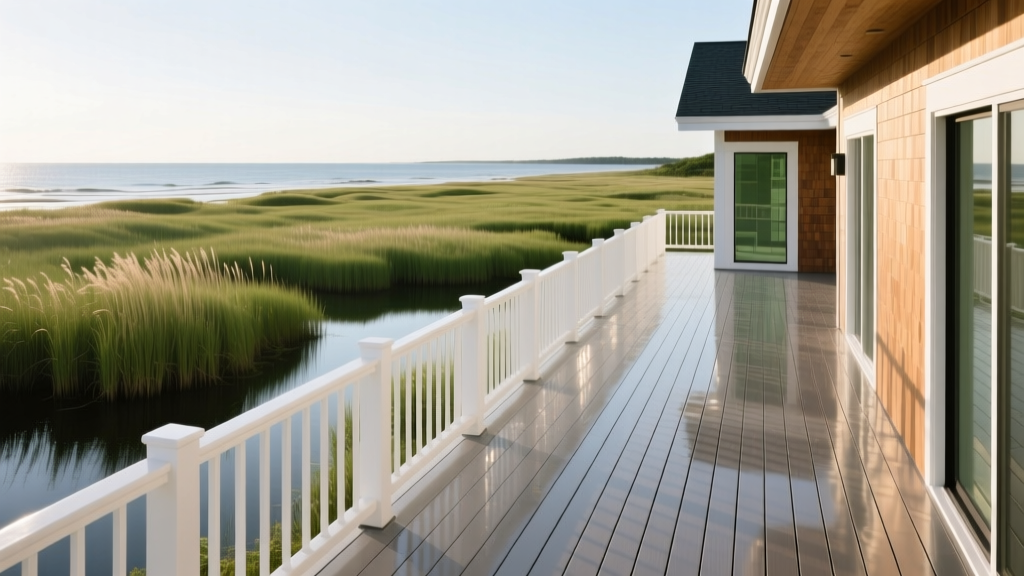
Building an outdoor living space in Barnstable, Massachusetts, requires navigating a unique microclimate. Situated on Cape Cod, properties here face relentless salt spray, high summer UV indices, driving nor'easter winds, and seasonal freeze-thaw cycles. Standard decking materials that perform adequately in inland New England will rapidly degrade in this coastal environment. When selecting a deck material in Barnstable, homeowners must prioritize moisture impermeability, UV stability, and corrosion resistance. According to the FEMA Coastal Construction Manual, structures in coastal high-hazard zones must utilize materials that resist both saltwater corrosion and biological decay without relying on high-maintenance surface coatings.
| Environmental Stressor | Impact on Decking | Material Vulnerability |
|---|---|---|
| Salt Air & Spray | Accelerates oxidation and metal corrosion | Untreated aluminum, standard steel fasteners, iron-rich composites |
| High Humidity & Moisture | Promotes mold, mildew, and wood rot | Uncapped composite, pressure-treated pine, porous tropical woods |
| UV Radiation (Summer) | Causes photodegradation and color fading | Uncapped PVC, unstained Ipe, low-quality composite shells |
| Freeze-Thaw Cycles | Water infiltration leads to cracking and delamination | Porous wood grains, cracked composite caps, hollow aluminum extrusions |
Top Contenders for Coastal Cape Cod
1. Cellular PVC (The Coastal Champion)
Cellular PVC, such as Azek Vintage or Wolf Serenity, contains zero wood fibers, making it entirely impervious to moisture absorption and biological rot. For Barnstable's damp, salt-heavy air, PVC is the most structurally resilient option. The material will not splinter, warp from water ingress, or harbor mold in its core. However, PVC has a higher coefficient of thermal expansion than wood. Installers must leave a precise 1/8-inch gap per 10 feet of board length to accommodate summer expansion, and use specialized PVC-compatible hidden fastener systems to allow for lateral movement. Expect to pay between $14.00 and $18.50 per square foot for premium PVC materials in 2026.
2. Capped Wood-Composite (The Balanced Alternative)
High-end capped composites like Trex Transcend Lineage or TimberTech Landmark feature a dense polyethylene shell over a wood-flour core. While the core contains organic material, the full polymer cap prevents moisture from reaching it. Composite boards are heavier and more rigid than PVC, offering superior wind resistance during coastal storms. The primary drawback in Barnstable is the potential for surface mold if organic debris (like oak leaves or pine needles) is allowed to accumulate and trap moisture against the shell. Regular sweeping and biannual washing with a sodium percarbonate-based cleaner are mandatory to maintain the warranty. Material costs range from $10.50 to $14.00 per square foot.
3. Tropical Hardwoods (The Traditionalist's Choice)
Ipe (Handroanthus spp.) boasts a Janka hardness rating of 3,680 lbf and natural oils that repel insects and resist rot, as documented by the Wood Database. Aesthetically, it offers a rich, natural grain that aligns with the historic character of many Cape Cod homes. However, Ipe requires significant upkeep in a coastal setting. If left untreated, the intense coastal UV will weather it to a silvery-gray within a single summer. To maintain its brown hue, it must be oiled annually with a high-quality penetrating sealer like Messmer's UV Plus. Furthermore, Ipe is incredibly dense, requiring pre-drilling for every fastener and carbide-tipped saw blades, driving up labor costs significantly. Material pricing sits between $16.00 and $22.00 per square foot.
Crucial Sub-Structure: Framing and Fasteners
The most common point of failure for Barnstable decks is not the decking board itself, but the sub-structure. Standard pressure-treated Southern Yellow Pine rated UC4A (Above Ground) is insufficient for coastal framing. You must specify UC4B (Ground Contact) or UC4C (Marine Ground Contact) lumber for all joists, beams, and posts to resist the high ambient moisture and salt penetration. Alternatively, powder-coated steel framing systems like Trex Elevens offer superior wind-load resistance, provided the coating is rated for marine environments.
Navigating Barnstable Zoning and Historic Guidelines
Before finalizing your material selection, you must consult local regulations. Barnstable encompasses several historic districts, particularly along the Route 6A corridor. The Cape Cod Commission and local historic preservation boards often enforce strict aesthetic guidelines. Highly reflective surfaces, stark whites, or unnatural colors (like bright grays or deep blacks) may be rejected in historic zones. If you live in a regulated district, cellular PVC and composite materials must be ordered in muted, natural tones—such as Azek's 'Coastline' or Trex's 'Island Mist'—to mimic weathered wood or natural cedar. Always submit material samples and color swatches to the Barnstable Historic District Commission before ordering.
2026 Cost Analysis: 300 Sq. Ft. Deck in Barnstable
Labor rates on Cape Cod carry a premium due to the high cost of living and seasonal contractor demand. The following table breaks down the estimated costs for a standard 300-square-foot, single-level deck with basic railings, installed in Barnstable in 2026.
| Material Category | Material Cost (300 sq ft) | Labor & Framing Cost | Total Estimated Project Cost |
|---|---|---|---|
| Capped Composite (Trex/TimberTech) | $3,150 - $4,200 | $10,500 - $13,500 | $13,650 - $17,700 |
| Cellular PVC (Azek/Wolf) | $4,200 - $5,550 | $10,500 - $13,500 | $14,700 - $19,050 |
| Tropical Hardwood (Ipe) | $4,800 - $6,600 | $13,500 - $16,500 | $18,300 - $23,100 |
Note: Labor costs assume UC4B pressure-treated framing and 316 stainless steel hardware. Demolition of an existing structure or complex stair builds will increase labor by 15-25%.
The Final Decision Matrix
Use this framework to finalize your deck material selection based on your specific property constraints and lifestyle preferences:
- Choose Cellular PVC if: Your deck faces direct ocean exposure, is located in a high-splash zone (near a pool or hot tub), and you want the lowest possible maintenance routine with zero risk of core rot.
- Choose Capped Composite if: You are building a large, multi-level deck where the rigidity and wind-load resistance of a heavier board are necessary, and you are willing to perform biannual cleanings to prevent surface mold.
- Choose Ipe Hardwood if: Your property is in a strict historic district that mandates natural wood, you prefer the tactile feel of solid timber, and you have the budget to hire a professional for annual UV oil applications.
Written by
David NakamuraDavid Nakamura is a licensed architect (AIA) and construction technology writer focused on sustainable building methods, mass timber engineering, and high-performance building envelopes. He holds a Master of Architecture from the University of Washington and is a certified Passive House Consultant (CPHC). David spent eight years at the Seattle firm Mithun, where he led the design of three LEED Platinum projects, before founding his own practice specializing in net-zero residential design. He serves on the editorial advisory board of GreenBuilder Magazine and has authored peer-reviewed papers on cross-laminated timber (CLT) connections for the Journal of Structural Engineering. In his spare time, David teaches woodworking at Pratt Fine Arts Center and kayaks the Puget Sound.
More from David Nakamura
View all
Construction Cost
Labor Cost to Build a Deck Per Sq Ft: 2026 Installation Guide
Discover the exact labor cost to build a deck per sq ft in 2026. This installation guide breaks down contractor rates, complexity factors, and hidden fees.
Aug 4, 2026

Construction Cost
How Much Does It Cost to Build a 3 Bedroom House? Financing Guide
Learn exactly how much it costs to build a 3 bedroom house and explore 2026 financing options, construction loan types, and budget frameworks for your build.
Aug 4, 2026

Construction Cost
Cost to Build a Tennis Court: 2026 Guide
How much does it cost to build a tennis court in 2026? Breakdowns for asphalt, concrete, and synthetic surfaces plus fencing and lighting.
Jul 30, 2026