Comparing Deck Stairs Materials for Maximum Durability and Lifespan
Compare the most durable deck stairs materials. Analyze lifespan, wear resistance, and maintenance for wood, composite, PVC, and aluminum treads.

The Hidden Failure Points in Deck Stair Construction
Deck stairs fail at a significantly higher rate than flat decking surfaces. While a well-built flat deck surface might endure 20 years of static loads and weather, stairs are subjected to dynamic impact forces, concentrated foot traffic, and complex water-trapping geometries. When evaluating deck stairs materials for maximum durability, the focus must extend beyond surface aesthetics to structural deflection, fastener shear strength, and moisture management at the stringer base.
According to the American Wood Council's Prescriptive Residential Deck Construction Guide (DCA-6), stair stringers and treads require specific load-path considerations that differ from standard joist framing. Selecting the wrong tread material or ignoring the throat-cut depth of a notched stringer will result in premature structural failure, regardless of how expensive the surface material is.
Tread Material Lifespan Matrix
The lifespan of stair treads is dictated by their resistance to cupping, UV degradation, and impact wear. The following matrix outlines the expected performance of the four primary deck stairs materials used in modern construction.
| Material Type | Expected Lifespan | Primary Failure Mode | Avg Cost per Tread (4ft) |
|---|---|---|---|
| Pressure-Treated SYP (2x12) | 10–15 Years | Edge cupping and end-grain checking | $18 – $25 |
| Capped Wood-Composite | 25–30 Years | Thermal sagging and surface scratching | $45 – $60 |
| Advanced PVC (Cellular) | 30–50 Years | Thermal expansion joint failure | $55 – $75 |
| Extruded Aluminum | 50+ Years | Galvanic corrosion at fastener points | $80 – $120 |
Deep Dive: Tread Material Durability
Pressure-Treated Southern Yellow Pine (SYP)
Traditional 2x12 pressure-treated SYP remains the most common stair tread material due to its low upfront cost and structural rigidity. However, a standard 2x12 measures 11.25 inches wide. On a flat deck, water sheds quickly, but on a horizontal stair tread, this wide surface area acts as a catchment basin. As the wood undergoes seasonal moisture cycling, the wide board is highly susceptible to edge cupping. Once a 2x12 tread cups, it holds standing water, accelerating rot and creating a severe slip hazard.
Expert Fix: For maximum wood tread durability, rip a 2x12 down to 10 inches wide to remove the pith (the center of the log), which is the primary driver of uneven shrinkage. Alternatively, use two 5/4x6 pressure-treated boards spaced 1/4 inch apart to allow water drainage and eliminate cupping tension.
Capped Wood-Composite (e.g., Trex Transcend)
Capped composites utilize a wood-flour core encased in a polyethylene shell. While highly resistant to rot and insect damage, composite materials lack the stiffness-to-weight ratio of solid lumber. The InterNACHI Life Expectancy Chart notes that while composite decking can last decades, stair applications introduce concentrated dynamic loads that can cause deflection.
Expert Fix: Composite stair treads must be supported by stringers spaced no more than 12 inches on-center (OC). If a builder uses standard 16-inch OC spacing on stairs, a 5/4 composite tread will eventually sag, snap, or pull free from the fasteners under heavy impact loads.
Advanced PVC (e.g., TimberTech Landmark)
Cellular PVC contains no wood fibers, making it completely impervious to moisture absorption and rot. It is the most dimensionally stable polymer option for high-humidity environments. However, PVC has a high coefficient of thermal expansion. A 10-foot run of PVC can expand and contract up to 3/8 of an inch between winter and summer temperatures.
Expert Fix: Never face-screw PVC treads tightly without allowing for lateral movement. Use hidden stair tread fasteners designed with slotted holes, or if face-screwing, pre-drill oversized holes and use color-matched composite plugs to hide the fastener heads while allowing the board to slide laterally.
Extruded Aluminum (e.g., Adek)
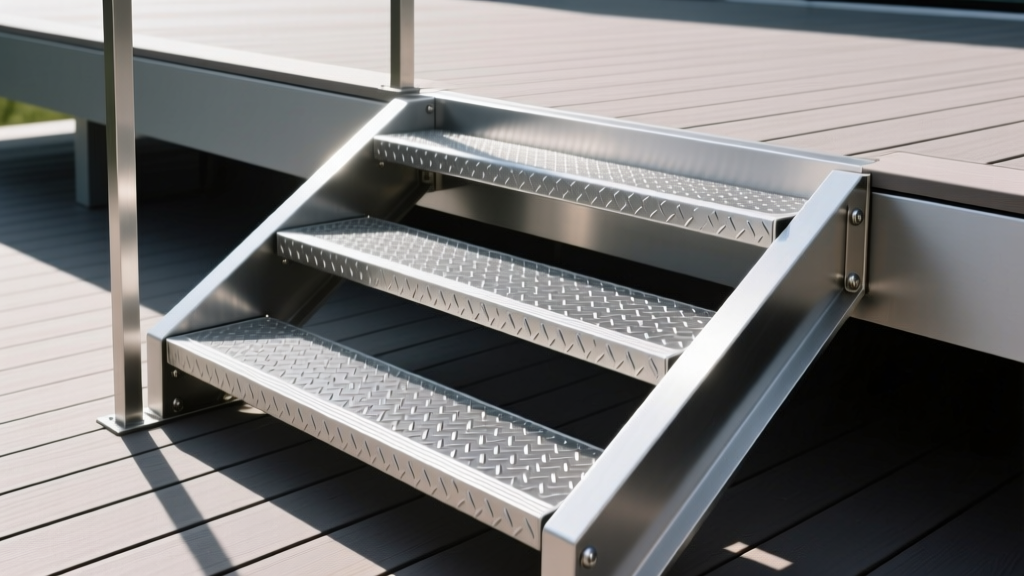
Aluminum stair treads represent the pinnacle of lifespan and structural integrity. Extruded aluminum profiles will not rot, warp, or combust. High-end aluminum treads feature integrated, co-extruded abrasive grip strips that maintain slip resistance long after surface-applied grit tape has worn away.
Expert Fix: Aluminum is highly susceptible to galvanic corrosion when in direct contact with the copper in modern pressure-treated wood (like MCA or ACQ treatments). Always use a dielectric separator tape or neoprene gasket between the aluminum tread and the wood stringer to prevent rapid pitting and degradation of the aluminum.
The most common cause of composite stair failure is applying flat-deck joist spacing to stairs. While composite deck boards can span 16 inches OC on a flat surface, stair treads experience dynamic impact forces (jumping, running) that require a maximum 12-inch OC stringer spacing. Failure to add a third (middle) stringer to a standard 36-inch wide stairway will void the manufacturer's warranty and lead to catastrophic tread failure.
The Stringer: Where Stairs Actually Rot
When homeowners complain about 'deck stairs materials' failing, the tread is rarely the actual culprit. The failure almost always originates in the stringer. Cutting a 2x12 to create stair steps removes a massive amount of structural wood. At the 'throat' (the inside corner of the cut), only 3.5 inches of wood remains to support the entire load of the stairway.
Furthermore, the bottom of the stringer is often rested directly on a concrete pad or bare soil. Concrete is porous and wicks groundwater. Through capillary action, moisture travels up the end-grain of the bottom step, rotting the stringer from the inside out while the exterior appears perfectly intact.
The Durability Solution: Never let a wood stringer touch concrete or soil. Install a Simpson Strong-Tie LTAZ or equivalent adjustable stair base standoff. This metal bracket elevates the bottom of the wood stringer 1/2 inch to 1 inch off the concrete pad, breaking the capillary moisture path and allowing air circulation to dry the end-grain.
Fastener Corrosion and Galvanic Degradation
The lifespan of your stair materials is ultimately capped by the lifespan of the hardware holding them together. Modern pressure-treated lumber is preserved with copper-based chemicals (Micronized Copper Azole or Alkaline Copper Quaternary). These chemicals are highly corrosive to standard metals.
- Electro-Galvanized (Clear Zinc): Will corrode and fail within 2 to 4 years when used with modern treated lumber. Never use on exterior stairs.
- Hot-Dipped Galvanized (G185): The minimum acceptable standard for inland applications. The thick zinc coating sacrifices itself to protect the steel core, providing a 15 to 20-year lifespan.
- Type 304 Stainless Steel: Required for high-humidity and moderate coastal zones. Resists copper-induced corrosion indefinitely.
- Type 316 Marine-Grade Stainless Steel: Mandatory for structures within 3,000 feet of saltwater. Contains molybdenum to prevent chloride pitting.
Climate-Specific Decision Framework
Selecting the right deck stairs materials requires matching the material's physical properties to your local microclimate. Use this framework to finalize your material schedule:
Coastal and High-Humidity Climates
Best Choice: Advanced PVC treads with 316 stainless steel hidden fasteners and galvanized steel stringers wrapped in PVC fascia. Wood and wood-flour composites will absorb ambient moisture, leading to swelling and mold growth in the stair riser cavities.
Heavy Freeze-Thaw and Snow Load Regions
Best Choice: Extruded aluminum treads or thick 2x12 pressure-treated SYP. Aluminum sheds snowmelt instantly and provides superior traction when fitted with co-extruded carbide grit. Avoid capped composites in heavy ice regions, as scraping ice off composite surfaces will permanently gouge the polymer shell.
Arid and High-UV Environments
Best Choice: Capped wood-composite or Ipe hardwood. PVC can become brittle under extreme, sustained UV exposure and high heat, leading to impact cracking. High-quality capped composites feature UV-inhibitor packages that resist fading and thermal cracking in desert climates.
'Stairways must be constructed with materials that maintain their structural integrity and slip resistance under the specific environmental loads of the site. Ignoring the intersection of material science and local climate is the primary driver of premature stair replacement.' — Adapted from International Residential Code (IRC) Section R311.7 commentary on stairway durability.
Ultimately, maximizing the lifespan of your deck stairs requires looking past the surface tread. By pairing a climate-appropriate tread material with properly elevated stringers, dielectric separation for dissimilar metals, and correctly rated stainless steel fasteners, you can build a stairway that outlasts the deck it is attached to.
Written by
Sarah WhitfieldSarah Whitfield is a chartered quantity surveyor (MRICS) and construction cost analyst with 15 years of experience in material pricing, procurement strategy, and project budgeting. She earned her degree in Construction Management from the University of Reading (UK) and has worked on projects ranging from $2M custom homes to $180M mixed-use developments across North America and Europe. Sarah currently leads cost estimating for BuildMat Insight, maintaining a proprietary database of 4,000+ material price points updated quarterly. She is a frequent contributor to RSMeans cost data panels and has presented at the International Cost Engineering Council (ICEC) congress. Based in Denver, CO, Sarah is an avid trail runner and volunteer mentor for Women in Construction.
More from Sarah Whitfield
View all
Wood & Lumber
What Are the Different Types of Wood? A Builder's Guide
Compare structural softwoods, finish hardwoods, and engineered lumber. Analyze Janka ratings, MOE values, and 2026 pricing for construction.
Aug 4, 2026

Walls & Panels
Steel Framing vs Wood Framing: Corrosion and Moisture Defense
Compare steel framing vs wood framing for moisture resistance. Learn about galvanized coatings, condensation risks, and corrosion protection strategies.
Jul 21, 2026

Stone & Masonry
How to Cut Stone Veneer: Wet Saw vs Grinder Comparison
Compare the best tools for cutting stone veneer. We review wet saws, angle grinders, and chop saws to help you achieve clean, chip-free cuts.
Jul 21, 2026