Decking Material Cost Breakdown: Wood vs Composite in 2026
Compare 2026 decking material costs per square foot. Expert breakdown of wood, composite, and PVC pricing, hidden fees, and 10-year lifecycle ROI.

The True Cost of Decking Materials: Beyond the Price Tag
When budgeting for an outdoor living space, the sticker price of the surface boards is only the beginning. A common miscalculation among homeowners and novice builders is equating the per-square-foot cost of a decking material with the total project cost. In reality, the surface decking material typically accounts for just 25% to 35% of the total installed price. The remainder is consumed by structural framing, footings, fasteners, labor, and waste.
As we navigate the 2026 building season, supply chain stabilizations have normalized the wild price swings of previous years, but inflation in specialized labor and structural steel continues to push installed costs upward. According to recent industry data compiled by Forbes Advisor, the national average cost to build a deck now ranges from $4,500 to $18,000, heavily dependent on the material tier and regional labor rates. To make a financially sound decision, you must evaluate materials not just on their day-one purchase price, but on their lifecycle cost, structural requirements, and maintenance overhead.
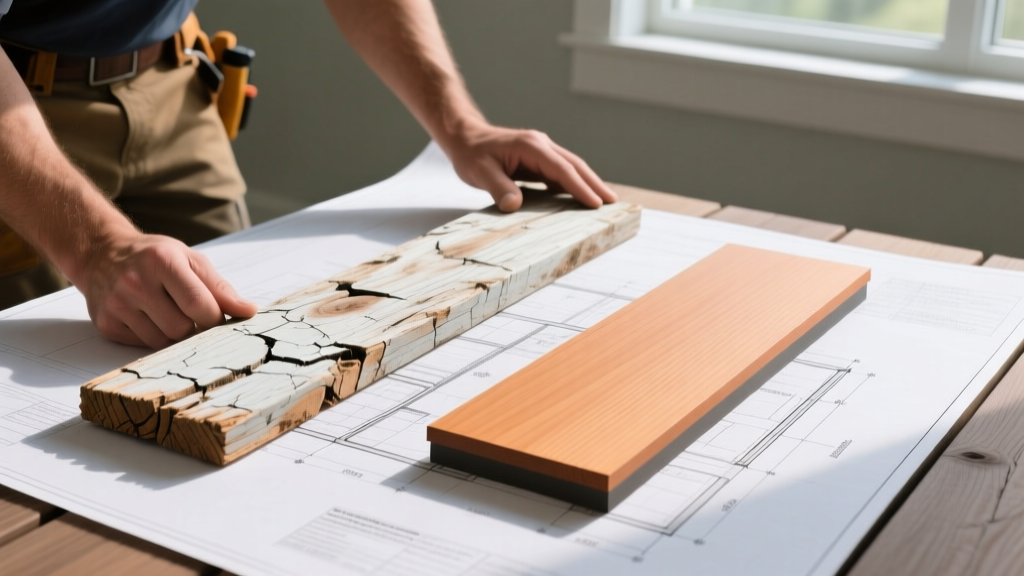
2026 Decking Material Price Matrix (Per Square Foot)
The following matrix breaks down the material-only costs versus the fully installed costs for the most prevalent decking categories in 2026. Installed costs assume a standard 300-square-foot rectangular deck, 3 feet off the ground, with pressure-treated pine framing and concrete sonotube footings.
| Material Category | Brand / Model Example | Material Cost (Sq. Ft.) | Installed Cost (Sq. Ft.) | Expected Lifespan |
|---|---|---|---|---|
| Pressure-Treated Pine | Standard #2 Southern Yellow Pine | $3.50 - $5.00 | $18.00 - $24.00 | 10 - 15 Years |
| Natural Cedar | Western Red Cedar (Clear Grade) | $6.50 - $8.50 | $26.00 - $34.00 | 15 - 20 Years |
| Entry-Level Composite | Trex Enhance Basics | $7.00 - $8.50 | $30.00 - $38.00 | 25 Years |
| Premium Composite | Trex Transcend Lineage | $10.50 - $13.00 | $42.00 - $55.00 | 25 - 30 Years |
| Advanced PVC | TimberTech Advanced PVC Landmark | $12.50 - $15.50 | $50.00 - $65.00 | 30 - 50 Years |
| Tropical Hardwood | Ipe (Brazilian Walnut) | $14.00 - $19.00 | $55.00 - $75.00 | 40+ Years |
The Structural Framing Multiplier
The weight and span limitations of your chosen decking material directly dictate your framing costs. For instance, tropical hardwoods like Ipe possess a Janka hardness rating of 3,510 lbf and immense structural rigidity, allowing them to span 24 inches on-center (OC) for residential applications. Conversely, many composite boards require 16-inch OC joist spacing for straight installations, and 12-inch OC for diagonal patterns. Upgrading from a 24-inch to a 12-inch joist spacing increases your framing lumber requirements by nearly 50%, adding roughly $2.50 to $4.00 per square foot to the underlying structure before a single deck board is laid.
Hidden Cost Variables That Skew Your Budget
Contractors often quote a base price that excludes the premium upgrades necessary for a modern, high-performance deck. Failing to account for these variables will result in severe budget overruns.
Warning: The Fastener and Waste Tax
1. Hidden Fasteners: Face-screwing composite or PVC boards compromises the aesthetic and can void manufacturer warranties if not done with specific color-matched screws. Upgrading to hidden clip systems (like the Trex Hideaway or TimberTech CONCEALoc) adds $1.50 to $2.50 per square foot in material costs alone, plus additional labor time for routing grooves if the boards are not pre-grooved.
2. The Waste Factor: A standard rectangular deck laid in a straight pattern requires a 10% waste factor for cuts and defects. However, if you opt for a 45-degree diagonal layout, a herringbone pattern, or a picture-frame border, your waste factor jumps to 15% - 20%. On a premium PVC material costing $14/sq ft, a 20% waste factor on a 400 sq ft deck adds over $1,100 in discarded material.
Lifecycle Cost Analysis: 10-Year Projection
To determine the true financial impact of your decking material, you must calculate the 10-year lifecycle cost. This metric combines the initial material purchase, installation premiums, and a decade of mandatory maintenance. Data from the USDA Forest Products Laboratory highlights that untreated and poorly maintained wood is highly susceptible to moisture-induced decay, checking, and fungal degradation, necessitating rigorous chemical intervention.
Pressure-Treated Wood (The High-Maintenance Budget Option)
- Initial Material Cost: $4.00 / sq ft
- 10-Year Maintenance: Requires power washing and re-sealing or staining every 18 to 24 months. Professional sealing costs $2.00 to $3.50 per square foot. Over 10 years, expect 5 professional treatments at an average of $2.50/sq ft = $12.50 / sq ft.
- 10-Year Lifecycle Cost: $16.50 / sq ft (Material + Maintenance)
Capped Composite (The Break-Even Standard)
- Initial Material Cost: $11.00 / sq ft
- 10-Year Maintenance: Requires only bi-annual cleaning with soap and water or a specialized composite cleaner (e.g., Corte-Clean). DIY cost is negligible; professional washing averages $0.30 / sq ft per year = $3.00 / sq ft over 10 years.
- 10-Year Lifecycle Cost: $14.00 / sq ft (Material + Maintenance)
Insight: The financial crossover point where capped composite becomes cheaper than pressure-treated wood typically occurs between year 6 and year 8. If you plan to stay in your home for less than 5 years, wood offers a better immediate ROI. If you plan to stay for a decade or more, composite is mathematically superior.
Regional Labor & Material Variance
Geography plays a massive role in decking material viability and cost. According to building experts featured in This Old House, environmental factors dictate material failure rates, which in turn influence local contractor preferences and labor pricing.
- Coastal & High-Humidity Regions (e.g., Florida, Pacific Northwest): Pressure-treated pine and natural cedar degrade rapidly in these environments due to salt spray and constant moisture. Advanced PVC is the recommended standard here. While the material cost is 30% higher than composite, PVC absorbs zero moisture, eliminating the risk of mold, mildew, and board swelling.
- Arid & High-UV Regions (e.g., Arizona, Southern California): Uncapped composites and softer woods will warp, fade, and splinter under intense UV exposure. Premium capped composites with UV-inhibitor shells (like Trex Transcend Lineage or TimberTech Landmark) are mandatory. Lighter color palettes (e.g., Coastal Bluff, Antique Teak) are required to prevent the surface temperature from exceeding 140°F, which can cause thermal expansion issues and board buckling if proper gapping is not maintained.
Decision Framework: Matching Material to Your ROI
Use this practical framework to select the exact decking material that aligns with your financial timeline and property goals.
Scenario A: Preparing to Sell Within 3-5 Years
Choose Pressure-Treated Pine or Entry-Level Composite. You will not recoup the premium cost of PVC or Ipe in the home appraisal. Invest the saved capital into high-impact visual upgrades like aluminum railings or integrated low-voltage LED stair lighting, which yield higher immediate returns for prospective buyers.
Scenario B: The "Forever Home" (10+ Year Horizon)
Choose Premium Capped Composite. It provides the optimal balance of realistic wood-grain aesthetics, structural longevity, and near-zero maintenance. Pair it with a steel framing system (like Fortress Evolution) to ensure the substructure outlasts the composite boards, which are typically warrantied for 25 to 30 years.
Scenario C: Luxury Build / Harsh Environment
Choose Advanced PVC or Ipe Hardwood. If budget is secondary to performance, PVC offers the highest resistance to moisture and staining (ideal for areas around pools or outdoor kitchens where grease spills occur). Ipe offers unmatched structural density and a natural, premium patina, but requires specialized carbide-tipped tooling for installation and annual oiling if you wish to maintain its original brown hue rather than letting it weather to silver.
Written by
Marcus ChenMarcus Chen is a licensed structural engineer (PE) and building materials analyst with over 12 years of experience across residential, commercial, and industrial construction. He holds a Master of Science in Civil Engineering from UC Berkeley and spent six years at Thornton Tomasetti before transitioning to independent consulting and technical writing. Marcus specializes in material selection for seismic-prone regions, concrete reinforcement strategies, and lifecycle cost analysis. His work has been cited by the American Concrete Institute (ACI) and the Structural Engineers Association of California (SEAOC). When he is not on a job site or at his desk, you will find him hiking the Sierra Nevada or restoring a 1920s craftsman bungalow in Oakland, CA.
More from Marcus Chen
View all
Construction Cost
How Much Did the Eiffel Tower Cost to Build?
How much did the Eiffel Tower cost to build in 1889? We adjust for inflation and compare its budget to modern skyscraper construction.
Aug 4, 2026

Fire Resistance
What Is a Fire Resistant Material? Testing & Certification Guide
Discover what is a fire resistant material through ASTM and UL testing. Learn how fire ratings, certifications, and assemblies work in construction.
Aug 4, 2026

Construction Cost
How Much Did the Burj Khalifa Cost to Build?
How much did the Burj Khalifa cost to build? We break down the $1.5B project and extract 5 money-saving strategies for your next build.
Jul 30, 2026