Evaluating Outdoor Decking Material Options for Maximum Lifespan
Compare lifespan and durability of top outdoor decking material options, including composite, PVC, aluminum, and modified wood, with real-world failure data.

The True Cost of Deck Replacement: Why Lifespan Dictates Material Choice
When selecting from the vast array of outdoor decking material options, homeowners and contractors often fixate on upfront costs and initial aesthetics. However, the true financial and structural metric is the cost-per-year of service life. A $6,000 pressure-treated wood deck that requires $4,000 in maintenance and replacement over 15 years is vastly more expensive than a $14,000 cellular PVC deck that remains structurally intact and visually pristine for 50 years with zero maintenance.
According to life expectancy data compiled by the National Association of Home Builders (NAHB), the functional lifespan of a deck is entirely dependent on the material's resistance to its three primary enemies: moisture intrusion, ultraviolet (UV) degradation, and thermal expansion. This guide bypasses marketing claims to evaluate the actual durability, failure modes, and realistic lifespans of modern decking materials.
Material Lifespan & Failure Matrix
The following matrix breaks down the top-tier outdoor decking material options available in 2026, focusing on premium product lines that represent the upper echelon of durability in their respective categories.
| Material Category | Premium Product Lines | Material Cost (per sq. ft.) | Expected Lifespan | Primary Failure Mode |
|---|---|---|---|---|
| Capped Composite | Trex Transcend Lineage, TimberTech Reserve | $11.00 - $14.50 | 30 - 40 Years | Uncapped edge moisture absorption; surface scratching |
| Cellular PVC | AZEK Landmark, Wolf Serenity | $13.00 - $17.00 | 50+ Years | UV chalking; extreme thermal expansion/contraction |
| Aluminum | Wahoo Decks, Nexan Building Products | $16.00 - $22.00 | Lifetime (60+ Years) | Powder-coat degradation; galvanic corrosion at fasteners |
| Modified Wood | Kebony, Thermory Benchmark Ash | $9.00 - $13.00 | 25 - 35 Years | Surface checking; silvering without UV oil maintenance |
Deep Dive: Polymer & Metal Durability
Capped Wood-Plastic Composites (WPC)
Modern composite decking is governed by ASTM D7032 standards, which dictate load-bearing and durability requirements. The durability of a composite board relies entirely on its polymer cap. Premium options like Trex Transcend Lineage utilize an advanced ASA (Acrylonitrile Styrene Acrylate) or high-density polyethylene (HDPE) shell that is co-extruded around a wood-fiber core.
The Edge Case Vulnerability: While the top and sides are capped, the cut ends are often left exposed during installation. If these ends are not sealed with a specialized composite end-tape or silicone-based sealant, the exposed wood-flour core will wick moisture. Over a 10-year period, this leads to localized swelling, delamination, and fungal decay at the joist intersections. Furthermore, WPCs are susceptible to thermal expansion—typically expanding up to 1/8 inch per 12-foot board in direct summer sun, requiring precise gapping during installation.
Cellular PVC (Polyvinyl Chloride)
Cellular PVC contains zero organic wood fibers, making it biologically immune to rot, mold, and termite damage. The USDA Forest Products Laboratory consistently notes that eliminating organic cellulose from exterior building envelopes effectively eliminates the food source for decay fungi.
However, PVC's weakness is thermal. It has a higher coefficient of thermal expansion than composite. In desert climates or south-facing orientations, dark-colored PVC boards can experience significant longitudinal movement, which can pop hidden fasteners if the substructure spacing exceeds 16 inches on-center (OC). Additionally, after 20+ years of intense UV exposure, lower-tier PVC may begin to chalk, though premium lines like AZEK Landmark use advanced polymer alloys to mitigate this.
Powder-Coated Aluminum
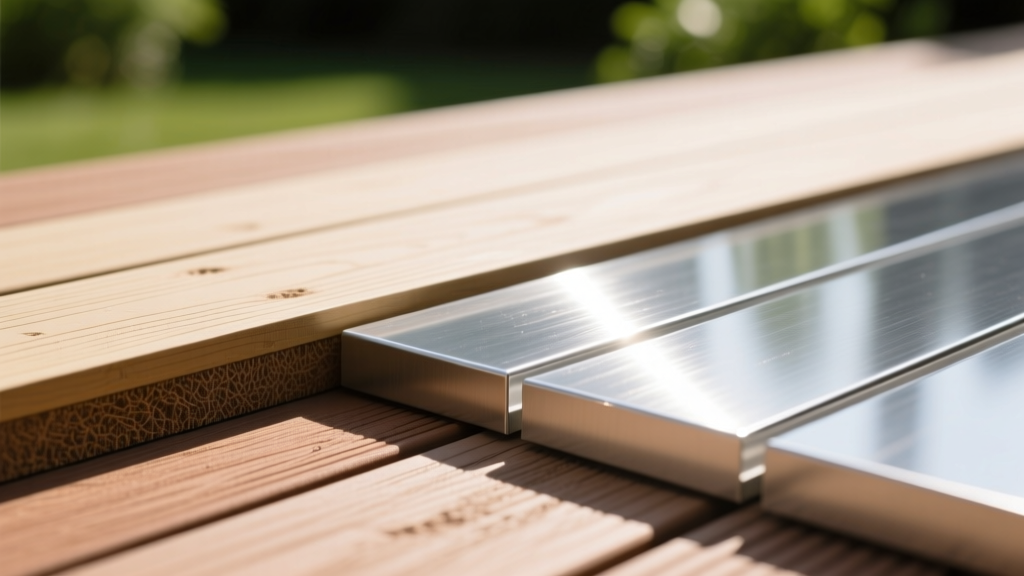
Aluminum represents the absolute pinnacle of structural lifespan. It will not rot, warp, splinter, or burn. Products like Wahoo Decks utilize marine-grade 6063-T6 aluminum with an AAMA 2604 powder-coat finish, which resists fading and chalking far better than standard liquid paints.
Never use standard galvanized, zinc-plated, or even basic stainless steel screws directly into aluminum joists without a neoprene or nylon isolation washer. The dissimilar metals will create a galvanic cell in the presence of moisture, leading to rapid oxidation, pitting, and structural failure of the fastener within 3 to 5 years in coastal or high-humidity environments. Always use manufacturer-specified fasteners with built-in isolation barriers.
Modified Woods: The Natural Alternative
For those who demand the authentic feel of wood but require composite-level lifespans, thermally modified and acetylated woods are the premier outdoor decking material options. Kebony uses a bio-based liquid to modify the cellular structure of radiata pine, while Thermory uses intense heat and steam to alter the wood's equilibrium moisture content (EMC).
Thermally modified ash (like Thermory Benchmark) drops its EMC to roughly 4-6%, compared to 12-15% for untreated wood. This drastic reduction means the wood physically cannot absorb enough ambient moisture to support fungal growth, granting it a Class 1 durability rating without chemical preservatives.
The trade-off is surface maintenance. While the structural integrity will last 30 years, the UV rays will still break down the surface lignin, turning the wood a silvery-gray within 12 months. If you want to maintain the rich brown hue, you must apply a penetrating UV-inhibiting oil (like Messmer's UV Plus) every 18 to 24 months.
Microclimate Matching Framework
Durability is not absolute; it is relative to your specific environment. Use this decision framework to match your microclimate to the optimal material:
- Coastal / Salt Spray Environments: Aluminum or Cellular PVC. Avoid composites, as the wood fibers can absorb salt moisture, and avoid standard pressure-treated wood due to rapid corrosion of metal fasteners.
- Heavy Shade / High Dampness (Pacific Northwest, Deep Woods): Cellular PVC or Aluminum. Composites, even capped ones, can develop surface mildew in perpetually damp, shaded environments that require chemical cleaning.
- High UV / Desert Climates (Southwest): Light-colored Capped Composite or Modified Wood. Avoid dark PVC, which will experience extreme thermal expansion and can become uncomfortably hot to walk on barefoot (surface temps can exceed 140°F).
- Wildfire Prone Zones (WUI): Aluminum or heavy hardwoods (Ipe). The American Wood Council notes that in Wildland-Urban Interface (WUI) zones, non-combustible decking or heavy timber is often mandated by local fire codes to prevent ember ignition.
The Final Verdict: Aligning Material with Your Timeline
When evaluating outdoor decking material options through the lens of durability, your choice should be dictated by your ownership horizon. If you plan to sell the home in 5 to 7 years, a mid-tier capped composite offers the best balance of low maintenance and high ROI. If you are building a forever home and want a structure that will outlive your mortgage, powder-coated aluminum or cellular PVC provides a zero-rot, zero-splinter guarantee that justifies the 30% to 40% upfront material premium. Always pair your chosen decking with a fully taped, moisture-resistant substructure (such as joist tape and structural steel or ground-contact-rated lumber) to ensure the framing outlasts the deck boards themselves.
Written by
Sarah WhitfieldSarah Whitfield is a chartered quantity surveyor (MRICS) and construction cost analyst with 15 years of experience in material pricing, procurement strategy, and project budgeting. She earned her degree in Construction Management from the University of Reading (UK) and has worked on projects ranging from $2M custom homes to $180M mixed-use developments across North America and Europe. Sarah currently leads cost estimating for BuildMat Insight, maintaining a proprietary database of 4,000+ material price points updated quarterly. She is a frequent contributor to RSMeans cost data panels and has presented at the International Cost Engineering Council (ICEC) congress. Based in Denver, CO, Sarah is an avid trail runner and volunteer mentor for Women in Construction.
More from Sarah Whitfield
View all
Wood & Lumber
What Are the Different Types of Wood? A Builder's Guide
Compare structural softwoods, finish hardwoods, and engineered lumber. Analyze Janka ratings, MOE values, and 2026 pricing for construction.
Aug 4, 2026

Walls & Panels
Steel Framing vs Wood Framing: Corrosion and Moisture Defense
Compare steel framing vs wood framing for moisture resistance. Learn about galvanized coatings, condensation risks, and corrosion protection strategies.
Jul 21, 2026

Stone & Masonry
How to Cut Stone Veneer: Wet Saw vs Grinder Comparison
Compare the best tools for cutting stone veneer. We review wet saws, angle grinders, and chop saws to help you achieve clean, chip-free cuts.
Jul 21, 2026