Lightweight Decking Material Costs & ROI Breakdown
Analyze the 2026 cost breakdown of lightweight decking material. Compare aluminum, PVC, and foamed composite pricing, framing savings, and long-term ROI.

The Economic Shift: Surface Costs vs. Substructure Savings
When evaluating a deck build, contractors and homeowners traditionally fixate on the per-square-foot cost of the decking boards themselves. However, specifying a lightweight decking material fundamentally alters the structural economics of the entire project. Heavy, wood-plastic composite (WPC) boards often weigh upwards of 2.5 to 3.0 pounds per linear foot, necessitating dense 12-inch on-center (OC) joist spacing to prevent sagging. By contrast, lightweight alternatives—specifically extruded aluminum, cellular PVC, and advanced foamed-core composites—weigh between 0.8 and 1.5 pounds per linear foot. This dramatic weight reduction allows for wider joist spacing (up to 24 inches OC for certain aluminum profiles), directly reducing substructure lumber, hardware, and labor costs.
This cost breakdown analyzes the true financial impact of lightweight decking materials in 2026, moving beyond surface-level pricing to quantify substructure savings, specialized installation requirements, and long-term lifecycle economics.
Material Cost Matrix: Aluminum, Cellular PVC, and Foamed Composites
The lightweight decking category is dominated by three primary material classes. The table below outlines the 2026 market pricing, physical weight, and structural span capabilities for premium products in each category.
| Material Class | Representative Product Lines | Weight (per linear ft) | Material Cost (per sq ft) | Max Joist Spacing (Residential) |
|---|---|---|---|---|
| Extruded Aluminum | AridDek, LockDry, Wahoo Decks | 0.8 - 1.1 lbs | $16.00 - $24.00 | 24" OC |
| Cellular PVC | Wolf Serenity, Azek Landmark | 1.2 - 1.5 lbs | $11.00 - $16.00 | 16" OC |
| Foamed-Core Composite | Trex Transcend Lineage | 1.6 - 1.9 lbs | $12.00 - $17.00 | 16" OC |
| Fiberglass (FRP) | Strongwell, Fibergrate | 0.9 - 1.2 lbs | $18.00 - $26.00 | 24" OC |
Note: Pricing reflects 2026 MSRP and average distributor rates for standard 16-foot boards. Exotic colors or specialized waterproof interlocking profiles command a 15-20% premium.
The Hidden Savings: Framing and Joist Spacing Economics
The most significant financial advantage of a lightweight decking material is not found at the lumberyard's decking aisle, but in the framing aisle. According to the American Wood Council's Prescriptive Residential Deck Construction Guide (DCA-6), joist spacing is dictated by the anticipated dead and live loads of the decking material. Heavy composites require 12-inch OC spacing, while structurally rigid aluminum and FRP grating can safely span 24 inches OC.
By doubling the joist spacing from 12" to 24" OC, you cut the required joist lumber by exactly 50%. For a standard rectangular deck, this also halves the number of required joist hangers, structural screws, and the labor hours needed to layout, cut, and secure the substructure.
400-Square-Foot Deck Framing Calculation (20' x 20')
To quantify the substructure savings, consider a 400-square-foot deck utilizing 12-foot joists spanning between two main beams.
- Heavy Composite Scenario (12" OC): Requires 21 joists. At 2026 average pricing of $16.50 for a 2x8x12 pressure-treated joist, material cost is $346.50. Add 21 joist hangers at $2.15 each ($45.15). Total framing material: $391.65.
- Lightweight Aluminum Scenario (24" OC): Requires 11 joists. Material cost for 2x8x12s is $181.50. Add 11 joist hangers ($23.65). Total framing material: $205.15.
Net Substructure Savings: $186.50 in materials, plus approximately 3.5 hours of reduced framing labor (at $65/hr = $227.50). Total hidden savings: $414.00. This effectively reduces the premium price gap between standard wood and high-end aluminum.
Specialized Tooling and Installation Labor Variables
While lightweight materials save money on framing, they introduce specific installation costs that must be factored into the initial budget. Contractors transitioning from traditional wood or WPC to aluminum or cellular PVC must account for the following variables:
1. Cutting and Machining Costs
Extruded aluminum decking cannot be cut with standard carbide-tipped wood blades without risking burrs, dangerous kickback, and rapid blade degradation. Installers must invest in specialized non-ferrous metal cutting blades or diamond-tipped blades designed for aluminum extrusions. A high-quality 10-inch non-ferrous blade (such as the Freud Diablo D10080N) costs between $45 and $65 and will require more frequent replacement on large-scale commercial projects. Furthermore, cutting aluminum generates fine metallic dust that must be swept immediately to prevent it from embedding into the powder-coated finish and causing surface oxidation spots.
2. Thermal Expansion Management
Aluminum expands and contracts at a rate approximately twice that of natural wood along its length. According to installation guidelines highlighted by Decks.com industry resources, installers must leave precise 1/8-inch to 3/16-inch gaps at end-joints depending on the ambient temperature during installation. This requires the use of specialized slotted fastener holes and floating clip systems rather than rigid face-screwing. Failure to accommodate thermal expansion will result in buckling during peak summer heat or fastener tear-out during winter contraction.
3. Waterproofing and Under-Deck Systems
Many lightweight aluminum profiles (like AridDek or LockDry) feature interlocking watertight channels. To achieve a truly dry under-deck space, installers must purchase proprietary end-caps, pitch-altering sleeper systems, and integrated gutter components. While this eliminates the need for a separate $8 to $12 per square foot under-deck drainage membrane (like Trex RainEscape), the proprietary aluminum accessories add roughly $3.50 to $5.00 per square foot to the total material invoice.
Long-Term ROI and Thermal Performance Economics
The financial analysis of a lightweight decking material is incomplete without calculating the 10-year lifecycle cost. Traditional wood requires bi-annual sealing ($1.50 - $2.50 per sq ft per application). Heavy composites, while low maintenance, are prone to mold accumulation in shaded areas and can suffer from irreversible surface staining.
Cellular PVC and aluminum decking offer superior long-term economics due to their impervious surfaces. Aluminum, in particular, provides a distinct thermal advantage. Dark-colored capped composites can reach surface temperatures of 145°F to 160°F in direct 90°F summer sunlight, making them unusable barefoot. Modern lightweight aluminum decking is manufactured with specialized infrared (IR) reflective powder coatings. These coatings reflect solar radiation rather than absorbing it, keeping surface temperatures 20°F to 30°F cooler than comparable dark composites. This thermal efficiency not only improves user comfort but also reduces the thermal load transferred to the underlying wooden joists, marginally extending the lifespan of the substructure by reducing moisture-baking cycles.
Decision Framework: Matching Material to Project Constraints
Selecting the correct lightweight decking material requires aligning the project's structural constraints with the material's physical properties. Use the following framework to finalize your specification:
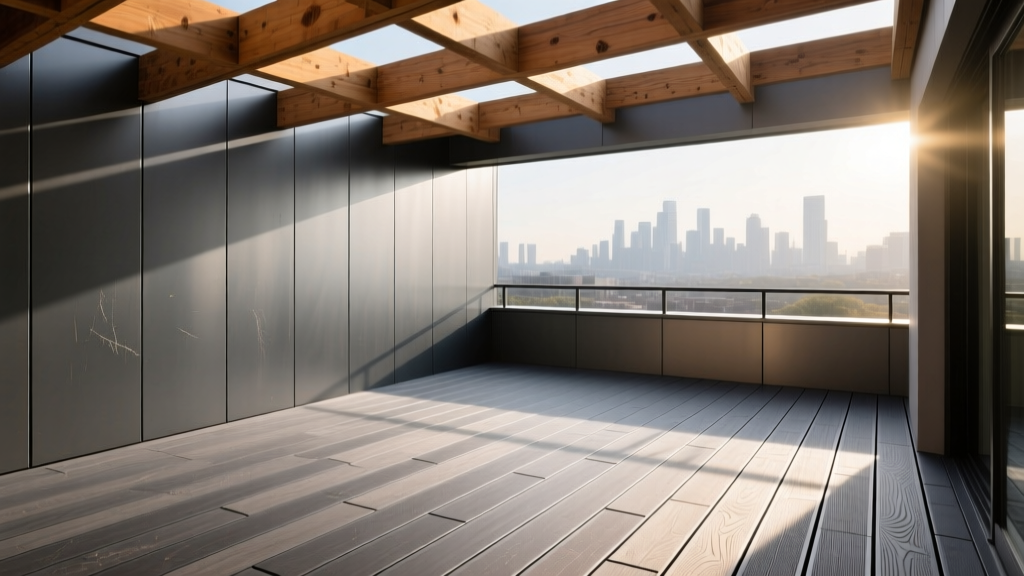
- Choose Extruded Aluminum When: The project involves a second-story balcony requiring a dry under-space, a rooftop deck where strict weight limits apply, or a marine environment (saltwater) where wood and steel fasteners rapidly degrade. The high upfront material cost is offset by zero maintenance and integrated drainage.
- Choose Cellular PVC When: The design requires complex routing, curved edges, or custom mitered picture-frame borders. PVC can be heat-formed and routed like wood, which is impossible with aluminum. It is also the optimal choice for historic district renovations where a traditional wood-grain aesthetic is mandated by local architectural boards.
- Choose Foamed-Core Composite When: You need a middle-ground solution that offers a 30% weight reduction over traditional WPC (allowing for easier handling and slightly wider spans) while maintaining the rigid, capped exterior shell that resists scratching and fading in high-traffic commercial applications.
By shifting the budgetary focus from the surface boards to the holistic structural system, builders can leverage lightweight decking materials to deliver premium, low-maintenance outdoor spaces without exceeding the baseline costs of heavy composite alternatives.
Written by
Sarah WhitfieldSarah Whitfield is a chartered quantity surveyor (MRICS) and construction cost analyst with 15 years of experience in material pricing, procurement strategy, and project budgeting. She earned her degree in Construction Management from the University of Reading (UK) and has worked on projects ranging from $2M custom homes to $180M mixed-use developments across North America and Europe. Sarah currently leads cost estimating for BuildMat Insight, maintaining a proprietary database of 4,000+ material price points updated quarterly. She is a frequent contributor to RSMeans cost data panels and has presented at the International Cost Engineering Council (ICEC) congress. Based in Denver, CO, Sarah is an avid trail runner and volunteer mentor for Women in Construction.
More from Sarah Whitfield
View all
Wood & Lumber
What Are the Different Types of Wood? A Builder's Guide
Compare structural softwoods, finish hardwoods, and engineered lumber. Analyze Janka ratings, MOE values, and 2026 pricing for construction.
Aug 4, 2026

Walls & Panels
Steel Framing vs Wood Framing: Corrosion and Moisture Defense
Compare steel framing vs wood framing for moisture resistance. Learn about galvanized coatings, condensation risks, and corrosion protection strategies.
Jul 21, 2026

Stone & Masonry
How to Cut Stone Veneer: Wet Saw vs Grinder Comparison
Compare the best tools for cutting stone veneer. We review wet saws, angle grinders, and chop saws to help you achieve clean, chip-free cuts.
Jul 21, 2026