Best Options for Flooring on Stairs: Durability Analysis
Analyze the most durable options for flooring on stairs. Compare hardwood, LVP, and tile based on impact resistance, nosing wear, and slip safety.

The Unique Stress Profile of Stair Treads
Staircases subject flooring materials to mechanical stresses that flat floors rarely encounter. A standard residential staircase experiences concentrated point loads on the nosing (the front edge of the tread) that can exceed three times the impact force of a standard footfall. When evaluating options for flooring on stairs, standard abrasion ratings (like the AC rating for laminate) are insufficient. You must analyze edge integrity, impact resistance, coefficient of friction, and substrate adhesion.
The primary failure modes for stair flooring include nosing delamination, edge chipping, adhesive shear failure, and surface wear concentrated on the first three treads of any flight. This analysis breaks down the structural durability of the top stair flooring materials, providing exact specifications required for long-term performance.
Durability Matrix: Stair Flooring Materials Compared
| Material | Nosing/Edge Integrity | Point-Load Impact Resistance | Slip Resistance (DCOF) | Expected Stair Lifespan |
|---|---|---|---|---|
| Solid Hardwood | Excellent (if solid bullnose) | High (Janka dependent) | 0.40 - 0.50 (varies by finish) | 25-40+ years (refinishable) |
| Engineered Hardwood | Poor to Fair (veneer chipping risk) | High (core dependent) | 0.40 - 0.50 | 15-25 years (limited refinish) |
| SPC Luxury Vinyl Plank | Excellent (with flush-mount caps) | Very High (rigid core) | 0.45 - 0.60 (textured) | 15-20 years |
| Porcelain Tile | Poor (high chip risk on edges) | Extreme (but brittle) | 0.50 - 0.70 (textured/matte) | 30+ years (grout/membrane fails first) |
| WPC Luxury Vinyl | Fair (overlap nosing can snap) | Moderate (prone to heel dents) | 0.45 - 0.60 | 10-15 years |
Deep Dive: Hardwood & Engineered Wood on Stairs
Hardwood remains the benchmark for stair durability, provided the correct species and nosing profiles are selected. The National Wood Flooring Association (NWFA) strictly advises against using MDF or plywood-core nosing pieces on stairs, as the veneer will inevitably chip under heel strikes.
Species Selection and Janka Hardness
For stairs, select species with a Janka hardness rating above 1,200 lbf. White Oak (1,360 lbf) and Hickory (1,820 lbf) are optimal. Avoid softwoods like Pine (380 lbf) or American Cherry (950 lbf), which will dent rapidly from pet claws and high heels. If using engineered wood, ensure the top wear layer is at least 3mm thick and features a solid-sawn face rather than a rotary-peeled veneer, which is prone to edge splintering.
Many manufacturers sell engineered stair nosings that consist of a thin veneer wrapped over an MDF core. Under concentrated point loads, the MDF compresses, causing the veneer to fracture. Always source solid hardwood nosing pieces, even if the rest of the staircase is engineered wood. Secure them with urethane construction adhesive and blind-nailed face fasteners.
Finish Durability: Site-Finished vs. Factory UV-Cured
While site-finished hardwood allows for seamless color matching, factory-applied UV-cured aluminum oxide finishes offer superior abrasion resistance. Aluminum oxide finishes routinely score over 3,000 cycles on the Taber Abraser test, significantly outlasting standard site-applied polyurethane (which typically fails around 1,000 to 1,500 cycles). For high-traffic residential stairs, prefinished solid treads with aluminum oxide coatings will delay the need for sanding and refinishing by a decade or more.
Deep Dive: Luxury Vinyl Plank (LVP/LVT) & Stair Caps
When evaluating vinyl options for flooring on stairs, the core composition and the nosing system dictate longevity. Flexible glue-down LVT is generally unsuitable for stair edges due to telegraphing and edge-lift. Rigid core vinyl is required.
SPC vs. WPC Core Density
Stone Plastic Composite (SPC) features a limestone-PVC core that is significantly denser than the wood-plastic composite (WPC) core. On stair treads, SPC resists the point-load denting caused by high heels or heavy furniture being carried up the stairs. WPC, while comfortable underfoot, will permanently dent under sustained edge pressure.
The Critical Role of Stair Caps
Never attempt to wrap standard LVP planks over a stair edge. The material will eventually snap or delaminate. You must use manufacturer-approved stair caps. There are two primary types:
- Overlap Nosing: The cap overlaps the tread plank. This is easier to install but creates a lip that catches dirt, shoe soles, and vacuum cleaners, leading to premature physical damage to the lip.
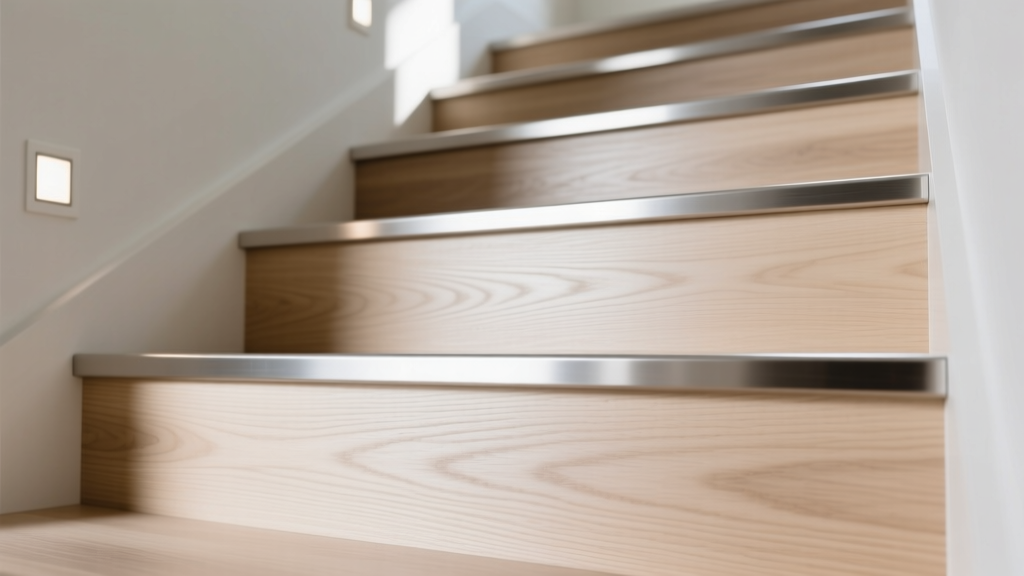
- Flush-Mount Nosing: The cap sits perfectly level with the tread plank, usually secured by a locking mechanism or heavy-duty adhesive. Flush-mount systems (such as those offered by Shaw or CoreTec) are vastly superior for durability and safety on stairs.
Ensure the wear layer on the LVP is a minimum of 20 mil (0.5mm) for residential stairs and 22 mil or higher for commercial applications. Anything less will wear through to the print layer within five years on the first three treads of the staircase.
Deep Dive: Porcelain Tile and Stone Treads
Tile offers unmatched scratch and impact resistance, but it introduces severe brittleness and slip hazards on stairs. The Tile Council of North America (TCNA) emphasizes that stair installations require absolute substrate rigidity to prevent deflection cracks.
Managing Point Loads and Edge Chipping
The leading edge of a tiled stair is highly susceptible to chipping. Standard bullnose tiles are often thinner at the curve and crack easily. The professional solution is to use specialized metal or PVC stair profiles, such as those manufactured by Schluter Systems (e.g., Schluter-TREP or Schluter-RODI). These profiles protect the tile edge from impact while providing a built-in anti-slip grip.
Slip Resistance Standards (ANSI A326.3)
Stair treads must meet strict slip-resistance criteria. According to the ANSI A326.3 standard, hard surface flooring in wet or potentially wet areas should achieve a Dynamic Coefficient of Friction (DCOF) of 0.42 or higher. For stairs, even in dry residential environments, targeting a DCOF of 0.50 or higher is recommended. Avoid polished porcelain or honed marble on stairs entirely; specify textured, matte, or structured-surface porcelain tiles to ensure adequate traction.
Wooden stair stringers and treads naturally flex. If installing porcelain tile, you must apply an uncoupling membrane (like Schluter-DITRA) or a liquid-applied anti-fracture membrane over the plywood treads before setting the tile with a polymer-modified thinset. Skipping this step will result in cracked tiles within the first year of use.
Adhesives and Fastening: The Hidden Durability Factor
The most durable flooring material will fail if the adhesive system degrades. Stair treads experience sheer forces every time a user pushes off the toe of the tread.
- Hardwood: Use a premium polyurethane construction adhesive (e.g., Loctite PL Premium) combined with 15-gauge finish nails or 2-inch wood screws driven through the subfloor into the stringers. Never rely on construction adhesive alone, and never use water-based adhesives that can cause the wood to cup.
- Rigid Core Vinyl: Follow the manufacturer's exact adhesive specification. Many SPC stair caps require a specific pressure-sensitive acrylic adhesive or a two-part epoxy. Using standard Liquid Nails on vinyl can cause chemical plasticizer migration, resulting in permanent staining and adhesive failure.
- Carpet (for contrast): If using carpet, ensure the tack strips are placed within 1/2 inch of the nosing edge, and use a high-density rebond pad (minimum 8 lbs, 7/16-inch thick) to prevent the carpet from bottoming out and wearing through the backing on the stair edge.
FAQ: Stair Flooring Edge Cases and Troubleshooting
Can I use standard laminate flooring on stairs?
It is highly discouraged. Laminate relies on a fiberboard core that swells when exposed to moisture (like wet shoes) and chips easily on the edges. While some manufacturers offer laminate stair nosing, the locking mechanisms on the edge of the tread are structurally weak and prone to snapping under heel strikes.
How do I fix a squeaky hardwood stair tread without ruining the finish?
Squeaks occur when the tread rubs against the riser or the stringer. If you have access from below (an unfinished basement), drive wood shims coated in carpenter's glue into the gaps between the tread and stringer, and secure the tread with 2-inch deck screws driven up through the stringer into the tread. If you only have top access, use a specialized breakaway screw kit (like Squeak-No-More) driven through the carpet or wood filler, though this will leave visible repair marks on bare hardwood.
What is the maximum allowable nosing overhang for safety?
According to the International Residential Code (IRC), the nosing projection (the overhang past the riser below) must be between 3/4 inch and 1 1/4 inches. Furthermore, the greatest nosing projection cannot exceed the smallest by more than 3/8 inch across the entire flight. Overhangs exceeding 1 1/4 inches create a tripping hazard and increase the leverage applied to the flooring edge, accelerating mechanical failure.
Written by
Marcus ChenMarcus Chen is a licensed structural engineer (PE) and building materials analyst with over 12 years of experience across residential, commercial, and industrial construction. He holds a Master of Science in Civil Engineering from UC Berkeley and spent six years at Thornton Tomasetti before transitioning to independent consulting and technical writing. Marcus specializes in material selection for seismic-prone regions, concrete reinforcement strategies, and lifecycle cost analysis. His work has been cited by the American Concrete Institute (ACI) and the Structural Engineers Association of California (SEAOC). When he is not on a job site or at his desk, you will find him hiking the Sierra Nevada or restoring a 1920s craftsman bungalow in Oakland, CA.
More from Marcus Chen
View all
Construction Cost
How Much Did the Eiffel Tower Cost to Build?
How much did the Eiffel Tower cost to build in 1889? We adjust for inflation and compare its budget to modern skyscraper construction.
Aug 4, 2026

Fire Resistance
What Is a Fire Resistant Material? Testing & Certification Guide
Discover what is a fire resistant material through ASTM and UL testing. Learn how fire ratings, certifications, and assemblies work in construction.
Aug 4, 2026

Construction Cost
How Much Did the Burj Khalifa Cost to Build?
How much did the Burj Khalifa cost to build? We break down the $1.5B project and extract 5 money-saving strategies for your next build.
Jul 30, 2026