How Much Does It Cost to Repair a Cracked Foundation in 2026?
Discover exactly how much it costs to repair a cracked foundation in 2026. Breakdowns for epoxy, carbon fiber, and pier installations.

The True Cost of Foundation Cracks: 2026 Pricing Matrix
When homeowners ask how much it costs to repair a cracked foundation, the answer depends entirely on the crack's morphology, the underlying soil mechanics, and the structural load of the building. A simple shrinkage crack might require a $400 polyurethane injection, while a differential settlement issue demanding helical piers can easily exceed $15,000. Understanding the specific repair methodology required for your foundation type is the first step in budgeting accurately.
| Repair Method | Best Application | 2026 Average Cost Range | Expected Lifespan |
|---|---|---|---|
| Epoxy Injection (ASTM C881) | Non-moving structural cracks in poured concrete | $450 - $900 per crack | Permanent (if soil stabilizes) |
| Polyurethane Foam Injection | Active leaking hairline cracks (<1/8 inch) | $350 - $750 per crack | 10 - 15 years |
| Carbon Fiber Straps | Minor wall bowing (<2 inches inward) | $400 - $800 per strap (4-6 needed) | Permanent |
| Steel Wall Anchors / Braces | Moderate to severe wall bowing (2-4 inches) | $600 - $1,100 per anchor | Permanent |
| Helical Piers (ICC-ES AC358) | Differential settlement, sinking footings | $1,800 - $2,800 per pier | Permanent (75+ years) |
| Polyurethane Slab Jacking | Sunken concrete slab foundations | $5 - $25 per square foot | 10 - 20 years |
Diagnosing the Crack: Why Morphology Dictates Price
Not all cracks are created equal. The International Association of Certified Home Inspectors (InterNACHI) categorizes foundation cracks by their orientation and width, which directly correlates to the failure mode and subsequent repair cost.
Vertical & Hairline Shrinkage Cracks
Vertical cracks that taper from bottom to top and measure less than 1/8-inch wide are typically shrinkage cracks caused by the initial curing of poured concrete. While rarely a structural threat, they are primary conduits for water intrusion. Repairing these involves routing the crack and injecting a flexible, hydrophobic polyurethane resin. Because the crack may still experience minor thermal expansion and contraction, rigid epoxy is contraindicated here. The low material cost and rapid cure time keep this repair at the lower end of the pricing spectrum.
Diagonal & Stair-Step Cracks
Diagonal cracks running at a 30- to 75-degree angle, or stair-step cracks in CMU (concrete masonry unit) and brick foundations, indicate differential settlement. One side of the foundation is sinking faster than the other. According to the University of Minnesota Extension, these cracks require immediate structural evaluation. Simply sealing the crack is a cosmetic band-aid; the underlying soil must be stabilized. This usually necessitates the installation of helical piers or push piers driven down to load-bearing strata, significantly elevating the project cost into the five-figure range.
Horizontal Cracks & Wall Bowing
Horizontal cracks in basement walls are the most severe indicator of structural distress, typically caused by lateral hydrostatic pressure from expansive, water-saturated soils pushing against the foundation. If the wall is bowing inward less than two inches, carbon fiber straps (such as Simpson Strong-Tie FX-70 systems) epoxied to the wall can halt further movement. If the deflection exceeds two inches, the carbon fiber will snap under the tensile load, requiring heavy-duty steel I-beam braces or exterior wall anchors to physically pull the wall back to plumb.
Many contractors suggest monitoring a horizontal crack for six months to see if it 'stabilizes.' In expansive clay soils, hydrostatic pressure increases exponentially with moisture. Waiting often allows a 2-inch bow to become a 4-inch bow, pushing the repair requirement from $2,000 in carbon fiber to $8,000 in steel anchors and exterior excavation.
Hidden Cost Variables That Inflate Your Bill
The base price per pier or per strap rarely tells the whole financial story. When calculating how much it costs to repair a cracked foundation, you must factor in site-specific variables that contractors will include in their final change orders.
- Geotechnical Engineering Reports ($400 - $800): For settlement issues, reputable contractors will require a soil analysis to determine the depth of the load-bearing strata before quoting pier depths.
- Exterior Excavation & Landscaping ($1,500 - $4,000): If horizontal cracks require exterior waterproofing membranes or wall anchor plates, heavy machinery must excavate the perimeter. Restoring hardscaping, decks, or HVAC units located near the foundation adds substantial labor costs.
- Interior Finishing Demolition ($500 - $2,000): Basement drywall, insulation, and subflooring must be removed to expose the bare concrete for carbon fiber installation or interior pier brackets.
- Municipal Permits ($150 - $500): Structural alterations, particularly underpinning with helical piers, require engineering stamps and municipal inspections in most jurisdictions.
DIY vs. Professional Repair: A Financial Decision Framework
The market is flooded with DIY foundation repair kits, but misapplying these products can lead to catastrophic structural failure. Use this framework to determine when to self-repair and when to hire a licensed structural contractor.
When DIY is Financially Sound
If the crack is strictly vertical, less than 1/16-inch wide, shows no signs of lateral displacement (one side is not pushed forward of the other), and is only leaking water during heavy rain, a DIY polyurethane injection kit (like those from RadonSeal or Sika) costing $80 to $150 is highly effective. These kits use low-pressure ports that adequately fill non-structural shrinkage voids.
When Professional Intervention is Mandatory
If you observe any of the following, DIY repairs are not just ineffective; they are dangerous because they mask symptoms of active structural failure:
- Cracks wider than 1/4-inch.
- Horizontal cracks of any width.
- Doors and windows on the floors above the foundation that stick or fail to latch.
- Diagonal drywall cracks emanating from the corners of interior door frames.
- Visible gaps between the baseboards and the floor.
Do not accept a quote from a contractor who diagnoses a settlement issue without using a laser level or water level to measure the exact variance in the foundation's elevation. Furthermore, ensure their proposed helical piers are ICC-ES evaluated (such as Chance or Atlas brands) rather than untested, locally fabricated steel pipes.
Step-by-Step: What to Expect During a Professional Assessment
Understanding the assessment process helps you gauge the competence of the contractor and ensures you aren't being upsold on unnecessary repairs.
- Elevation Mapping: The technician uses a digital water level to map the floor slab or foundation stem wall, creating a topographical map of the settlement. This identifies the exact 'hinge point' of the crack.
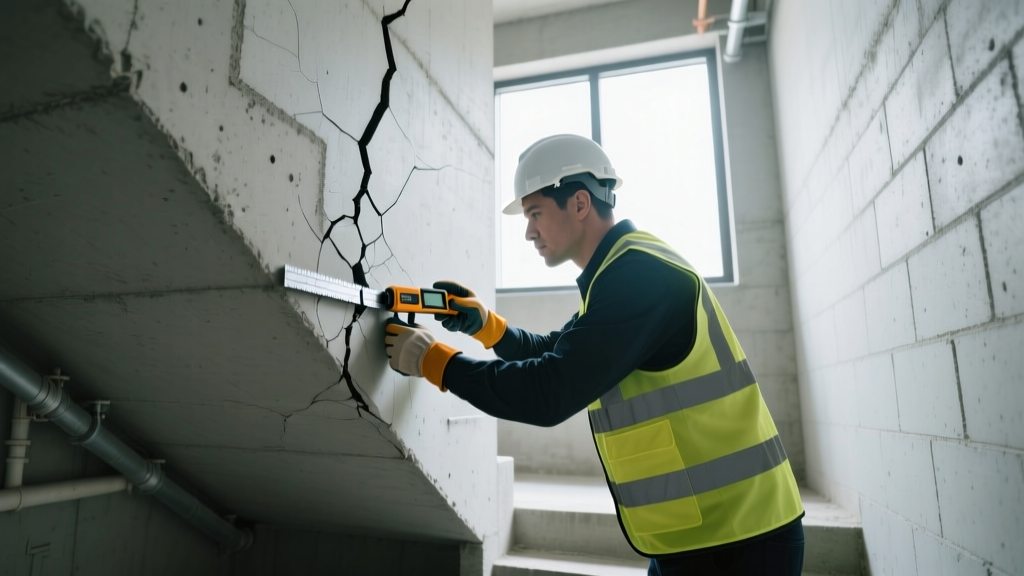
- Crack Gauge Measurement: Digital calipers measure the exact width and depth of the crack to determine if it is active (widening over time) or dormant.
- Hydrostatic Pressure Evaluation: The inspector checks exterior grading, gutter downspout extensions, and the presence of French drains to determine if water management is the root cause of the soil expansion.
- Load Calculation: For piering projects, the contractor calculates the dead and live load of the structure to determine the number of piers required and the hydraulic pressure needed to lift the foundation without cracking the interior drywall.
Frequently Asked Questions
Does homeowners insurance cover cracked foundation repair?
In almost all cases, no. Standard HO-3 policies exclude damage caused by earth movement, soil settlement, and hydrostatic pressure. The only exception is if the crack was the direct, sudden result of a covered peril, such as a vehicle crashing into the foundation or a sudden, accidental plumbing leak that washed away the supporting soil (though plumbing exclusions often apply to long-term, slow leaks).
Can I sell a house with a repaired foundation?
Yes, and a professionally repaired foundation with a transferable, lifetime warranty often sells better than a house with an unrepaired, active crack. Buyers and their lenders require structural integrity. Providing the engineering report, the contractor's warranty, and municipal permit sign-offs will satisfy most underwriting requirements.
How long does a typical foundation repair take?
Epoxy and polyurethane crack injections are completed in a single day. Carbon fiber strap installations take 1 to 2 days, including surface preparation and epoxy curing time. Helical pier underpinning for an average single-family home typically requires 3 to 5 days of heavy equipment work, followed by 1 day of interior concrete patching and cleanup.
Written by
Elena RodriguezElena Rodriguez is a civil engineer and technical writer specializing in concrete technology, masonry systems, and ASTM/ACI compliance. She earned her B.S. in Civil Engineering from Texas A&M University and spent a decade at a materials testing laboratory, performing over 2,000 concrete compressive strength tests and masonry prism evaluations. Elena is an ACI-certified Field Testing Technician (Grade I) and a member of ASTM Committee C12 on Natural Building Stone. She currently consults on forensic engineering cases involving concrete failures and moisture intrusion. Based in San Antonio, TX, Elena is a proud member of the Society of Women Engineers (SWE) and coaches her daughter's FIRST Robotics team.
More from Elena Rodriguez
View all
Walls & Panels
Cost Analysis: Light Gauge Steel Framing Advantages and Disadvantages
Evaluate light gauge steel framing advantages and disadvantages through a strict cost analysis lens, comparing material, labor, and lifecycle expenses.
Aug 4, 2026

Walls & Panels
Gypsum Board Types: Exact Specifications, Thickness & Dimensions
Compare standard, Type X, and moisture-resistant gypsum board types. Get exact specifications, thicknesses, dimensions, and ASTM standards for your project.
Aug 4, 2026

Fire Resistance
Best Fire-Resistant Outdoor Decking Materials: 2026 Buyer Guide
Discover the best fire-resistant outdoor decking materials for 2026. Compare Class A PVC, aluminum, and hardwood options for WUI compliance and safety.
Aug 4, 2026