Sourcing Foundation Building Materials in Oxnard: 2026 Guide
Discover the best foundation building materials Oxnard builders use in 2026 to combat coastal sulfates, expansive clays, and high water tables.

Oxnard’s Geotechnical Profile: Why Standard Materials Fail
Sourcing the correct foundation building materials Oxnard projects require is not a one-size-fits-all endeavor. Situated between the Pacific Ocean and the Santa Clara River Valley, Oxnard presents a highly complex geotechnical environment. Builders who default to standard American Concrete Institute (ACI) 318 baseline specifications often face premature foundation degradation due to three distinct local soil threats: marine-deposited sulfates, high water tables, and expansive clays.
Essential Foundation Building Materials for Oxnard Projects
To ensure structural longevity in 2026, contractors and homeowners must specify materials engineered to resist local chemical and mechanical stressors. Below is the definitive specification guide for Oxnard foundation systems.
1. Concrete Mixes: Type V and Low w/cm Ratios
Oxnard’s western and central zones contain high concentrations of water-soluble sulfates, a byproduct of historical marine deposits and decades of agricultural fertilization. When sulfates react with the tricalcium aluminate (C3A) in standard Portland cement, they form ettringite—a compound that expands and causes severe concrete spalling. For a comprehensive breakdown of this chemical reaction, refer to the Portland Cement Association’s guidelines on sulfate attack.
- West Oxnard / Harbor Zone: Specify Type V (High Sulfate Resistant) Portland cement. Limit the water-cementitious materials ratio (w/cm) to a maximum of 0.42 to reduce permeability.
- Central / Transitional Zone: Type II (Moderate Sulfate Resistant) is acceptable, provided the w/cm ratio does not exceed 0.45.
- Compressive Strength: Minimum 3,500 psi at 28 days for all continuous footings; 4,000 psi for elevated structural slabs.
2. Corrosion-Resistant Reinforcement
Properties within 1.5 miles of the Oxnard coastline or the Channel Islands Harbor are subject to airborne chloride ingress. Standard black rebar (ASTM A615) will oxidize, expanding up to seven times its original volume and blowing out the concrete cover.
- Epoxy-Coated Rebar (ASTM A775): The baseline requirement for coastal Oxnard. Ensure the epoxy coating is a minimum of 7 mils thick and that all cut ends are sealed with an approved epoxy patching material on-site.
- GFRP Rebar (Glass Fiber Reinforced Polymer): For high-end coastal builds or seawall-adjacent properties, Aslan 100 or equivalent GFRP rebar eliminates chloride-induced corrosion entirely. It is non-magnetic and non-conductive, though it requires specialized bending and tying protocols.
3. High-Performance Vapor Barriers
Oxnard’s high water table, particularly in the Riverpark and western residential tracts, generates significant hydrostatic pressure and moisture vapor transmission (MVT). A standard 6-mil polyethylene sheet is entirely insufficient and frequently punctured during rebar tying.
- Specification: 15-mil to 20-mil cross-laminated polyethylene (e.g., Stego Wrap or Fortifiber MemBrain).
- Permeance: Must meet ASTM E1745 Class A requirements (less than 0.01 perms).
- Seaming: All overlaps must be a minimum of 6 inches, sealed with manufacturer-approved acrylic or butyl tape, not standard duct tape.
Material Specification Matrix for Oxnard Zones
| Geographic Zone | Primary Soil Threat | Concrete Spec | Reinforcement Spec | Vapor / Moisture Control |
|---|---|---|---|---|
| West / Coastal | Chlorides, High Water Table | Type V, 4000 psi, 0.42 w/cm | GFRP or ASTM A775 Epoxy | 20-mil Cross-laminated + Sub-slab depressurization |
| Central / Ag-Belt | Sulfates, Organic Peat Pockets | Type V, 3500 psi, 0.45 w/cm | ASTM A775 Epoxy-Coated | 15-mil Poly + Capillary break (4-inch crushed rock) |
| East / Inland | Expansive Clay (Swell Potential) | Type II, 3500 psi, 0.45 w/cm | Grade 60 Black Rebar (ASTM A615) | 10-mil Poly + Perimeter moisture control systems |
Deep Foundation Alternatives for Expansive Soils
In eastern Oxnard and the fringes bordering Camarillo, the soil transitions into highly expansive clays capable of 3% to 5% volumetric strain. Standard shallow slab-on-grade foundations will experience differential settlement and severe center-lift or edge-drop cracking. When sourcing foundation building materials Oxnard engineers recommend for these zones, deep foundation elements become mandatory.
Drilled Caissons vs. Helical Piers
Drilled Caissons
Best for: New construction in East Oxnard with heavy structural loads.
Specs: 18-inch to 24-inch diameter shafts drilled 20+ feet into the stable Camarillo Formation. Requires a 4-inch to 6-inch void form (e.g., Sonotube or wax-impregnated cardboard) beneath the grade beam to accommodate clay swell without lifting the structure.
Helical Piers
Best for: Foundation repairs, retrofits, or tight-access infill lots.
Specs: Square shaft or round shaft helical piles (e.g., Chance or MacLean Dixie) torqued to refusal. The torque-to-capacity correlation allows real-time verification of load-bearing capacity without waiting for concrete cure times.
Navigating Local Supply Chains and Batch Plant Logistics
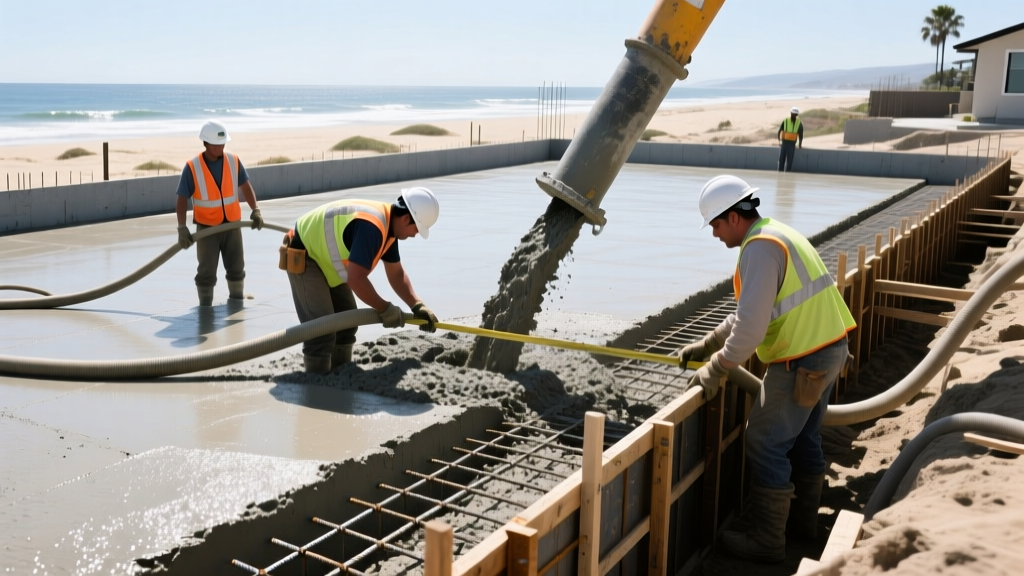
Sourcing materials is only half the battle; logistics in Oxnard dictate the success of a foundation pour. The local ready-mix supply chain is anchored by major batch plants along the Ventura Freeway (US-101) corridor and Del Norte Boulevard.
Logistics Tip for 2026: When ordering Type V sulfate-resistant concrete, batch plants require a 48-hour advance notice. Type V cement is not kept in standard daily hoppers due to lower demand volume compared to Type I/II. Failing to pre-order will result in trucks arriving with standard mix, forcing an expensive rejection at the site.
Furthermore, Oxnard’s summer microclimate features morning marine layer fog followed by rapid temperature spikes. If pouring between July and October, specify a set-retarding admixture (such as MasterSet DELVO) to extend the slump life. This prevents cold joints if concrete trucks are delayed by traffic on Oxnard Boulevard or Rice Avenue.
2026 Cost Estimates for Coastal Foundation Upgrades
Upgrading from baseline code-minimum materials to Oxnard-optimized specifications impacts the overall foundation budget. Below are the current regional cost premiums for 2026:
- Type V Cement Premium: +$18 to +$25 per cubic yard over standard Type I/II mixes.
- Epoxy-Coated Rebar (ASTM A775): +$0.35 to +$0.50 per linear foot compared to black rebar.
- GFRP Rebar: +$1.20 to +$1.80 per linear foot (requires specialized labor and ties, adding roughly 15% to total rebar installation costs).
- 20-mil Cross-Laminated Vapor Barrier: +$0.85 to +$1.10 per square foot installed, including taped seams and pipe boots.
- Void Forms for Grade Beams: +$4.50 per linear foot for 12-inch wax-impregnated void forms in expansive soil zones.
Common Mistakes When Sourcing Locally
Even experienced out-of-town contractors make critical errors when procuring foundation building materials Oxnard sites demand. Avoid these frequent pitfalls:
- Ignoring the Geotechnical Report’s Sulfate Section: Relying on a generic Ventura County soil map instead of the site-specific borings. Sulfate levels can vary drastically across a single half-acre lot near historical agricultural drains.
- Using Standard Rebar Chairs: Plastic or standard steel bar chairs can compromise the epoxy coating on rebar or create a direct corrosion pathway to the soil. Always specify concrete-tipped or heavy-duty plastic chairs with a minimum 3-inch clearance to the subgrade.
- Undersizing the Capillary Break: The FEMA Coastal Construction Manual mandates strict moisture control for coastal zones. A 2-inch gravel layer is insufficient; Oxnard’s high water table requires a minimum 4-inch layer of washed, angular 3/4-inch crushed rock beneath the vapor barrier to break capillary suction.
By aligning material specifications with Oxnard’s unique coastal, agricultural, and expansive soil profiles, builders can eliminate premature foundation failure, ensure compliance with strict California Building Code overlays, and deliver structures engineered to withstand the local environment for decades.
Written by
Elena RodriguezElena Rodriguez is a civil engineer and technical writer specializing in concrete technology, masonry systems, and ASTM/ACI compliance. She earned her B.S. in Civil Engineering from Texas A&M University and spent a decade at a materials testing laboratory, performing over 2,000 concrete compressive strength tests and masonry prism evaluations. Elena is an ACI-certified Field Testing Technician (Grade I) and a member of ASTM Committee C12 on Natural Building Stone. She currently consults on forensic engineering cases involving concrete failures and moisture intrusion. Based in San Antonio, TX, Elena is a proud member of the Society of Women Engineers (SWE) and coaches her daughter's FIRST Robotics team.
More from Elena Rodriguez
View all
Walls & Panels
Cost Analysis: Light Gauge Steel Framing Advantages and Disadvantages
Evaluate light gauge steel framing advantages and disadvantages through a strict cost analysis lens, comparing material, labor, and lifecycle expenses.
Aug 4, 2026

Walls & Panels
Gypsum Board Types: Exact Specifications, Thickness & Dimensions
Compare standard, Type X, and moisture-resistant gypsum board types. Get exact specifications, thicknesses, dimensions, and ASTM standards for your project.
Aug 4, 2026

Fire Resistance
Best Fire-Resistant Outdoor Decking Materials: 2026 Buyer Guide
Discover the best fire-resistant outdoor decking materials for 2026. Compare Class A PVC, aluminum, and hardwood options for WUI compliance and safety.
Aug 4, 2026