Foundation Building Materials Leak Risks: Poured vs Block vs ICF
Compare foundation building materials leak risks across poured concrete, CMU block, and ICF. Includes waterproofing costs, failure modes, and repair specs.
The Physics of Below-Grade Water Intrusion
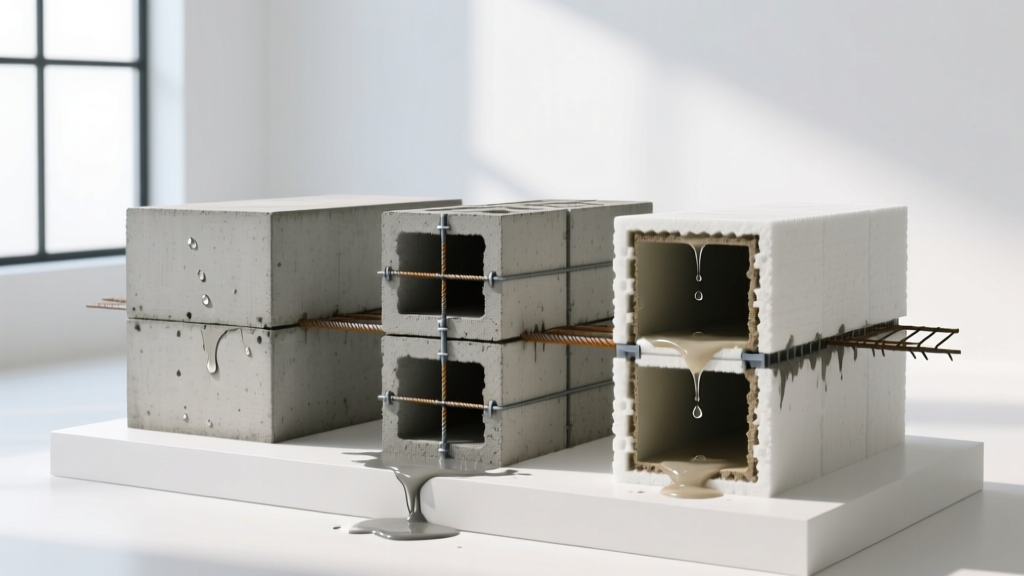
Water does not merely seep into below-grade structures; it is forced in by hydrostatic pressure. For every foot of water head, pressure increases by 0.433 psi. In regions with high water tables or dense clay soils, a foundation wall can face thousands of pounds of lateral hydraulic force. When evaluating modern construction assemblies, analyzing the foundation building materials leak vulnerabilities of the three dominant systems—poured concrete, Concrete Masonry Units (CMU), and Insulated Concrete Forms (ICF)—reveals that no material is inherently waterproof. According to the Building Science Corporation, managing below-grade water requires a multi-tiered approach that accounts for the specific physical failure modes of the chosen wall assembly.
Rather than relying on the structural mass to stop water, builders must match the correct exterior membrane, drainage plane, and interior management system to the specific leak vectors inherent to each material type. Below, we break down the exact failure points, required preparatory work, and 2026 waterproofing costs for each foundation system.
Poured Concrete: Cold Joints and Shrinkage Vectors
Poured concrete is often assumed to be a monolithic, water-tight barrier. In reality, the chemical process of hydration and the physical realities of forming create distinct pathways for water intrusion.
Primary Leak Vectors
- Shrinkage Cracks: As concrete cures, it loses moisture and undergoes thermal contraction. This typically results in vertical shrinkage cracks ranging from 0.010 to 0.016 inches wide within the first 30 days. While structurally benign, these micro-fissures easily wick water under hydrostatic pressure.
- Cold Joints: The intersection where the wall pour meets the previously cured footing creates a "cold joint." Without a continuous waterstop (such as a PVC or bentonite strip) embedded during the pour, this horizontal seam becomes a primary conduit for groundwater.
- Form Tie Holes: Snap ties used to hold aluminum or plywood forms together leave 1-inch diameter voids through the wall. If the plastic cones are not knocked back at least 1 inch and patched with hydraulic cement, water will track directly through these penetrations.
CMU Block Foundations: The Mortar Joint Matrix
Concrete block foundations are highly susceptible to water intrusion due to their segmented nature. A standard 8x8x16 inch CMU wall contains hundreds of linear feet of mortar joints, each representing a potential failure point.
Primary Leak Vectors
The primary vulnerability lies in the mortar joints. Type N mortar, often used in above-grade masonry, lacks the compressive strength and bond integrity required for below-grade lateral soil pressure. As the soil expands during freeze-thaw cycles or heavy saturation, the wall experiences micro-deflection. This breaks the bond between the mortar and the block, creating hairline separations.
Furthermore, the hollow cores of standard CMU blocks act as concealed water reservoirs. If water breaches the exterior face shell, it fills the cells and eventually finds a path through the interior face shell or mortar joints. The FEMA Coastal Construction Manual explicitly mandates that CMU foundations in high-hazard zones be fully grouted or feature robust exterior parging to eliminate these internal reservoirs.
Required Preparatory Work
Before applying any peel-and-stick or fluid-applied membrane to a CMU wall, the surface must receive a 3/8-inch parging coat of Type S Portland cement mortar. This creates a smooth, continuous substrate. Applying a rubberized asphalt membrane directly over the rough, porous surface of raw CMU will result in membrane bridging, pinholes, and eventual adhesive failure.
Insulated Concrete Forms (ICF): The Hidden Moisture Path
ICF systems utilize expanded polystyrene (EPS) or extruded polystyrene (XPS) foam forms that remain in place after the concrete core is poured. While the EPS foam itself is impervious to rot and does not absorb liquid water, it introduces a unique leak diagnostic challenge.
Primary Leak Vectors
The EPS panels are typically permeable to water vapor (ranging from 2.0 to 5.0 perms) but will allow liquid water to travel laterally behind the foam if the exterior waterproofing membrane is breached. Because the foam acts as a protective shield, water entering through a compromised membrane seam will travel along the exterior face of the concrete core, often entering the living space several feet away from the actual membrane breach.
Additionally, the plastic webbing ties that hold the ICF blocks together penetrate the exterior foam. If the exterior membrane is not meticulously detailed around these ties, or if the foam seams are left unsealed, hydrostatic pressure will force water behind the insulation layer.
Comparative Matrix: Leak Susceptibility and Waterproofing Costs
The following matrix outlines the specific waterproofing requirements and current material costs for each foundation type in 2026.
| Material Type | Primary Leak Vector | Required Substrate Prep | Recommended Membrane | Avg. Installed Cost (per sq. ft.) |
|---|---|---|---|---|
| Poured Concrete | Shrinkage cracks, cold joints | Patch tie holes, grind fins | Peel-and-stick rubberized asphalt | $5.50 - $7.25 |
| CMU Block | Mortar joint separation, hollow cores | 3/8" Type S parging coat | Fluid-applied polyurethane or Bentonite | $6.80 - $9.50 |
| ICF | Foam seams, lateral tracking | Seam tape, spray foam gaps | Self-adhered modified bitumen (compatible with EPS) | $4.75 - $6.00 |
Advanced Waterproofing Systems by Material Type
Selecting the correct membrane chemistry is critical to preventing material-specific failures.
1. Rubberized Asphalt (Peel-and-Stick)
Products like Tremco Paraseal or Polyguard 650 XT feature a high-density polyethylene (HDPE) cross-laminated film backed by rubberized asphalt. This is the gold standard for poured concrete. The HDPE provides puncture resistance during backfilling, while the asphalt adhesive self-seals around minor shrinkage cracks. It requires a primer coat and must be installed at temperatures above 40°F (4°C).
2. Sodium Bentonite Clay Panels
Products such as CETCO Voltex consist of sodium bentonite clay sandwiched between geotextiles. When exposed to moisture, the clay swells to 15 times its dry volume, forming an impermeable gel. This is highly effective for CMU block foundations because it can be installed directly over the rough block surface without a parging coat, provided the joints are flush and free of major voids. It is also ideal for blind-side waterproofing where the membrane is placed against the shoring before the block is laid.
3. Fluid-Applied Polyurethane
For complex geometries or ICF systems where adhesive compatibility with EPS foam is a concern, fluid-applied elastomeric polyurethane (such as Tremco AlphaGuard) provides a seamless, monolithic coating. It cures into a flexible rubber membrane that bridges foam seams and accommodates thermal expansion without tearing.
Diagnostic Decision Tree: Tracing the Leak Source
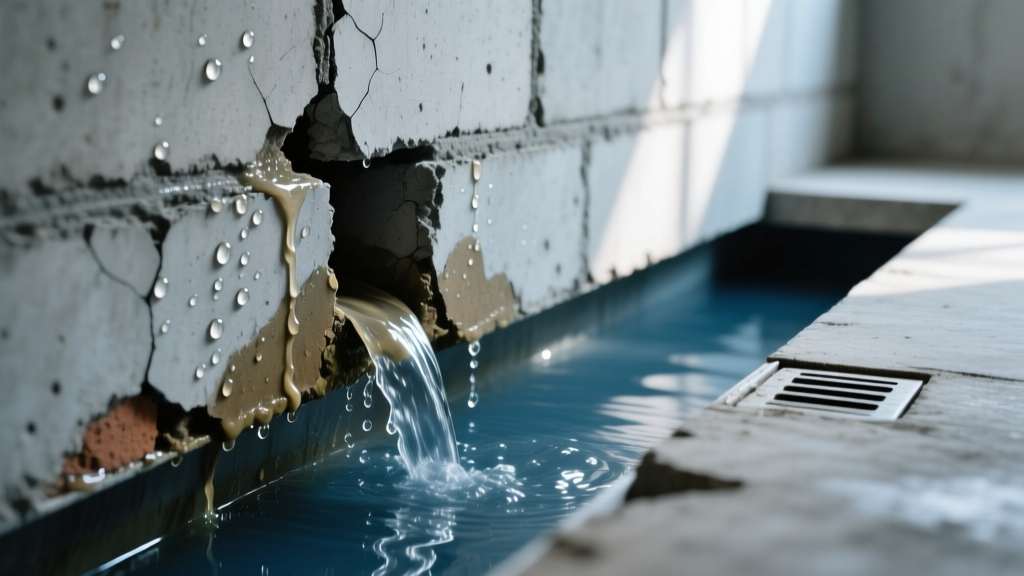
When a foundation leak occurs, identifying the entry point requires a systematic approach based on the wall material:
- Observe the Water Profile: Is the water entering at the floor-to-wall joint (cove joint), mid-wall, or through the top of the wall?
- For Poured Concrete Mid-Wall Leaks: Inspect for vertical shrinkage cracks. If the crack is dry on the surface but damp behind the drywall, the exterior membrane has likely delaminated or ruptured at that specific elevation. Injection with hydrophobic polyurethane resin is the standard interior repair.
- For CMU Block Mid-Wall Leaks: Check the mortar joints. If water is weeping from multiple horizontal joints simultaneously, the exterior parging has failed, and the block cores are fully saturated. Interior French drains and weep hole drilling are required to relieve hydrostatic pressure.
- For ICF Leaks: Water entering at the baseboard may have originated from a breach near the top of the wall, tracking down behind the EPS foam. You must excavate the exterior to inspect the membrane seams and foam tie penetrations, as interior sealing will only trap water inside the wall assembly.
Final Specification Guidelines for Architects and Builders
"No foundation material is immune to hydrostatic pressure. The goal of below-grade design is not to build a submarine, but to build a system that safely manages and redirects water away from the structural assembly before it can exploit material-specific vulnerabilities. Always pair your chosen wall material with a drainage board (dimple mat) and a properly sloped footing drain to relieve hydrostatic head pressure."
By understanding the distinct leak profiles of poured concrete, CMU block, and ICF systems, construction professionals can specify the exact preparatory steps and membrane chemistries required to ensure a dry, durable below-grade environment. Always verify local building codes regarding minimum waterproofing versus damp-proofing requirements, particularly in areas designated with expansive soils or high seasonal water tables.
Written by
Elena RodriguezElena Rodriguez is a civil engineer and technical writer specializing in concrete technology, masonry systems, and ASTM/ACI compliance. She earned her B.S. in Civil Engineering from Texas A&M University and spent a decade at a materials testing laboratory, performing over 2,000 concrete compressive strength tests and masonry prism evaluations. Elena is an ACI-certified Field Testing Technician (Grade I) and a member of ASTM Committee C12 on Natural Building Stone. She currently consults on forensic engineering cases involving concrete failures and moisture intrusion. Based in San Antonio, TX, Elena is a proud member of the Society of Women Engineers (SWE) and coaches her daughter's FIRST Robotics team.
More from Elena Rodriguez
View all
Walls & Panels
Cost Analysis: Light Gauge Steel Framing Advantages and Disadvantages
Evaluate light gauge steel framing advantages and disadvantages through a strict cost analysis lens, comparing material, labor, and lifecycle expenses.
Aug 4, 2026

Walls & Panels
Gypsum Board Types: Exact Specifications, Thickness & Dimensions
Compare standard, Type X, and moisture-resistant gypsum board types. Get exact specifications, thicknesses, dimensions, and ASTM standards for your project.
Aug 4, 2026

Fire Resistance
Best Fire-Resistant Outdoor Decking Materials: 2026 Buyer Guide
Discover the best fire-resistant outdoor decking materials for 2026. Compare Class A PVC, aluminum, and hardwood options for WUI compliance and safety.
Aug 4, 2026