Epoxy Injection Foundation Crack Repair Cost & Selection Guide
Evaluate epoxy injection foundation crack repair cost with our selection framework. Compare DIY vs pro pricing, materials, and structural ROI.

The Economics of Structural Crack Repair
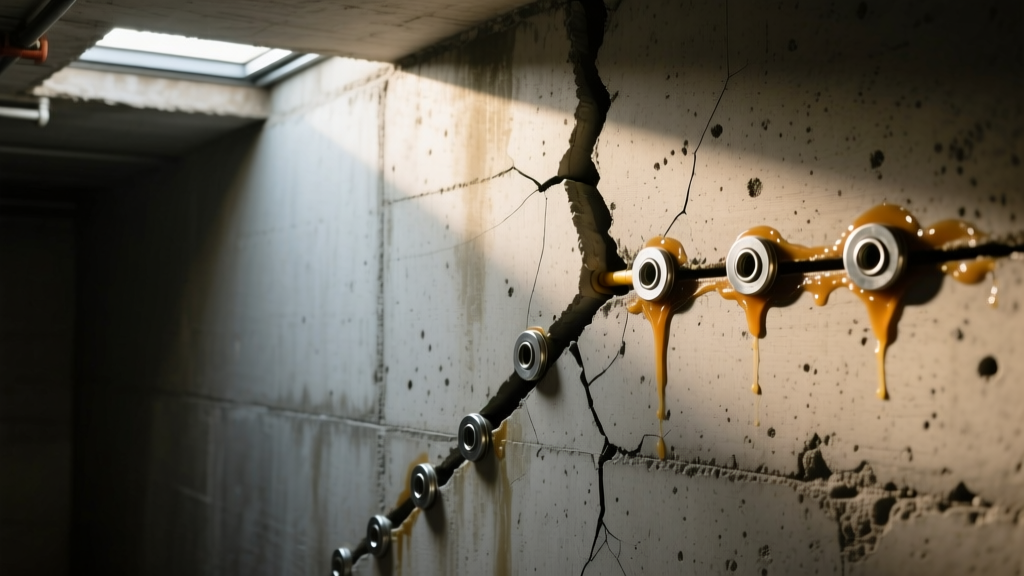
When a poured concrete foundation develops a crack, the immediate concern is structural integrity and water intrusion. However, the financial implications of the repair method chosen dictate long-term return on investment. Understanding the true epoxy injection foundation crack repair cost requires moving beyond superficial quotes and analyzing the material science, labor variables, and structural outcomes. Epoxy injection is not a universal fix; it is a highly specific structural welding technique designed to restore the monolithic tensile strength of concrete.
The national average for professional epoxy injection ranges from $350 to $850 per crack, typically translating to $15 to $25 per linear foot. However, this pricing model is heavily influenced by crack morphology, accessibility, and the required surface preparation. Contractors generally enforce a minimum call-out fee of $250 to $350, meaning a single 3-foot crack will carry a disproportionately high cost per foot compared to a continuous 20-foot fissure.
Quick Cost Snapshot: Professional vs. DIY
- Professional Structural Epoxy: $350 - $850 per crack (Includes surface routing, port installation, high-pressure injection, and port removal).
- Professional Polyurethane (Water-stop only): $250 - $600 per crack (Lower material cost, faster cure time, but zero structural restoration).
- DIY Low-Pressure Epoxy Kits: $80 - $160 per kit (Covers 10-15 linear feet of 1/16-inch cracks; requires significant manual labor and surface sealing precision).
Material Science: Why Epoxy Commands a Premium
To evaluate cost-effectiveness, you must understand what you are purchasing. Structural epoxies used in foundation repair, such as Sikadur 52 or Emecole 102, are governed by ASTM C881 standards. Specifically, foundation repair requires Type I, Grade 1, Class B or C epoxies. These formulations possess a tensile strength exceeding 7,000 psi, which is inherently stronger than the 3,000 to 4,000 psi tensile strength of the surrounding concrete matrix.
When injected correctly, the epoxy does not merely fill the void; it fuses the two severed halves of the foundation wall back together. If the wall experiences future thermal expansion or soil settlement, the concrete adjacent to the repair will fail before the epoxy joint itself. This permanent structural restoration is why epoxy injection foundation crack repair cost is higher than flexible sealants, yet vastly more cost-effective than exterior excavation and membrane replacement, which can exceed $10,000.
Viscosity and Crack Width Constraints
The cost of the repair is directly tied to the viscosity of the epoxy required. Hairline cracks (less than 1/16 inch) require ultra-low viscosity epoxies (200-500 centipoise) and high-pressure injection pumps (up to 3,000 psi) to force the resin into the capillary network of the fissure. Wider cracks (1/8 to 1/4 inch) can utilize thicker, paste-like epoxies applied via low-pressure DIY kits. Attempting to use a low-pressure DIY kit on a hairline crack will result in superficial sealing, leaving the deep structural void unfilled and leading to guaranteed failure.
Epoxy vs. Polyurethane: A Cost-Benefit Matrix
A common error in foundation repair selection is conflating epoxy (structural) with polyurethane (waterproofing). Selecting the wrong material based on a misunderstanding of the crack's behavior is the primary cause of repair failure. Use the following matrix to align your financial investment with the physical reality of the crack.
| Feature | Structural Epoxy Injection | Polyurethane Foam Injection |
|---|---|---|
| Primary Function | Restores monolithic structural strength | Creates a flexible, watertight seal |
| Tensile Strength | 7,000+ psi (Rigid) | < 50 psi (Highly Flexible) |
| Moisture Tolerance | Fails if injected into active water leaks | Reacts with water to expand and seal |
| Avg. Professional Cost | $450 - $850 per crack | $250 - $500 per crack |
| Ideal Crack Type | Dry, dormant shrinkage or settlement cracks | Active, leaking cracks subject to movement |
The Epoxy Selection Decision Tree
Do not commit to an epoxy injection foundation crack repair cost without running the fissure through this diagnostic framework. Epoxy is unforgiving; if the conditions are wrong, the material will not cure or bond properly.
Node 1: Is the crack actively leaking?
- YES: STOP. Epoxy cannot displace hydrostatic pressure or bond to wet concrete surfaces inside the crack. You must first inject a hydrophobic polyurethane to stop the water, wait for the wall to dry completely, and then follow up with structural epoxy if tensile strength is required. This dual-injection process will increase your total cost by 60-80%.
- NO: Proceed to Node 2.
Node 2: Is the crack dormant or active?
According to InterNACHI guidelines on foundation defects, dormant cracks (typically vertical shrinkage cracks that have stopped moving) are ideal for rigid epoxy. Active cracks (often diagonal or horizontal, driven by ongoing soil settlement or lateral earth pressure) will simply crack the concrete adjacent to the epoxy weld when the soil moves again.
- DORMANT: Epoxy injection is the optimal, permanent solution. Proceed to material selection.
- ACTIVE: Epoxy alone is a wasted investment. You must address the exterior soil mechanics (grading, drainage, or helical piers) or use carbon-fiber stitching combined with flexible polyurethane.
Node 3: What is the substrate material?
- Poured Concrete: Epoxy injection is highly effective.
- CMU (Concrete Masonry Unit / Cinderblock): Epoxy injection is generally ineffective for stair-step cracks in mortar joints. The porous nature of CMU and the weak mortar interface mean the epoxy will blow out into the hollow cores. CMU requires routing, hydraulic cement, and exterior membrane systems or carbon-fiber straps.
Professional vs. DIY Injection: Financial and Risk Breakdown
The market is saturated with DIY epoxy kits (e.g., CrackWeld Pro, RadonSeal DIY kits) retailing between $90 and $150. While the material cost savings are obvious, the failure rate of DIY applications hovers near 40%, primarily due to improper surface sealing.
The Surface Seal Blowout Risk
Before injecting epoxy, the surface of the crack must be sealed with a fast-setting epoxy paste to prevent the liquid resin from leaking out of the wall during injection. Professionals use pneumatic routing tools to chase the crack and pack the surface seal deep into the concrete pores. DIYers typically trowel the paste over the surface. When the injection pressure reaches 40-60 psi, a weak DIY surface seal will rupture, spilling expensive epoxy onto the basement floor and leaving the deep void unfilled. If you choose the DIY route to save $400, allocate an extra 4 hours strictly to surface preparation and sealing.
Cost-Benefit Scenarios
Scenario A: Single, dry, 8-foot vertical shrinkage crack in an unfinished basement.
Recommendation: DIY Low-Pressure Kit. The crack is accessible, dry, and wide enough (1/16") for gravity or low-pressure feed. Total cost: $120. Time investment: 3 hours.
Scenario B: Multiple diagonal cracks in a finished basement with drywall.
Recommendation: Professional High-Pressure Injection. Cutting out drywall, routing the crack, and managing the mess requires professional liability. Furthermore, high-pressure pumps (1,500+ psi) are required to ensure the epoxy reaches the exterior soil-facing side of an 8-inch thick wall. Total cost: $600 - $900. Time investment: Zero.
Edge Cases: When Epoxy is the Wrong Investment
Even when the injection techniques are executed flawlessly, certain structural realities render epoxy injection financially illogical.
- Horizontal Shear Cracks: A horizontal crack running the length of a basement wall, especially near the mid-height or floor joist line, indicates catastrophic lateral earth pressure failure. The wall is bowing. Injecting epoxy will not stop the wall from collapsing inward. This requires steel I-beams, carbon fiber straps, or exterior excavation and wall rebuilding. Budget: $5,000 - $15,000+.
- Spalling and Honeycombing: If the crack is accompanied by severe concrete degradation (spalling) where the aggregate is exposed, the concrete matrix itself is failing due to freeze-thaw cycles or chemical attack. Epoxy cannot bond to crumbling aggregate. The compromised concrete must be chipped away and replaced with polymer-modified repair mortars before any injection is considered.
- Cold Joints: The seam where the basement floor meets the wall (the cove joint) or where two separate pours met during construction are not true cracks; they are cold joints. Epoxy injection is entirely ineffective here due to the lack of a continuous capillary network. Cove joint leaks must be managed via interior French drains and sump pump systems.
Finalizing Your Repair Strategy
Calculating the true epoxy injection foundation crack repair cost requires matching the material properties to the specific failure mode of your foundation. By rigorously applying the selection framework—verifying moisture levels, assessing crack movement, and confirming substrate compatibility—you ensure that every dollar spent contributes to the permanent structural restoration of the property. Do not pay a premium for structural epoxy if the crack is actively leaking, and do not rely on flexible polyurethane if the wall requires tensile reinforcement. Precision in diagnosis is the ultimate cost-saving measure in foundation repair.
Written by
Sarah WhitfieldSarah Whitfield is a chartered quantity surveyor (MRICS) and construction cost analyst with 15 years of experience in material pricing, procurement strategy, and project budgeting. She earned her degree in Construction Management from the University of Reading (UK) and has worked on projects ranging from $2M custom homes to $180M mixed-use developments across North America and Europe. Sarah currently leads cost estimating for BuildMat Insight, maintaining a proprietary database of 4,000+ material price points updated quarterly. She is a frequent contributor to RSMeans cost data panels and has presented at the International Cost Engineering Council (ICEC) congress. Based in Denver, CO, Sarah is an avid trail runner and volunteer mentor for Women in Construction.
More from Sarah Whitfield
View all
Wood & Lumber
What Are the Different Types of Wood? A Builder's Guide
Compare structural softwoods, finish hardwoods, and engineered lumber. Analyze Janka ratings, MOE values, and 2026 pricing for construction.
Aug 4, 2026

Walls & Panels
Steel Framing vs Wood Framing: Corrosion and Moisture Defense
Compare steel framing vs wood framing for moisture resistance. Learn about galvanized coatings, condensation risks, and corrosion protection strategies.
Jul 21, 2026

Stone & Masonry
How to Cut Stone Veneer: Wet Saw vs Grinder Comparison
Compare the best tools for cutting stone veneer. We review wet saws, angle grinders, and chop saws to help you achieve clean, chip-free cuts.
Jul 21, 2026