2026 Foundation Repair Cost Average: Complete Homeowner Pricing Guide
Discover the 2026 foundation repair cost average for slab, pier, and basement systems. Get exact pricing, hidden fees, and structural repair frameworks.

The True Foundation Repair Cost Average in 2026
When structural distress appears as stair-step cracking in masonry or doors that refuse to latch, homeowners immediately seek a baseline budget. As of 2026, the national foundation repair cost average sits between $4,800 and $7,500 for moderate stabilization projects. However, this median figure masks the extreme variance in structural remediation. Minor epoxy injections for non-structural shrinkage cracks can cost as little as $250 to $800, while comprehensive underpinning of a severely settled two-story colonial can easily exceed $35,000.
Material inflation, specifically the rising cost of galvanized steel for piering systems and specialized polyurethane resins, has pushed 2026 pricing roughly 8% higher than historical baselines. Furthermore, regional soil mechanics dictate not just the repair method, but the depth of the intervention, which directly correlates to the final invoice.
2026 Pricing Matrix: Repair Methods & Unit Costs
Contractors typically price foundation repair by the linear foot, the square foot, or the individual pier. Understanding these unit costs prevents sticker shock when evaluating proposals.
| Repair Method | Primary Application | 2026 Unit Cost | Typical Total Project Range |
|---|---|---|---|
| Steel Push Piers | Heavy structure settlement | $1,400 - $2,200 per pier | $12,000 - $30,000+ |
| Helical Piers | Light structures / New construction | $1,600 - $2,800 per pier | $14,000 - $35,000+ |
| Polyurethane Foam Jacking | Slab voids / Sidewalks | $5 - $25 per sq. ft. | $1,500 - $6,000 |
| Carbon Fiber Straps | Bowing basement walls | $350 - $650 per strap | $3,500 - $8,000 |
| Wall Plate Anchors | Severe wall deflection | $400 - $800 per anchor | $4,000 - $10,000 |
| Epoxy / Polyurethane Crack Injection | Active water leaks | $250 - $500 per crack | $500 - $1,500 |
The Soil-Structure Interaction: Why Geography Dictates Price
The single largest variable in your foundation repair cost average is the geotechnical profile of your property. A house in Dallas, Texas, built on highly expansive Beaumont clay requires entirely different engineering than a home in Minneapolis dealing with seasonal frost heave.
- Expansive Clay Regions (Texas, Oklahoma, Colorado): These soils swell when wet and shrink during droughts, causing severe differential settlement. Piers must be driven past the active clay zone into stable bedrock or load-bearing strata. In parts of North Texas, this means driving steel push piers 35 to 50 feet deep, significantly increasing the per-pier cost due to the extra steel and hydraulic driving time required.
- Frost Heave Regions (Midwest, Northeast): Water in the soil freezes and expands, lifting shallow footings. Repairs here often involve helical piers anchored below the local frost line (typically 4 to 6 feet deep), coupled with exterior rigid foam insulation to create a Frost-Protected Shallow Foundation (FPSF) effect.
- Coastal & High Water Table Zones (Florida, Gulf Coast): Sandy, loose soils offer poor skin friction for standard push piers. Helical piers are mandatory here, as their screw-like bearing plates pull the structure down to a specified torque, ensuring load capacity regardless of the loose topsoil.
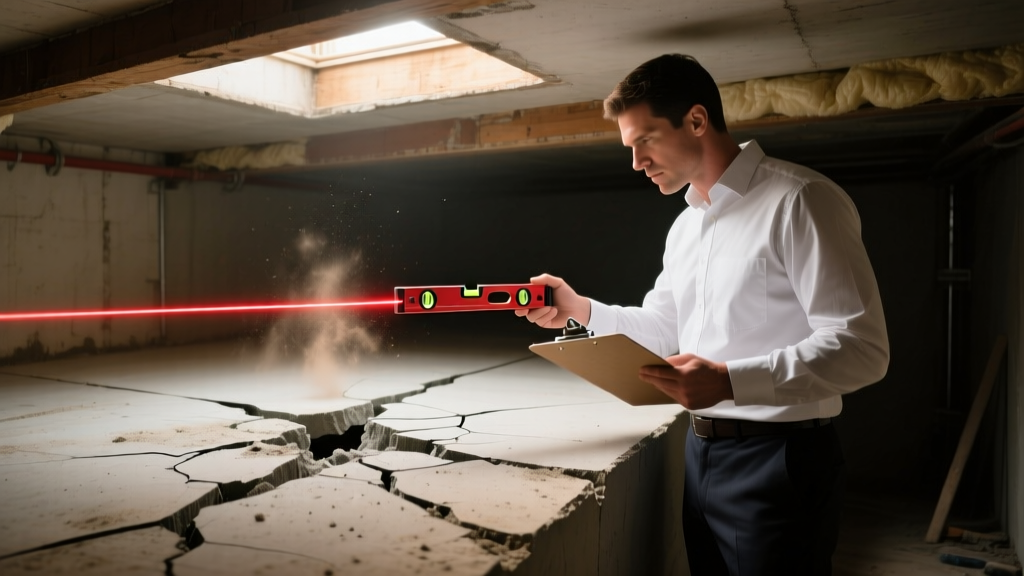
Decision Framework: Matching the Failure Mode to the Fix
Choosing the wrong repair method is a costly mistake. Use this framework to verify your contractor's proposed solution against the actual physics of your foundation failure.
Differential Settlement: Push Piers vs. Helical Piers
If your foundation is sinking, underpinning is required. But which type? Push piers rely on the weight of the structure to provide the resistance needed to drive the steel pipe deep into the ground. If you have a heavy, two-story brick home, push piers are highly effective and cost-efficient. However, if you have a lightweight single-story slab or a wood-frame addition, the house lacks the mass to drive the pier. In this scenario, you must use helical piers, which are mechanically torqued into the earth like a giant screw, independent of the structure's weight.
Slab Voids: Polyurethane vs. Traditional Mudjacking
For sunken concrete slabs, avoid traditional mudjacking. Mudjacking pumps a cementitious slurry weighing over 100 lbs per cubic foot beneath the slab. This heavy material adds immense dead load to already compromised, eroding soils, often leading to secondary settlement. In 2026, the industry standard is high-density polyurethane foam injection (using resins like Alchatek AP Lift 430). The foam weighs merely 2 to 4 lbs per cubic foot, expands to fill micro-voids, cures in 15 minutes, and is completely impervious to water washout.
Many foundation repair companies offer free inspections. Remember that these companies make money by selling repairs, not by providing objective diagnostics. A salesperson may recommend $20,000 in piering for a slab that only requires $3,000 in surface drainage correction and minor foam jacking. Always verify severe structural diagnoses with an independent third party.
The Independent Engineer Rule: Protecting Your Investment
Before signing a five-figure underpinning contract, invest $500 to $1,500 in a Licensed Structural Engineer (PE) who is unaffiliated with any repair contractor. The engineer will perform a floor elevation survey, analyze the cracking patterns, and write a geotechnical remediation plan. This plan dictates exactly how many piers are needed, to what depth, and at what spacing. You then hand this engineered plan to three different foundation repair companies to bid on the exact same scope of work, ensuring an apples-to-apples comparison and eliminating contractor upselling.
Warranties, Insurance, and Hidden Financial Realities
Understanding the financial safety nets available—and those that are explicitly excluded—is vital for budgeting.
The Reality of 'Lifetime' Warranties
Most reputable piering manufacturers (such as Foundation Supportworks or Chance Helical Piers) offer lifetime transferable warranties. However, read the exclusions carefully. These warranties cover the steel materials against manufacturing defects and the installation workmanship. They almost universally exclude subsequent movement caused by new plumbing leaks, extreme drought conditions, or changes to the property's grading and drainage. If a tree root breaks your sewer line and washes out the soil beneath a newly installed pier, the warranty will not cover the secondary settlement.
Homeowners Insurance Exclusions
Standard HO-3 homeowners insurance policies categorically exclude foundation damage caused by 'earth movement' (settlement, heave, sinkholes) and poor surface water drainage. According to industry data aggregators like Forbes Home, insurance will only cover foundation repair if the damage is the direct result of a covered peril, such as a sudden, accidental plumbing leak beneath the slab, or a vehicle crashing into the structure. For expansive soil issues, homeowners must budget for repairs out-of-pocket or utilize specialized structural financing.
Final Cost Verification Checklist
Before authorizing work, ensure your contractor's proposal explicitly includes the following line items to avoid mid-project change orders:
- Permitting & Engineering Fees: Are city permits and the final structural engineer sign-off included in the base price?
- Interior/Exterior Restoration: Does the quote cover patching the drywall, re-pouring the sidewalk sections cut for pier access, or replanting landscaping?
- Hydrostatic Pressure Relief: If bowing walls are being strapped, is a French drain or weep hole system included to relieve the water pressure that caused the bowing in the first place?
By understanding the mechanical realities of your soil, the specific unit costs of 2026 materials, and the necessity of independent engineering, you can navigate the foundation repair process with financial predictability and structural confidence. For further baseline estimates, homeowners can also cross-reference localized labor rates via platforms like Angi's foundation repair cost guides to ensure their bids align with current regional markets.
Written by
Elena RodriguezElena Rodriguez is a civil engineer and technical writer specializing in concrete technology, masonry systems, and ASTM/ACI compliance. She earned her B.S. in Civil Engineering from Texas A&M University and spent a decade at a materials testing laboratory, performing over 2,000 concrete compressive strength tests and masonry prism evaluations. Elena is an ACI-certified Field Testing Technician (Grade I) and a member of ASTM Committee C12 on Natural Building Stone. She currently consults on forensic engineering cases involving concrete failures and moisture intrusion. Based in San Antonio, TX, Elena is a proud member of the Society of Women Engineers (SWE) and coaches her daughter's FIRST Robotics team.
More from Elena Rodriguez
View all
Walls & Panels
Cost Analysis: Light Gauge Steel Framing Advantages and Disadvantages
Evaluate light gauge steel framing advantages and disadvantages through a strict cost analysis lens, comparing material, labor, and lifecycle expenses.
Aug 4, 2026

Walls & Panels
Gypsum Board Types: Exact Specifications, Thickness & Dimensions
Compare standard, Type X, and moisture-resistant gypsum board types. Get exact specifications, thicknesses, dimensions, and ASTM standards for your project.
Aug 4, 2026

Fire Resistance
Best Fire-Resistant Outdoor Decking Materials: 2026 Buyer Guide
Discover the best fire-resistant outdoor decking materials for 2026. Compare Class A PVC, aluminum, and hardwood options for WUI compliance and safety.
Aug 4, 2026