Average Cost Foundation Repair: 2026 Cost Breakdown
Analyze the average cost foundation repair in 2026. Get exact pricing for piering, mudjacking, and crack sealing by foundation type and soil condition.
The 2026 Baseline: National Foundation Repair Pricing
When evaluating structural remediation, the average cost foundation repair in 2026 sits at a national median of $5,450. However, this aggregate figure masks extreme variances driven by soil mechanics, foundation typology, and the specific engineered solution required. Minor epoxy crack injections can resolve for under $800, while comprehensive hydraulic piering systems designed to stabilize severe differential settlement routinely exceed $25,000.
Understanding where your project falls on this spectrum requires moving beyond generic online estimators. Foundation repair is not a commodity; it is a highly specialized geotechnical intervention. According to Angi's foundation repair cost database, labor and heavy equipment mobilization account for nearly 60% of the final invoice, while engineered materials (steel piers, polyurethane resins, carbon fiber) make up the remainder.
- National Average: $5,450
- Typical Range: $2,200 to $11,500
- Severe Structural Remediation: $15,000 to $35,000+
- Cost per Linear Foot (Piering): $1,000 to $1,800
Method-Specific Cost Matrix: Piers, Foam, and Epoxy
The repair method dictated by your structural engineer will be the primary cost driver. Below is a comparative breakdown of the most common remediation techniques deployed in 2026, including material specifications and longevity expectations.
| Repair Method | 2026 Unit Cost | Best Application | Engineered Lifespan |
|---|---|---|---|
| Helical Piers (2-7/8" round shaft) | $1,500 - $2,500 per pier | Light to moderate loads; new construction; tension applications | 75 - 100+ years |
| Push Piers (Steel friction piers) | $1,200 - $1,800 per pier | Heavy structural loads; lifting settled footings to bedrock | 100+ years |
| Polyurethane Foam (2.5 - 4.0 lb density) | $5 - $25 per sq. ft. | Slab lifting; void filling; lightweight soil stabilization | 50+ years |
| Mudjacking (Cementitious slurry) | $3 - $6 per sq. ft. | Exterior flatwork (driveways, patios); non-structural slabs | 5 - 10 years |
| Carbon Fiber Straps | $500 - $800 per strap | Bowing basement walls; shear crack stabilization | Permanent (if wall movement < 2 inches) |
| Epoxy / Polyurethane Injection | $250 - $800 per crack | Non-structural shrinkage cracks; active water leak sealing | 10 - 20 years |
Deep Foundation Systems: Helical vs. Push Piers
When a structure experiences differential settlement due to expansive clay or poorly compacted fill soil, surface-level repairs are insufficient. Deep foundation systems transfer the structural load past the unstable active soil zone to load-bearing strata or bedrock.
Push piers utilize the weight of the structure itself to hydraulically drive steel pipe sections into the ground. They are generally more cost-effective for heavy masonry or multi-story homes but require a minimum structural weight to drive effectively. Helical piers, which feature steel helical bearing plates welded to a central shaft, are mechanically torqued into the soil. They are ideal for lighter structures (like single-story wood frames or porches) and can be installed in restricted access areas where heavy hydraulic rams cannot fit. As noted in American Society of Civil Engineers (ASCE) guidelines, proper load testing per ASTM D1143 is critical for both systems to ensure the friction or end-bearing capacity meets the engineered design load.
Slab Lifting: Polyurethane vs. Cementitious Mudjacking
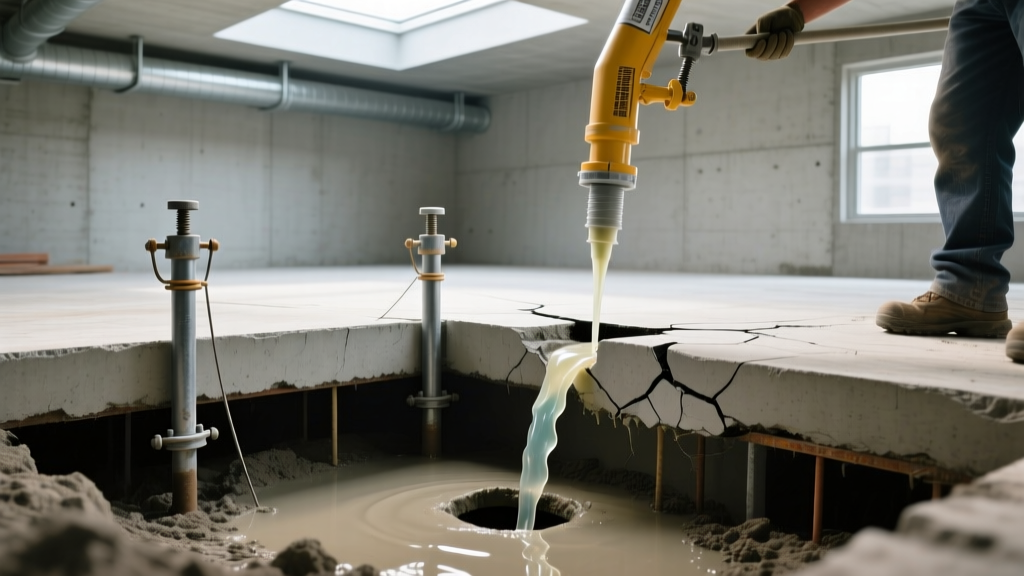
For sunken concrete slabs that have not suffered structural shear failure, slab jacking is the standard protocol. Traditional mudjacking involves pumping a heavy slurry of topsoil, sand, and Portland cement through 2-inch drilled holes. While cheap upfront, the slurry weighs roughly 120 lbs per cubic foot, which can exacerbate soil subsidence over time.
In 2026, polyurethane foam jacking is the industry standard for structural slabs. The closed-cell structural foam expands up to 30 times its liquid volume, weighing a mere 2 to 4 lbs per cubic foot. It cures in 15 minutes, requires only 5/8-inch injection holes, and is impervious to water degradation. While polyurethane costs roughly 300% more than mudjacking per square foot, the elimination of future re-settlement makes it the superior long-term investment for interior floors and garage slabs.
Foundation Type Variables: Slab vs. Crawl Space vs. Basement
The architecture of your foundation dictates the labor intensity and access requirements of the repair, heavily influencing the final invoice.
- Slab-on-Grade Foundations: Repairing settling footings beneath a monolithic slab is highly invasive. Contractors must either tunnel beneath the grade beam (adding $150 to $250 per linear foot for excavation and shoring) or break through the interior concrete floor to access the footing. Concrete demolition, debris removal, and post-repair patching can add $2,500 to $5,000 to the total project cost.
- Crawl Space Foundations: Crawl spaces offer direct access to footings and piers, reducing excavation costs. However, structural failures here often involve rotted wooden sill plates, compromised steel lally columns, or sinking concrete pad footings. Replacing adjustable steel supports and pouring new reinforced concrete pads typically costs $150 to $400 per column.
- Basement Foundations: Basement repairs rarely involve lifting; they involve resisting lateral earth pressure. Bowing walls caused by hydrostatic pressure or frost heave require stabilization. If the wall has bowed less than 2 inches, carbon fiber straps ($500-$800 each) are sufficient. If deflection exceeds 2 inches, steel I-beam braces ($800-$1,200 each) or exterior earth excavation with waterproofing membranes ($100-$150 per linear foot) are mandatory.

Hidden Cost Multipliers: Soil Mechanics and Site Access
Contractor estimates frequently exclude secondary variables that can inflate the final bill by 20% to 40%. Be prepared for the following hidden multipliers:
In regions with expansive clay soils, plumbing leaks beneath a slab can wash away supporting soil (piping) or cause the clay to swell (heave). If a leak is suspected, a hydrostatic pressure test ($500 to $800) must be performed before any piering or lifting occurs. Lifting a slab with an active leak will sever cast-iron or PVC waste lines, resulting in catastrophic sewage contamination and tens of thousands in secondary remediation costs.
- Depth to Bedrock: In regions like the Texas Blackland Prairie or parts of the Carolinas, load-bearing strata may sit 30 to 50 feet below grade. Push piers require additional steel sections for deep drives. Most contractors include the first 25 feet of pier depth in the base price, charging an additional $150 to $250 for every extra 3-foot steel extension required.
- Equipment Access Constraints: Hydraulic piering rigs weigh up to 10,000 lbs and require a 4-foot wide clearance path. If fences, HVAC units, or tight property lines prevent access, contractors must use mini-excavators or manual hand-digging, adding $1,000 to $3,000 in specialized labor.
- Landscaping and Hardscape Restoration: Foundation repair destroys adjacent landscaping. Excavation for exterior waterproofing or pier installation requires the removal of shrubs, decks, and concrete walkways. Restoration is almost never included in the structural repair contract.
Actionable Decision Framework: Repair vs. Replace
Not every crack warrants a $10,000 intervention. Use this diagnostic framework to determine the appropriate scale of your response, referencing data from HomeGuide's national construction pricing index to validate contractor quotes.
- Monitor (Cost: $0 - $300): Diagonal drywall cracks at door/window corners measuring less than 1/8 inch, or minor shrinkage cracks in the slab. Install a digital crack monitor and track movement over 6 months. If seasonal, it is normal thermal expansion.
- Cosmetic / Waterproofing Repair (Cost: $500 - $2,500): Vertical cracks in poured concrete basement walls that weep water during heavy rain but show no lateral displacement. Route and seal with flexible polyurethane or install an interior French drain system.
- Targeted Stabilization (Cost: $3,000 - $8,000): One corner of the home is settling (differential settlement of 1 to 2 inches). Doors are sticking in one specific room. Install 3 to 5 helical or push piers exclusively under the compromised footing to arrest movement.
- Comprehensive Structural Remediation (Cost: $15,000 - $35,000+): Widespread settlement exceeding 3 inches, severe stair-step cracking in brick veneer, or basement walls bowing inward more than 3 inches. This requires full-perimeter piering, wall anchors, and potentially a structural engineer's retainer ($1,500 - $3,000) to oversee the load transfer.
Securing three itemized bids from licensed foundation specialists is mandatory. Ensure each bid specifies the exact pier depth, the engineered load capacity, and the terms of the lifetime warranty—specifically whether the warranty is transferable to a new homeowner and if it covers future soil subsidence or only material defects.
Written by
Sarah WhitfieldSarah Whitfield is a chartered quantity surveyor (MRICS) and construction cost analyst with 15 years of experience in material pricing, procurement strategy, and project budgeting. She earned her degree in Construction Management from the University of Reading (UK) and has worked on projects ranging from $2M custom homes to $180M mixed-use developments across North America and Europe. Sarah currently leads cost estimating for BuildMat Insight, maintaining a proprietary database of 4,000+ material price points updated quarterly. She is a frequent contributor to RSMeans cost data panels and has presented at the International Cost Engineering Council (ICEC) congress. Based in Denver, CO, Sarah is an avid trail runner and volunteer mentor for Women in Construction.
More from Sarah Whitfield
View all
Wood & Lumber
What Are the Different Types of Wood? A Builder's Guide
Compare structural softwoods, finish hardwoods, and engineered lumber. Analyze Janka ratings, MOE values, and 2026 pricing for construction.
Aug 4, 2026

Walls & Panels
Steel Framing vs Wood Framing: Corrosion and Moisture Defense
Compare steel framing vs wood framing for moisture resistance. Learn about galvanized coatings, condensation risks, and corrosion protection strategies.
Jul 21, 2026

Stone & Masonry
How to Cut Stone Veneer: Wet Saw vs Grinder Comparison
Compare the best tools for cutting stone veneer. We review wet saws, angle grinders, and chop saws to help you achieve clean, chip-free cuts.
Jul 21, 2026