Foundation Spalling Repair Cost: 2026 Pricing & Repair Method Guide
Analyze the 2026 foundation spalling repair cost, from DIY surface patches to structural epoxy injections. Get exact material pricing and labor rates.

The True Cost of Foundation Spalling in 2026
Foundation spalling—the flaking, peeling, or chipping of concrete surfaces—is rarely just a cosmetic issue. Driven by freeze-thaw cycles, chloride-induced rebar corrosion, and concrete carbonation, spalling compromises the structural integrity of your foundation walls and footings. In 2026, the national average foundation spalling repair cost ranges from $850 to $4,200, depending heavily on the depth of the degradation and whether the underlying steel reinforcement has suffered section loss.
• DIY Surface Patching: $75 - $180 (Materials only)
• Professional Resurfacing: $4.50 - $9.00 per square foot
• Structural Epoxy Injection: $300 - $650 per linear foot of crack
• Full-Depth Section Replacement: $1,800 - $5,500+ per zone
Cost Breakdown by Repair Methodology
Selecting the correct repair protocol is governed by the American Concrete Institute (ACI) Committee 546 guidelines on concrete repair. Misdiagnosing the spall depth leads to premature failure and wasted capital. Below is a comparative matrix of the primary repair methods utilized by foundation contractors this year.
| Repair Method | 2026 Cost Range | Application Scenario | Expected Lifespan |
|---|---|---|---|
| Polymer-Modified Overlay | $4.50 - $9.00 / sq ft | Surface scaling < 1 inch deep; no rebar exposure | 10 - 15 years |
| Form-and-Pour Mortar Patch | $45 - $85 / sq ft | Deep spalls exposing intact rebar; corner repairs | 20 - 30 years |
| Epoxy Crack Injection | $300 - $650 / linear ft | Active structural cracking accompanying spall zones | Permanent (if water managed) |
| Cathodic Protection Install | $15 - $25 / sq ft | Halt ongoing chloride-induced rebar corrosion | 30+ years |
Material Spotlight: What to Buy for the Job
Using standard bagged concrete mix for foundation spalling is a critical error. Standard mixes lack the shrinkage-compensating properties and bonding agents required for vertical and overhead applications. For lasting repairs, specify polymer-modified, rapid-hardening mortars that meet ASTM C928 standards.
Top-Tier Commercial Products (2026 Pricing)
- Sika MonoTop-612 Structural Repair Mortar: Approximately $48 per 50 lb bag. Ideal for deep, formed repairs where high compressive strength (6,000 psi at 28 days) and low permeability are required. Contains silica fume to protect underlying rebar.
- MAPEI Planitop X: Approximately $55 per 55 lb bag. A one-component, fiber-reinforced, shrinkage-compensated mortar. Excellent for corner spalls and edge repairs where formwork is difficult to erect.
- Quikrete Concrete Resurfacer (for non-structural scaling): Approximately $28 per 40 lb tub. Strictly for shallow, horizontal footing scaling (less than 1/2 inch). Do not use on vertical foundation walls.
Before patching, spray the exposed concrete substrate with a 1% phenolphthalein indicator solution. If the concrete turns pink, the pH is above 9 (alkaline, protective). If it remains colorless, the concrete has carbonated and lost its passivating layer. You must apply a zinc-rich primer or migrating corrosion inhibitor (like Cortec MCI-2020) to the rebar before applying the patching mortar, or the spalling will return within 24 months.
Hidden Cost Triggers: When Spalling Means Structural Failure
The initial foundation spalling repair cost estimate often balloons once contractors begin the chipping phase. According to data from the Portland Cement Association, freeze-thaw damage often masks deeper chloride ingress. Budget for these hidden triggers:
- Rebar Section Loss (>20%): If the exposed steel rebar has rusted to the point where its cross-sectional area is reduced by more than 20%, it must be cut out and sistered with new epoxy-coated rebar. Add $150 - $300 per linear foot for structural steel splicing.
- Subgrade Excavation: If spalling occurs below the frost line or near the footing, hand-excavation or hydro-excavation is required to access the repair zone. Expect to pay $85 - $125 per cubic yard for tight-access soil removal.
- Exterior Waterproofing Integration: Repairing the concrete is pointless if hydrostatic pressure remains unmanaged. Applying a blind-side waterproofing membrane (such as Tremco Paraseal) over the repaired zone adds $6.50 to $11.00 per square foot but is mandatory to prevent water from carrying new chlorides into the patch.
Step-by-Step Decision Tree: DIY vs. Professional Contracting
Not all spalling requires a structural engineering team. Use this diagnostic framework to determine your route:
Scenario A: The Shallow Surface Scale
Symptoms: Concrete surface is flaking in thin sheets (1/4 to 1/2 inch deep). No yellow/brown rust stains are visible. The concrete sounds solid when tapped with a hammer (no hollow delamination sounds).
Action: DIY Repair.
Protocol: Pressure wash at 3,000 PSI. Apply a concrete bonding adhesive (e.g., SikaLatex R). Trowel on a polymer-modified overlay.
Cost Impact: Under $200.
Scenario B: The Delaminated Chunk with Exposed Rebar
Symptoms: Large chunks of concrete have fallen away. Steel rebar is visible, heavily rusted, and possibly expanding (which causes the surrounding concrete to crack outward, known as 'oxide jacking').
Action: Hire a Certified International Concrete Repair Institute (ICRI) Contractor.
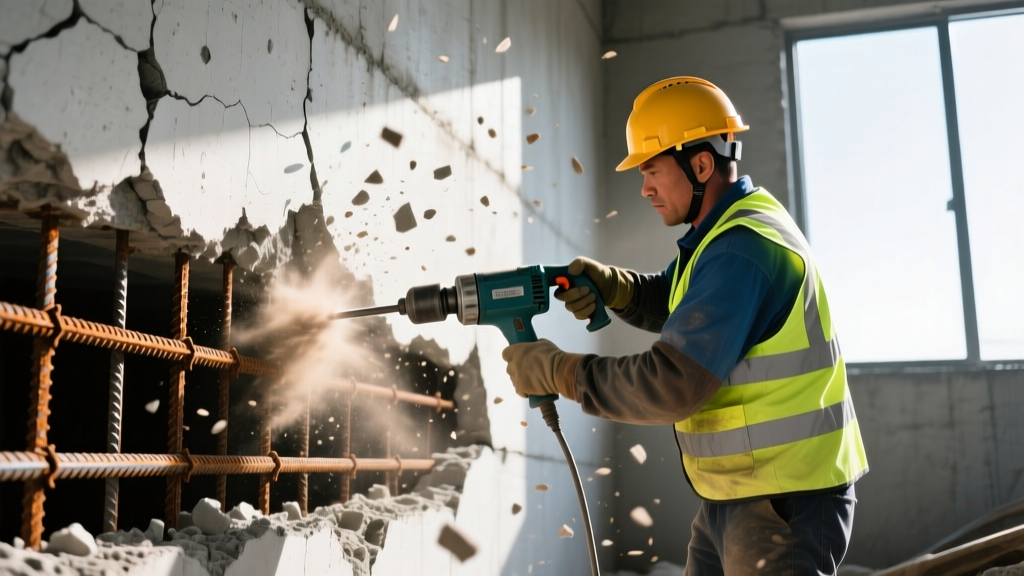
Protocol: Pneumatic chipping to sound concrete. Sandblast the rebar. Apply rust passivator. Erect formwork. Pump or pour shrinkage-compensated structural mortar.
Cost Impact: $1,500 - $4,500.
Scenario C: Spalling Accompanied by Horizontal Shear Cracks
Symptoms: Spalling is concentrated along a horizontal crack line, and the foundation wall is bowing inward by more than 1/2 inch.
Action: Halt repairs and consult a Structural Engineer immediately.
Protocol: The spalling is a secondary symptom of lateral earth pressure failure. Patching the concrete will not stop the wall from collapsing. Carbon fiber straps or steel I-beam bracing must be installed first.
Cost Impact: $5,000 - $15,000+ (Engineering + Bracing + Subsequent Concrete Repair).
Frequently Asked Questions
Does homeowners insurance cover foundation spalling repair costs?
Generally, no. Standard homeowners insurance policies classify foundation spalling as a 'maintenance and wear-and-tear' issue, specifically excluding gradual deterioration, freeze-thaw damage, and soil settlement. Coverage is typically only triggered if the spalling was the direct, immediate result of a covered peril, such as a vehicle striking the foundation or a sudden, localized plumbing explosion undermining the footing.
How long does a professional spalling repair take to cure?
Modern ASTM C928 rapid-hardening mortars achieve 3,000 psi compressive strength within 3 to 4 hours, allowing for same-day backfilling and waterproofing. However, traditional Portland cement-based patching mixes require a minimum 7-day wet-cure period to prevent plastic shrinkage cracking, which delays exterior waterproofing and backfill operations.
Can I just paint over spalling concrete to seal it?
Absolutely not. Painting over spalling or delaminated concrete traps moisture inside the substrate. When temperatures drop below freezing, the trapped water expands by 9%, accelerating the spalling process exponentially. You must physically remove the compromised concrete, treat the substrate, and replace the mass before applying any breathable silane/siloxane penetrating sealer.
Written by
David NakamuraDavid Nakamura is a licensed architect (AIA) and construction technology writer focused on sustainable building methods, mass timber engineering, and high-performance building envelopes. He holds a Master of Architecture from the University of Washington and is a certified Passive House Consultant (CPHC). David spent eight years at the Seattle firm Mithun, where he led the design of three LEED Platinum projects, before founding his own practice specializing in net-zero residential design. He serves on the editorial advisory board of GreenBuilder Magazine and has authored peer-reviewed papers on cross-laminated timber (CLT) connections for the Journal of Structural Engineering. In his spare time, David teaches woodworking at Pratt Fine Arts Center and kayaks the Puget Sound.
More from David Nakamura
View all
Construction Cost
Labor Cost to Build a Deck Per Sq Ft: 2026 Installation Guide
Discover the exact labor cost to build a deck per sq ft in 2026. This installation guide breaks down contractor rates, complexity factors, and hidden fees.
Aug 4, 2026

Construction Cost
How Much Does It Cost to Build a 3 Bedroom House? Financing Guide
Learn exactly how much it costs to build a 3 bedroom house and explore 2026 financing options, construction loan types, and budget frameworks for your build.
Aug 4, 2026

Construction Cost
Cost to Build a Tennis Court: 2026 Guide
How much does it cost to build a tennis court in 2026? Breakdowns for asphalt, concrete, and synthetic surfaces plus fencing and lighting.
Jul 30, 2026