Pool Foundation Repair Cost: A Selection Framework for Structural Fixes
Navigate pool foundation repair cost with our selection framework. Compare helical piers, polyurethane foam, and epoxy for structural pool shells.

The Pool Foundation Failure Matrix: Diagnosing Before You Price
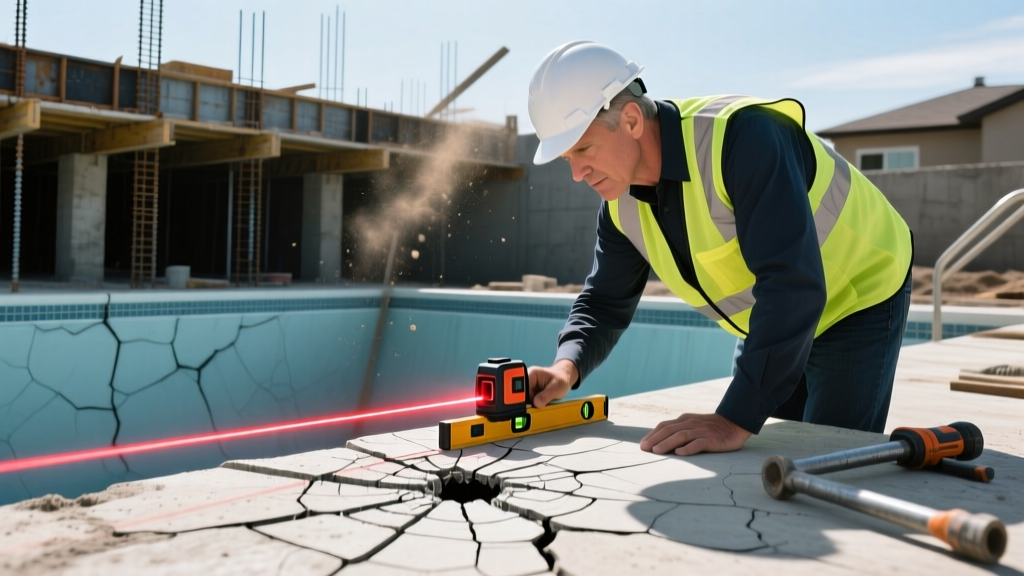
Calculating an accurate pool foundation repair cost requires isolating the specific structural failure mode. A swimming pool shell—typically a 6-to-8-inch thick gunite or shotcrete vault—acts as a monolithic concrete foundation. When the underlying subgrade fails, the shell experiences differential settlement, hydrostatic uplift, or shear cracking. Applying a cosmetic fix to a structural subsidence issue guarantees recurring failure. According to structural guidelines from the American Concrete Institute (ACI), concrete repair strategies must address the root cause of deterioration, not merely the symptom.
Before evaluating contractor bids, map your pool's symptoms to this diagnostic matrix to determine the required engineering intervention.
| Observable Symptom | Probable Root Cause | Required Intervention Category |
|---|---|---|
| Diagonal stepping cracks in pool tile/coping | Differential settlement of pool beam | Deep Foundation Underpinning |
| Pool deck slab sloping away from shell | Subgrade washout or soil consolidation | Slab Jacking / Void Filling |
| Horizontal cracks along the deep end wall | Hydrostatic pressure or lateral soil loading | Lateral Bracing / Helical Tiebacks |
| Fine, spider-web cracking in the plaster/gunite | Shotcrete rebound or shrinkage (non-structural) | Epoxy Injection / Surface Sealing |
2026 Pool Foundation Repair Cost Breakdown by Method
Pricing for structural pool stabilization has shifted due to specialized equipment requirements and the premium on working in restricted-access backyard environments. The table below reflects current 2026 market rates for structural pool repairs, excluding standard landscaping restoration or plumbing re-routes.
| Repair Method | Unit Cost Metric | Typical Total Project Range | Best Application |
|---|---|---|---|
| Helical Piers (Underpinning) | $2,200 - $2,800 per pier | $12,000 - $35,000+ | Severe pool beam settlement, expansive clay soils |
| Polyurethane Foam Jacking | $8 - $14 per sq. ft. | $3,500 - $9,000 | Deck settlement, minor shell voids, coping lift |
| Structural Epoxy Injection | $45 - $85 per linear foot | $1,500 - $4,500 | Restoring monolithic integrity to cracked gunite shells |
| Carbon Fiber Stapling | $300 - $500 per staple | $2,000 - $6,000 | Arresting active shear cracks in pool walls |
Deep Dive: Selecting the Right Stabilization Method
The selection framework hinges on three variables: load-bearing requirements, soil hydro-sensitivity, and site access. Here is how the primary methodologies perform under real-world conditions.
Helical Piers for Pool Beam Underpinning
When expansive clay soils—heavily documented in regional soil mechanics reports by Texas A&M AgriLife Extension—cause the pool's structural bond beam to heave or settle, surface-level repairs are useless. Helical piers bypass the active soil zone and transfer the pool's load to stable bedrock or dense bearing strata.
For residential pools, contractors typically utilize 1.5-inch or 1.75-inch square shaft piers with 7-inch to 10-inch helix plates (such as those manufactured by Hubbell Power Systems/Chance). The installation relies on a strict torque-to-capacity correlation; a hydraulic drive head monitors installation torque to verify the pier has achieved the required 40,000 to 60,000 lbs of load capacity. The primary cost driver here is access. If a mini-excavator cannot reach the pool equipment pad, hand-digging the pile caps will increase labor costs by 30% to 40%.
Polyurethane Foam Jacking for Deck and Coping Voids
Traditional mudjacking (cementitious slurry) is obsolete for pool environments. The heavy slurry (approx. 120 lbs per cubic foot) adds excessive dead load to already compromised subgrades and can wash out if a subterranean plumbing leak occurs. High-density, closed-cell polyurethane foam (e.g., Alchemy-Spetec Deep Lift products) cures in 15 minutes, weighs only 4 to 6 lbs per cubic foot, and is entirely hydro-insensitive. This is the mandatory selection for lifting settled pool decks or re-leveling coping stones without risking water-degradation of the repair material.
Epoxy and Carbon Fiber for Shell Integrity
If a pool shell has cracked but the underlying subgrade is stable, the goal is to restore the monolithic tensile strength of the gunite. High-modulus, low-viscosity structural epoxies (like Sika SikaDur) are injected under pressure to weld the concrete matrix back together. For cracks experiencing active shear movement, structural carbon fiber staples (such as Simpson Strong-Tie systems) are routed into the concrete and bonded with epoxy, providing tensile reinforcement that prevents the crack from propagating under hydrostatic load.
The Selection Decision Tree
Step 1: Is the subgrade actively moving?
- Yes: Proceed to Step 2. (Do not patch cracks yet; they will re-open).
- No: Select Structural Epoxy Injection and Carbon Fiber Stapling to seal and reinforce the shell.
Step 2: Is the failure isolated to the deck/coping, or is the main pool shell settling?
- Deck/Coping Only: Select Polyurethane Foam Jacking to fill voids and lift the slab back to grade.
- Main Pool Shell/Bond Beam: Proceed to Step 3.
Step 3: What is the soil profile?
- Expansive Clay / Deep Unstable Fill: Select Helical Piers driven to refusal or stable bearing strata.
- Shallow Washout / Sand Lens: Select Compaction Grouting or Polyurethane Void Filling, combined with drainage correction.
Hidden Cost Variables That Derail Pool Repair Budgets
When evaluating a contractor's proposal, ensure these frequently omitted line items are accounted for in your total pool foundation repair cost calculation.
Warning: Subterranean Plumbing Leaks
Soil washout under a pool shell is frequently caused by a pinhole leak in the main drain or return line. If a contractor underpins a pool without first performing a hydrostatic pressure test on the plumbing lines, the newly installed piers may eventually settle into the newly washed-out soil. Always budget $800 - $1,500 for a professional leak detection and pressure test prior to foundation stabilization.
Hydrostatic Relief Valve Integration
If your pool is experiencing lateral wall cracking or floor blowouts, the water table beneath the shell is likely exerting upward pressure. Foundation repair must include the retrofitting of hydrostatic relief valves in the pool floor (typically $400 - $600 per valve) to allow groundwater to enter the pool rather than cracking the concrete vault.
Vetting Contractors for Structural Pool Work
Standard foundation repair companies often lack the specific engineering knowledge required for submerged, water-retaining concrete structures. The Association of Pool & Spa Professionals (APSP) emphasizes that pool structures require specialized understanding of hydrostatic dynamics and waterproofing integrity. When reviewing bids, require the contractor to provide:
- A Geotechnical Soil Report: Or at minimum, a detailed soil probe analysis showing the depth to stable bearing strata.
- Engineered Stamping: A licensed structural engineer must stamp the pier placement plan, specifying the exact helix plate size and required installation torque.
- Waterproofing Remediation Plan: Drilling through a pool's bond beam or injecting foam compromises the existing waterproofing barrier. The proposal must detail how the penetration points will be sealed using hydrophilic waterstops or marine-grade polyurethane sealants to prevent future chlorine-leaching into the subgrade.
By applying this selection framework, you transition from guessing at pool foundation repair costs to engineering a permanent, cost-effective stabilization strategy tailored to your specific structural failure mode.
Written by
Sarah WhitfieldSarah Whitfield is a chartered quantity surveyor (MRICS) and construction cost analyst with 15 years of experience in material pricing, procurement strategy, and project budgeting. She earned her degree in Construction Management from the University of Reading (UK) and has worked on projects ranging from $2M custom homes to $180M mixed-use developments across North America and Europe. Sarah currently leads cost estimating for BuildMat Insight, maintaining a proprietary database of 4,000+ material price points updated quarterly. She is a frequent contributor to RSMeans cost data panels and has presented at the International Cost Engineering Council (ICEC) congress. Based in Denver, CO, Sarah is an avid trail runner and volunteer mentor for Women in Construction.
More from Sarah Whitfield
View all
Wood & Lumber
What Are the Different Types of Wood? A Builder's Guide
Compare structural softwoods, finish hardwoods, and engineered lumber. Analyze Janka ratings, MOE values, and 2026 pricing for construction.
Aug 4, 2026

Walls & Panels
Steel Framing vs Wood Framing: Corrosion and Moisture Defense
Compare steel framing vs wood framing for moisture resistance. Learn about galvanized coatings, condensation risks, and corrosion protection strategies.
Jul 21, 2026

Stone & Masonry
How to Cut Stone Veneer: Wet Saw vs Grinder Comparison
Compare the best tools for cutting stone veneer. We review wet saws, angle grinders, and chop saws to help you achieve clean, chip-free cuts.
Jul 21, 2026