Built Up Roofing Material Lifespan: Durability and Failure Guide
Analyze the durability and lifespan of built up roofing material. Compare ply counts, bitumen types, failure modes, and 2026 maintenance costs.

The Anatomy of Built Up Roofing Material Durability
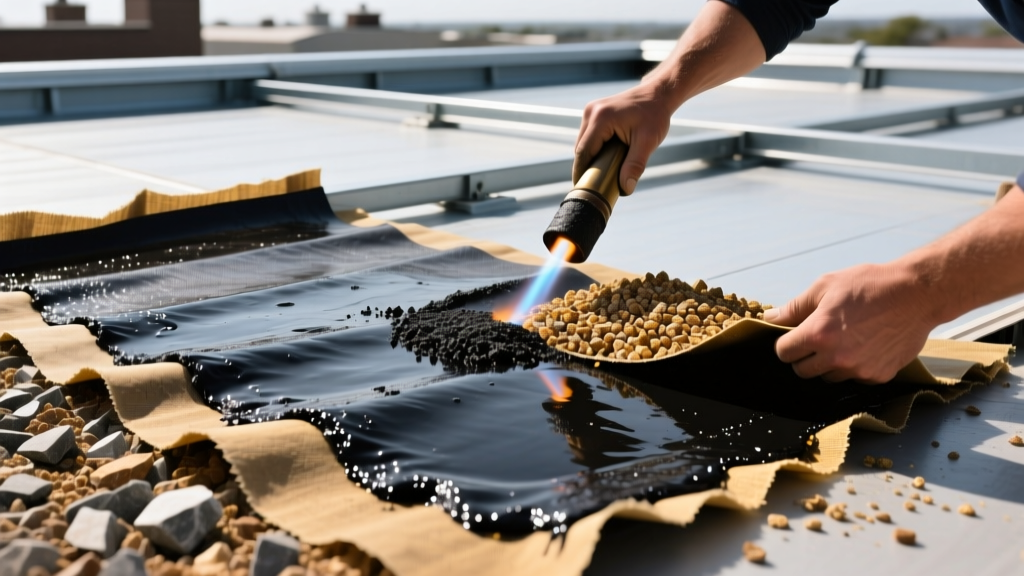
Built up roofing material (BUR) has been the standard for low-slope commercial roofing for over a century. Unlike single-ply membranes (TPO or EPDM) that rely on a single layer of synthetic rubber or plastic, BUR achieves its exceptional durability through redundancy. The system consists of alternating layers of bitumen (asphalt or coal tar pitch) and reinforcing fabrics, creating a continuous, monolithic membrane. The lifespan of a BUR system is not a fixed number; it is a direct mathematical result of ply count, bitumen chemistry, and surfacing mass.
According to the National Roofing Contractors Association (NRCA), a properly installed and maintained BUR system can easily exceed 30 years. However, achieving this upper limit requires strict adherence to ASTM material standards and precise application temperatures. For instance, Type IV asphalt must be mopped at 425°F (± 25°F) to ensure proper interply adhesion without burning off the volatile oils that provide long-term waterproofing.
Expected Lifespan by System Configuration
The structural integrity of built up roofing material scales directly with the number of reinforcing plies. A 'ply' refers to the reinforcing fabric (usually organic or fiberglass felts meeting ASTM D2178). The bitumen acts as the adhesive and waterproofing agent, while the plies provide tensile strength and puncture resistance.
| System Configuration | Expected Lifespan | 2026 Installed Cost (per sq. ft.) | Best Application Scenario |
|---|---|---|---|
| 3-Ply BUR (Base + 2 Plies) | 15 - 20 Years | $4.50 - $5.50 | Short-term hold commercial properties, low-traffic roofs. |
| 4-Ply BUR (Base + 3 Plies) | 20 - 25 Years | $5.50 - $7.00 | Standard commercial/industrial flat roofs, moderate foot traffic. |
| 5-Ply BUR (Base + 4 Plies) | 25 - 35+ Years | $7.00 - $8.50 | Institutional buildings, high-traffic maintenance roofs, long-term assets. |
Note: Costs reflect 2026 national averages for hot-mopped systems with aggregate surfacing. Regional labor rates and material transport for heavy asphalt kettles can cause variances of up to 18%.
Primary Failure Modes and Edge Cases
While the Asphalt Roofing Manufacturers Association (ARMA) highlights BUR's exceptional track record, system failures do occur. Understanding the specific mechanics of these failures is critical for facility managers and roofing consultants.
1. Interply Blisters
Blisters are raised, spongy areas caused by trapped moisture or air between the plies. When the roof surface reaches 140°F to 160°F under direct summer sun, the trapped moisture vaporizes and expands, pushing the plies apart. The Fix: Small blisters (under 12 inches) that are not ruptured can often be left alone. Ruptured blisters must be cut in an 'X' pattern, dried out, and repaired using a hot-applied SBS-modified mastic and a heavy-duty fiberglass patch, followed by re-embedding gravel.
2. Alligatoring and Surface Degradation
If the flood coat and gravel surfacing are applied too thinly, UV radiation will attack the exposed asphalt binder. This causes the surface to dry out, shrink, and crack in a pattern resembling alligator skin. The Edge Case: Alligatoring on a BUR system is almost always a surfacing failure, not a membrane failure. The underlying plies are usually intact. Applying an aluminum-pigmented asphalt roof coating (ASTM D2824) can halt UV degradation and extend the roof's life by 7 to 10 years without a full tear-off.
3. Ponding Water Degradation
Unlike single-ply membranes, standard asphalt BUR is not designed for continuous submersion. Ponding water (water remaining for more than 48 hours) accelerates the leaching of oils from the asphalt. If your roof has structural deflections causing ponding, a coal tar pitch system is historically preferred, but in 2026, applying a specialized polyurethane roof coating over the BUR in the ponding areas is the standard remediation protocol.
The Critical Role of Surfacing Mass
The top layer of a built up roofing material system dictates its environmental resilience. The surfacing protects the bitumen flood coat from UV rays, physical impact, and thermal shock.
- Aggregate (Gravel/Slag): Applied at a rate of 400 lbs per square (400 lbs per 100 sq. ft.). This provides the highest UV protection, adds significant thermal mass to reduce building cooling loads, and offers Class A fire resistance. Aggregate-surfaced BUR systems outlast smooth-surfaced systems by an average of 5 to 8 years.
- Mineral-Graded Cap Sheet: A fiberglass-reinforced cap sheet embedded with ceramic-coated granules. Lighter than gravel (reducing structural load requirements) but offers slightly less impact resistance. Ideal for roofs where structural load limits prohibit heavy gravel.
- Smooth Surface with Coating: Requires immediate application of an elastomeric or aluminum coating. Highest maintenance requirement, as the coating must be reapplied every 7 to 10 years.
Actionable Maintenance Framework to Extend Lifespan
To push a 4-ply BUR system past the 25-year mark, facility managers must implement a proactive, data-driven maintenance schedule. Reactive repairs after leaks occur compromise the underlying insulation and decking.
- Bi-Annual Visual Inspections (Spring/Fall): Focus on flashings, penetrations, and drains. 90% of BUR leaks occur at the perimeter or at pipe penetrations, not in the field of the roof. Check for cracking in the mastic at coping joints.
- Clear Scuppers and Drains: Ensure a 3-foot radius around all drains is completely free of debris, leaves, and displaced gravel. Displaced gravel can wash into drains and cause catastrophic blockages during heavy rain events.
- Quinquennial Infrared Moisture Surveys (Every 5 Years): Hire a certified thermographer to perform an evening infrared scan. Wet insulation retains heat longer than dry insulation, showing up as bright spots on the thermal camera. This allows you to surgically cut out and replace only the wet sections of the roof before the moisture degrades the roof deck.
- Re-Graveling Bare Spots: Whenever the asphalt flood coat becomes visible, immediately apply a cold-applied asphalt adhesive and embed new, clean 3/4-inch gravel to prevent localized UV degradation.
Frequently Asked Questions
Can you install solar panels on a built up roofing material system?
Yes, but penetration-free mounting systems are mandatory. Drilling through a BUR membrane to attach racking creates immediate leak paths that are difficult to flash properly. Use ballasted solar racking systems that distribute weight across large footprint pads, protecting the BUR membrane while holding the panels in place.
How does BUR compare to modified bitumen for durability?
Modified bitumen (SBS or APP) is essentially an evolution of BUR, utilizing polymer-modified sheets rather than hot-mopped plies. While modified bitumen offers better elasticity and cold-weather flexibility, a 4-ply hot-mopped BUR system generally offers superior puncture resistance and redundancy due to the overlapping interply mopping process.
What is the tear-off cost for a BUR roof in 2026?
BUR tear-offs are labor-intensive due to the sheer weight of the materials. Expect to pay between $2.50 and $4.00 per square foot for demolition and disposal of a 4-ply gravel-surfaced BUR system, heavily dependent on local landfill tipping fees for asphalt and aggregate waste.
Written by
Sarah WhitfieldSarah Whitfield is a chartered quantity surveyor (MRICS) and construction cost analyst with 15 years of experience in material pricing, procurement strategy, and project budgeting. She earned her degree in Construction Management from the University of Reading (UK) and has worked on projects ranging from $2M custom homes to $180M mixed-use developments across North America and Europe. Sarah currently leads cost estimating for BuildMat Insight, maintaining a proprietary database of 4,000+ material price points updated quarterly. She is a frequent contributor to RSMeans cost data panels and has presented at the International Cost Engineering Council (ICEC) congress. Based in Denver, CO, Sarah is an avid trail runner and volunteer mentor for Women in Construction.
More from Sarah Whitfield
View all
Wood & Lumber
What Are the Different Types of Wood? A Builder's Guide
Compare structural softwoods, finish hardwoods, and engineered lumber. Analyze Janka ratings, MOE values, and 2026 pricing for construction.
Aug 4, 2026

Walls & Panels
Steel Framing vs Wood Framing: Corrosion and Moisture Defense
Compare steel framing vs wood framing for moisture resistance. Learn about galvanized coatings, condensation risks, and corrosion protection strategies.
Jul 21, 2026

Stone & Masonry
How to Cut Stone Veneer: Wet Saw vs Grinder Comparison
Compare the best tools for cutting stone veneer. We review wet saws, angle grinders, and chop saws to help you achieve clean, chip-free cuts.
Jul 21, 2026