Choosing the Right Car Roofing Material by Climate Zone
Select the ideal car roofing material for carports and RV covers based on regional climate challenges, from UV degradation to heavy snow loads.

The Climate-Material Matrix for Vehicle Shelters
Specifying a car roofing material for carports, RV covers, and shaded parking structures requires more than matching aesthetics to the primary residence. Vehicle shelters are uniquely vulnerable to environmental stressors because they are often open-sided, altering wind uplift dynamics, and lack the conditioned thermal buffers of a primary building envelope. In 2026, material science has advanced significantly, but selecting the wrong panel profile or alloy for your specific microclimate remains the leading cause of premature structural failure, fastener tear-out, and coating degradation.
This guide breaks down the exact material specifications, gauge requirements, and fastener protocols necessary to build durable vehicle shelters across four distinct climate zones.
Hot and Arid Climates: Beating UV and Heat Soak
In regions like the American Southwest, the Middle East, and inland Australia, the primary enemies of car roofing materials are intense ultraviolet (UV) radiation and extreme thermal expansion. Standard corrugated fiberglass and uninsulated bare metals will fail rapidly here; fiberglass yellows and becomes brittle within three years, while dark metals transfer enough radiant heat to damage vehicle clear coats.
Recommended Materials and Specifications
- Multiwall Polycarbonate (8mm to 10mm): Products like Palram SunTuf or Polygal feature a co-extruded UV-blocking layer on the top surface. This specific car roofing material blocks 99.9% of UV rays while allowing diffused light. Critical installation note: Polycarbonate expands at a rate of 1/8 inch per 3 feet for every 100°F temperature change. Fastener holes must be drilled 25% oversized to prevent panel buckling.
- Cool-Roof Coated Galvalume Steel: If solid shade is required, specify 26-gauge Galvalume steel coated with a CRRC (Cool Roof Rating Council) rated reflective pigment. According to the CRRC Rated Products Directory, high-SRI (Solar Reflectance Index) coatings can reduce roof surface temperatures by up to 50°F compared to standard polyester paints, drastically reducing heat transfer to the vehicles below.
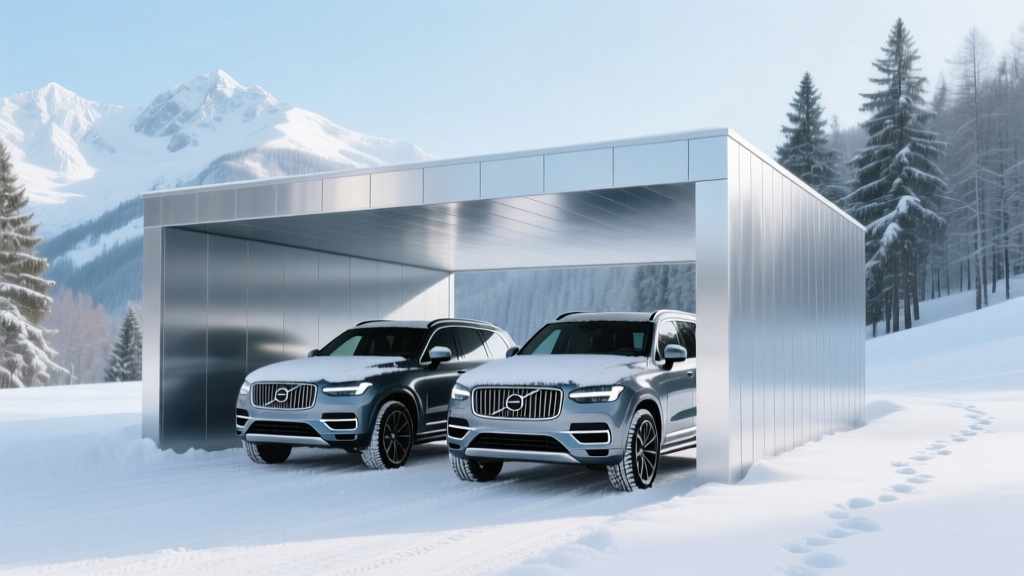
Heavy Snow and Alpine Zones: Managing Dead Loads
For carports in the Northeast US, Canada, and alpine regions, the governing factor is dead load management and ice damming. Open-sided structures are prone to 'snow drifting,' where wind blows snow off the carport roof, creating massive, uneven drifts against the side of the primary house or adjacent structures.
Structural and Material Requirements
Lightweight aluminum or vinyl car roofing materials are entirely unsuitable for these zones. You must engineer for ASCE 7-22 ground snow load standards, which frequently mandate a minimum 40 PSF (pounds per square foot) roof load capacity in northern tiers.
| Material Profile | Minimum Gauge | Required Pitch | Max Span (Purlin Spacing) |
|---|---|---|---|
| Corrugated Galvanized Steel | 24-Gauge | 4/12 or greater | 24 inches on center |
| Standing Seam Aluminum | .032 inch | 3/12 or greater | 36 inches on center |
| Multiwall Polycarbonate | 16mm (Triple-wall) | 5/12 minimum | 16 inches on center |
To prevent ice dams from forming at the eaves and dropping heavy ice blocks onto vehicles, install snow guards in a staggered pattern across the lower third of the roof plane. Furthermore, ensure the structural posts are rated for the combined weight of the maximum snow load plus the weight of the ice guards.
Coastal and Hurricane-Prone Regions: Salt and Uplift
Within 1,500 feet of a coastline, the atmosphere is saturated with chloride ions that rapidly corrode standard steel fasteners and zinc coatings. Additionally, open-sided carports act as aerodynamic wings during hurricane-force winds, creating massive uplift forces that can rip panels from the framing.
Corrosion and Wind Mitigation Protocols
The only acceptable car roofing material for coastal zones is marine-grade aluminum or heavily tested steel systems. According to the IBHS FORTIFIED Home standards, perimeter fastening and edge detailing are where most carport failures occur during high-wind events.
- Panel Selection: Use .032-inch or .040-inch aluminum standing seam panels. Aluminum naturally forms a protective oxide layer that resists salt spray, unlike galvanized steel which will red-rust within 36 months in a marine environment.
- Fastener Specification: This is the most common point of failure. You must use 316-grade stainless steel fasteners with neoprene washers. 304-grade stainless will eventually pit in salt air; galvanized or zinc-plated screws will fail catastrophically.
- Edge Flashing: Install continuous aluminum drip edges and fascia trim, sealed with a marine-grade polyurethane sealant (such as 3M Marine Adhesive Sealant 5200) to prevent wind-driven saltwater from infiltrating the panel laps.
Comprehensive Car Roofing Material Comparison
The following matrix synthesizes 2026 market data, providing a quick-reference framework for contractors and homeowners evaluating car roofing materials across different performance metrics.
| Material | Ideal Climate | Cost per Sq. Ft. (Material Only) | Expected Lifespan | Primary Vulnerability |
|---|---|---|---|---|
| 26-Ga Galvalume Steel | Temperate, Snow | $3.50 - $5.50 | 30-40 Years | Coastal salt corrosion |
| Standing Seam Aluminum | Coastal, High Wind | $8.00 - $12.50 | 50+ Years | Hail denting |
| 10mm Polycarbonate | Hot, Arid, UV | $4.00 - $6.50 | 15-20 Years | Heavy snow loads |
| PVC Tensile Fabric | Arid, Mild Wind | $6.00 - $9.00 | 10-15 Years | Tearing in hurricanes |
Critical Fastener and Flashing Failures to Avoid
According to technical bulletins from the Metal Roofing Alliance, 80% of metal carport roof failures are not caused by the panels themselves, but by improper fastening and flashing techniques. Avoid these three critical errors:
- Galvanic Corrosion Mismatches: Never use standard steel or zinc-plated screws to fasten aluminum panels. The dissimilar metals will create a galvanic cell in the presence of rainwater, rapidly corroding the aluminum around the fastener hole. Always use stainless steel fasteners with aluminum panels, separated by a neoprene or EPDM washer.
- Over-driving Screws: When installing corrugated car roofing materials, driving the screw too deep compresses the neoprene washer beyond its elastic limit, causing it to split and leak. Conversely, under-driving leaves the washer uncompressed. The correct torque leaves the washer slightly bulging around the metal washer head, creating a watertight seal without cutting the rubber.
- Ignoring Thermal Movement in Flashing: Carport ridge caps and eave trims are often screwed tightly to the panels. As the panels expand and contract with daily temperature swings, the fixed flashing will buckle and tear. Flashing must be installed with slotted holes or floating clips to allow independent movement from the primary roof panels.
By aligning your car roofing material selection with the specific mechanical and environmental demands of your climate zone, you ensure a vehicle shelter that remains structurally sound and visually intact for decades, protecting both the investment in the structure and the vehicles housed beneath it.
Written by
Sarah WhitfieldSarah Whitfield is a chartered quantity surveyor (MRICS) and construction cost analyst with 15 years of experience in material pricing, procurement strategy, and project budgeting. She earned her degree in Construction Management from the University of Reading (UK) and has worked on projects ranging from $2M custom homes to $180M mixed-use developments across North America and Europe. Sarah currently leads cost estimating for BuildMat Insight, maintaining a proprietary database of 4,000+ material price points updated quarterly. She is a frequent contributor to RSMeans cost data panels and has presented at the International Cost Engineering Council (ICEC) congress. Based in Denver, CO, Sarah is an avid trail runner and volunteer mentor for Women in Construction.
More from Sarah Whitfield
View all
Wood & Lumber
What Are the Different Types of Wood? A Builder's Guide
Compare structural softwoods, finish hardwoods, and engineered lumber. Analyze Janka ratings, MOE values, and 2026 pricing for construction.
Aug 4, 2026

Walls & Panels
Steel Framing vs Wood Framing: Corrosion and Moisture Defense
Compare steel framing vs wood framing for moisture resistance. Learn about galvanized coatings, condensation risks, and corrosion protection strategies.
Jul 21, 2026

Stone & Masonry
How to Cut Stone Veneer: Wet Saw vs Grinder Comparison
Compare the best tools for cutting stone veneer. We review wet saws, angle grinders, and chop saws to help you achieve clean, chip-free cuts.
Jul 21, 2026