Flat Roof Material Selection Framework: EPDM, TPO, and PVC
Compare EPDM, TPO, PVC, and modified bitumen with our flat roof material selection framework. Find the best membrane for your climate and budget.

The Core Variables in Flat Roof Material Selection
Selecting the correct flat roof material requires moving beyond basic cost-per-square-foot calculations. Low-slope and flat roof systems (defined as having a pitch of 3:12 or less) are highly susceptible to water ponding, thermal shock, and chemical degradation. A successful specification in 2026 depends on evaluating four critical variables: ponding water tolerance, HVAC exhaust composition, expected foot traffic, and regional wind uplift requirements.
According to the EPA's Heat Island Reduction Initiative, membrane reflectivity also plays a massive role in commercial HVAC load reduction, making the choice between black and white membranes a structural energy decision, not just an aesthetic one. Before reviewing specific products, facility managers must map their roof's operational profile against the performance matrix below.
Membrane Performance and Pricing Matrix
The following matrix outlines the baseline specifications and 2026 installed costs for the four dominant commercial flat roof materials. Costs assume a fully adhered installation over a standard polyisocyanurate insulation layer on a commercial deck.
| Material | 2026 Installed Cost (per sq. ft.) | Expected Lifespan | Ponding Water Tolerance | Grease/Oil Resistance | Seam Method |
|---|---|---|---|---|---|
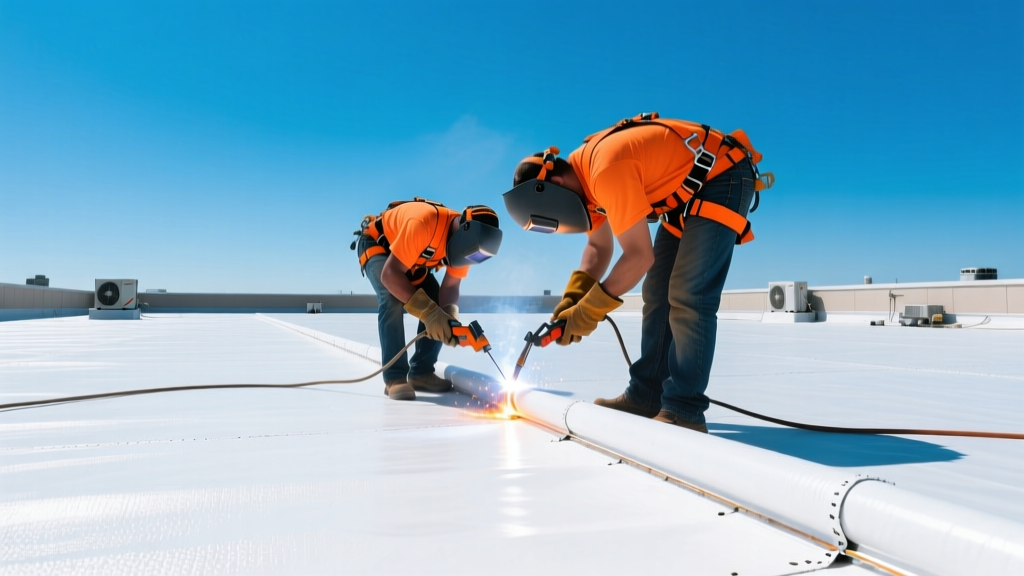
| TPO (60-mil) | $4.50 – $6.50 | 20 – 30 Years | Moderate | Poor | Heat Welded |
| PVC (60-mil) | $5.50 – $8.50 | 25 – 35+ Years | High | Excellent | Heat Welded |
| EPDM (60-mil) | $4.00 – $6.00 | 25 – 30 Years | Poor | Poor | Tape / Liquid Adhesive |
| Mod-Bit (SBS) | $5.00 – $7.50 | 20 – 25 Years | High | Moderate | Torch / Cold Adhesive |
Material Deep Dive: Specifications and Edge Cases
TPO (Thermoplastic Polyolefin)
TPO dominates the commercial market due to its balance of cost, reflectivity, and heat-welded seam strength. For 2026 specifications, mandate a minimum 60-mil thickness; 45-mil membranes are highly susceptible to puncture from dropped tools or hail. Leading manufacturers like GAF (EverGuard) and Carlisle SynTec have refined their formulations to meet ASTM D6878 standards, resolving the premature cracking issues seen in early-2000s production runs.
PVC (Polyvinyl Chloride)
PVC is the undisputed choice for buildings with high chemical exposure, particularly restaurants with animal fat and grease exhaust vents. Standard PVC relies on liquid plasticizers to maintain flexibility. Over 15 years, these plasticizers can migrate out of the membrane, causing it to become brittle. To prevent this, specify a KEE (Ketone Ethylene Ester) polymer membrane, such as Sika Sarnafil or Johns Manville PVC. KEE is a solid polymer that eliminates plasticizer migration, extending the membrane's functional life well past 30 years.
EPDM (Ethylene Propylene Diene Monomer)
EPDM is a synthetic rubber membrane prized for its elasticity and cold-weather performance. Black EPDM is highly effective in northern climates where absorbing solar heat helps melt snow and reduce ice damming. However, EPDM is highly vulnerable to petroleum-based products, oils, and grease. Furthermore, because seams are joined using primer and tape (or liquid adhesive) rather than thermal welding, EPDM is the most vulnerable to ponding water. If your roof design lacks a minimum 1/4:12 slope for positive drainage, avoid EPDM.
Modified Bitumen (Mod-Bit)
Mod-Bit bridges the gap between traditional built-up roofing (BUR) and single-ply membranes. SBS (Styrene-Butadiene-Styrene) modified bitumen offers rubber-like elasticity and is exceptionally resistant to physical punctures and heavy foot traffic. It is the ideal choice for roofs that house heavy HVAC equipment requiring frequent maintenance access. Installation via torch-application requires strict fire-safety protocols and is often prohibited on occupied buildings or wooden decks, making cold-process adhesives the safer, albeit slower, alternative.
Climate and Environmental Decision Tree
Use the following framework to narrow down your material choice based on your building's specific environmental stressors:
- High UV & Heat (Sunbelt/Southwest): Specify White TPO or White PVC (minimum 60-mil). The Department of Energy's Cool Roofs Guide notes that highly reflective white membranes can reduce peak cooling demand by 10-15%, drastically lowering utility overhead.
- Cold & Snow-Heavy (Northeast/Midwest): Specify Black EPDM or heavily insulated SBS Mod-Bit. Black surfaces absorb solar radiation, accelerating snowmelt and reducing the structural dead-load of accumulated snow.
- High Wind / Coastal Zones: Specify a Fully Adhered TPO or PVC system. Mechanically fastened systems rely on plates and screws that can fatigue under cyclic wind loading. Fully adhered systems bonded directly to the insulation board offer superior FM 1-90 and UL 90 wind uplift ratings.
- Restaurant / Food Processing: Specify KEE PVC exclusively. Animal fats and vegetable oils will dissolve the molecular bonds of TPO and EPDM within months of exposure.
Common Failure Modes and Avoidance Strategies
Understanding how flat roofs fail is critical to writing a bulletproof specification. The most common edge cases include:
- TPO Membrane Shrinkage and Seam Peeling: Often caused by using non-reinforced TPO or improper heat-welding temperatures. Always specify polyester-reinforced TPO and require the contractor to log ambient temperature and welder settings hourly.
- EPDM Biological Growth under Ponding Water: Water that sits for more than 48 hours on EPDM promotes algae and fungal growth, which degrades the carbon black in the rubber. If ponding is unavoidable, taper the polyisocyanurate insulation to create positive drainage to roof drains or scuppers.
- PVC Plasticizer Leaching onto Asphalt: If a PVC membrane is installed directly over an existing asphalt-based roof or bitumen, the PVC will draw the oils out of the asphalt, causing immediate membrane degradation. Always specify a separation slip sheet (like a 43-mil fiberglass mat) when overlaying PVC on older roofs.
Final Specification Checklist for Facility Managers
Before sending your project to bid, ensure your architectural documents explicitly state the following parameters to prevent contractors from value-engineering the system with inferior substitutes:
- Membrane Thickness: Minimum 60-mil (80-mil for hail-prone regions).
- Reinforcement: Polyester or fiberglass scrim reinforcement required for all single-ply membranes.
- Attachment Method: Fully adhered (specify low-VOC bonding adhesive) or mechanically attached with heavy-duty HDPE plates.
- Insulation Taper: Minimum 1/4 inch per foot slope towards drains to meet NRCA positive drainage guidelines.
- Warranty: 20-year No Dollar Limit (NDL) material and labor warranty from the manufacturer, which requires the contractor to be a certified, licensed applicator for that specific brand.
- Flashings: All penetrations and parapet walls must use pre-fabricated, reinforced membrane flashings rather than field-fabricated strips.
By treating your flat roof material selection as a data-driven engineering decision rather than a simple commodity purchase, you secure a watertight, energy-efficient asset that will perform reliably for decades.
Written by
Sarah WhitfieldSarah Whitfield is a chartered quantity surveyor (MRICS) and construction cost analyst with 15 years of experience in material pricing, procurement strategy, and project budgeting. She earned her degree in Construction Management from the University of Reading (UK) and has worked on projects ranging from $2M custom homes to $180M mixed-use developments across North America and Europe. Sarah currently leads cost estimating for BuildMat Insight, maintaining a proprietary database of 4,000+ material price points updated quarterly. She is a frequent contributor to RSMeans cost data panels and has presented at the International Cost Engineering Council (ICEC) congress. Based in Denver, CO, Sarah is an avid trail runner and volunteer mentor for Women in Construction.
More from Sarah Whitfield
View all
Wood & Lumber
What Are the Different Types of Wood? A Builder's Guide
Compare structural softwoods, finish hardwoods, and engineered lumber. Analyze Janka ratings, MOE values, and 2026 pricing for construction.
Aug 4, 2026

Walls & Panels
Steel Framing vs Wood Framing: Corrosion and Moisture Defense
Compare steel framing vs wood framing for moisture resistance. Learn about galvanized coatings, condensation risks, and corrosion protection strategies.
Jul 21, 2026

Stone & Masonry
How to Cut Stone Veneer: Wet Saw vs Grinder Comparison
Compare the best tools for cutting stone veneer. We review wet saws, angle grinders, and chop saws to help you achieve clean, chip-free cuts.
Jul 21, 2026