Average Cost of Roofing Materials by Climate Zone 2026
Analyze the true cost of roofing materials across US climate zones in 2026, including hidden expenses for snow, wind, and UV resistance upgrades.

The Climate-Cost Matrix: Base Material Pricing
Evaluating the cost of roofing materials requires looking beyond the base price per square (100 square feet). A material that performs flawlessly in the arid Southwest may suffer catastrophic failure in the humid, hurricane-prone Southeast. In 2026, supply chain stabilization has normalized base material costs, but climate-specific engineering, required underlayment upgrades, and specialized fasteners create massive price variances depending on your geographic location.
The following matrix outlines the baseline material costs and the primary environmental threats dictating material selection across the four primary US climate zones.
| Climate Zone | Primary Weather Threat | Optimal Material | Base Material Cost (Per Square) | Required Spec Upgrade |
|---|---|---|---|---|
| Hot-Dry (Southwest) | UV Degradation, Thermal Shock | Concrete / Clay Tile | $450 - $650 | High-temp synthetic underlayment |
| Cold / Snow (Northeast) | Ice Dams, Freeze-Thaw Cycles | 24-Gauge Standing Seam Metal | $950 - $1,400 | Ice & Water shield at eaves/valleys |
| Hot-Humid (Southeast) | Hurricane Wind Uplift, Salt Spray | Aluminum Standing Seam | $1,200 - $1,700 | 304 Stainless steel fasteners |
| Mixed (Midwest) | Hail Impact, Temperature Swings | Class 4 Impact Shingles | $165 - $220 | Sealant strips, ring-shank nails |
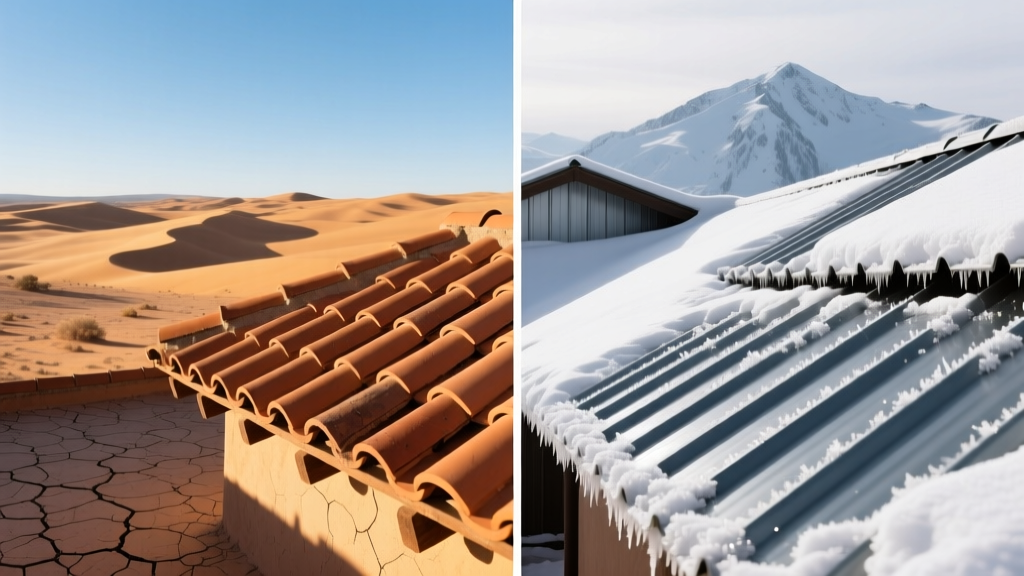
Hot-Dry & Desert Climates: Battling UV and Thermal Shock
In regions like Arizona, Nevada, and Southern California, roofs endure surface temperatures exceeding 160°F during summer afternoons, followed by rapid cooling at night. This thermal expansion and contraction causes standard asphalt shingles to blister, crack, and lose granules prematurely.
Material Selection and Pricing
Concrete and clay tiles are the dominant choices due to their thermal mass and natural ventilation properties. The cost of roofing materials in this category ranges from $450 to $650 per square for standard profile concrete tiles (e.g., Eagle Roofing or Boral). However, the hidden cost lies in structural reinforcement. Concrete tiles weigh 900 to 1,100 pounds per square. Upgrading roof trusses to support this dead load adds $3,500 to $6,000 to the overall project framing budget.
For low-slope or flat commercial and residential roofs in these zones, silicone cool roof coatings are mandatory for energy efficiency. According to ENERGY STAR Roof Products guidelines, highly reflective coatings can reduce peak cooling demand by 10-15%. High-solids silicone coatings (like Gaco Western) cost between $2.50 and $3.50 per square foot applied, significantly lowering interior HVAC strain.
Cold & Heavy Snow Climates: Preventing Ice Dams and Structural Overload
The Northeast, Great Lakes, and Mountain West require roofing systems engineered for heavy snow loads and the prevention of ice dams. When snow melts over a poorly ventilated attic and refreezes at the colder eaves, water is forced back up under the roofing material.
The Standing Seam Advantage
While architectural asphalt shingles are common, 24-gauge Galvalume standing seam metal is the superior choice for heavy snow regions. The interlocking panels and concealed fasteners eliminate penetration points for water intrusion, and the slick surface facilitates snow shedding. The cost of roofing materials for a 24-gauge standing seam system averages $950 to $1,400 per square.
Do not downgrade to 26-gauge metal to save $150-$200 per square. 26-gauge panels are prone to 'oil-canning' (visible waviness) and lack the structural rigidity to support the weight of localized snowdrifts, which can exceed 50 pounds per square foot in mountain valleys.
The Underlayment Multiplier
In cold climates, standard felt paper is insufficient. Building codes typically mandate an ice and water protector membrane along the eaves, valleys, and penetrations. A premium product like Grace Ice & Water Shield HT costs approximately $140 per roll (covering 200 square feet). For a standard 2,500-square-foot roof requiring full-deck coverage to mitigate severe ice damming risks, this underlayment upgrade adds $1,750 to the material cost alone.
Hot-Humid & Coastal Zones: Engineering for Wind Uplift and Corrosion
The Southeast and Gulf Coast face a dual threat: Category 4+ hurricane wind uplift and highly corrosive salt air. The cost of roofing materials here is heavily influenced by the necessity for non-corrosive metals and specialized fastening patterns.
Aluminum vs. Steel in Coastal Environments
Galvanized or Galvalume steel will rust rapidly within 5 to 10 miles of a saltwater coastline. Aluminum standing seam panels (such as the Petersen PAC-750 series) are mandatory for longevity. Aluminum material costs run $1,200 to $1,700 per square, roughly 20-30% higher than steel equivalents.
Furthermore, the IBHS FORTIFIED Roof Standard mandates specific edge metal and clip spacing to survive 130+ mph winds. Upgrading from standard perimeter clips to structural standing seam clips spaced at 12 inches on-center, paired with 304 stainless steel fasteners (rather than standard carbon steel), adds $400 to $600 per square to the accessory and fastener budget.
Mixed & Temperate Climates: Surviving Hail and Thermal Cycling
The Midwest and Mid-Atlantic experience drastic temperature swings and severe spring hailstorms. Here, the cost of roofing materials is defined by impact resistance ratings.
Class 4 Impact-Resistant Shingles
Standard 3-tab or basic architectural shingles will shatter when struck by 2-inch hail traveling at terminal velocity. Upgrading to a UL 2218 Class 4 impact-resistant shingle (e.g., Owens Corning Duration Storm or Malarkey Vista) costs between $165 and $220 per square. These shingles feature a rubberized (SBS modified) asphalt core that absorbs impact energy rather than fracturing.
Technical bulletins from the National Roofing Contractors Association (NRCA) emphasize that installing Class 4 shingles with standard smooth-shank nails negates their wind warranty. Contractors must use 1.25-inch ring-shank roofing nails to ensure the shingle remains anchored during the microbursts that typically accompany Midwestern hailstorms.
Hidden Climate-Specific Cost Multipliers
When budgeting, homeowners and contractors must account for the 'invisible' materials that make a roof climate-compliant. The base cost of roofing materials is merely the starting point.
- Ventilation Baffles and Ridge Vents: In hot-humid zones, inadequate intake ventilation causes moisture buildup and premature decking rot. Upgrading from standard box vents to a continuous ridge vent system (like Cobra SnowCountry, designed to block wind-driven snow in cold climates) costs $4.50 to $6.00 per linear foot.
- Synthetic Underlayment: In high-heat zones, traditional #15 asphalt felt dries out, becomes brittle, and tears under the weight of tile installers. High-temp synthetic underlayments (e.g., Tyvek Protec) cost $18 to $22 per square, compared to $8 for felt, but are non-negotiable for tile roofs.
- Pipe Boots and Flashing: Standard rubber pipe boots crack under intense UV exposure in the Southwest within 7 years. Upgrading to lead or silicone-coated aluminum pipe boots costs $15 to $25 each, compared to $4 for standard rubber, but extends the penetration seal lifespan to match the roof.
Lifecycle Cost vs. Upfront Investment
Analyzing the cost of roofing materials strictly through an upfront lens leads to poor long-term financial decisions. A $140/square architectural shingle roof in a hail-prone mixed climate may require full replacement every 12 years due to granule loss and mat fracturing. Over a 50-year period, the homeowner will purchase and install four roofs.
Conversely, a $1,100/square standing seam metal roof in the same climate will easily last 50 years with minimal maintenance. When factoring in insurance premium discounts (often 15-25% in states like Texas and Colorado for Class 4 and metal roofs) and the elimination of tear-off disposal fees for subsequent layers, the lifecycle cost of premium climate-specific materials frequently undercuts cheaper, climate-inappropriate alternatives.
Written by
Marcus ChenMarcus Chen is a licensed structural engineer (PE) and building materials analyst with over 12 years of experience across residential, commercial, and industrial construction. He holds a Master of Science in Civil Engineering from UC Berkeley and spent six years at Thornton Tomasetti before transitioning to independent consulting and technical writing. Marcus specializes in material selection for seismic-prone regions, concrete reinforcement strategies, and lifecycle cost analysis. His work has been cited by the American Concrete Institute (ACI) and the Structural Engineers Association of California (SEAOC). When he is not on a job site or at his desk, you will find him hiking the Sierra Nevada or restoring a 1920s craftsman bungalow in Oakland, CA.
More from Marcus Chen
View all
Construction Cost
How Much Did the Eiffel Tower Cost to Build?
How much did the Eiffel Tower cost to build in 1889? We adjust for inflation and compare its budget to modern skyscraper construction.
Aug 4, 2026

Fire Resistance
What Is a Fire Resistant Material? Testing & Certification Guide
Discover what is a fire resistant material through ASTM and UL testing. Learn how fire ratings, certifications, and assemblies work in construction.
Aug 4, 2026

Construction Cost
How Much Did the Burj Khalifa Cost to Build?
How much did the Burj Khalifa cost to build? We break down the $1.5B project and extract 5 money-saving strategies for your next build.
Jul 30, 2026