Top Types of Roofing Materials for Flat Roofs by Climate
Discover the best types of roofing materials for flat roofs based on your climate zone. Compare TPO, EPDM, PVC, and Mod-Bit for 2026 installations.

The Climate-Material Mismatch: Why Flat Roofs Fail
Low-slope and flat roof failures are rarely caused by the membrane material itself degrading uniformly. Instead, 80% of premature failures stem from a fundamental mismatch between the membrane chemistry and the local microclimate. A material that performs flawlessly in the arid Southwest will suffer catastrophic seam failure in the freeze-thaw cycles of the Northeast. When evaluating the types of roofing materials for flat roofs, contractors and building owners must prioritize climate-specific physical properties—such as thermal shock resistance, solar reflectance, and wind uplift tolerance—over generic lifespan claims.
This guide breaks down the optimal flat roof membranes for the four primary North American climate zones, detailing exact material specifications, installation methods, and 2026 cost expectations.
Climate-to-Material Decision Matrix
| Climate Zone | Primary Membrane | Optimal Thickness | Seam Technology | Key Vulnerability |
|---|---|---|---|---|
| Hot / Arid (Southwest) | TPO / PVC | 60-mil to 80-mil | Hot-Air Welded | UV plasticizer migration |
| Cold / Snowy (Northeast) | Black EPDM / SBS Mod-Bit | 60-mil (EPDM) | Primer & Tape / Torch | Ice wedging at seams |
| Coastal / High-Wind (Gulf) | Reinforced PVC | 50-mil to 60-mil | Hot-Air Welded | Chemical degradation from salt |
| Wet / Humid (Pacific NW) | PVC / Tapered BUR | 60-mil (PVC) | Hot-Air Welded | Ponding water & biological growth |
Hot & Arid Climates: Battling UV and Thermal Shock
In regions like Arizona, Nevada, and Southern California, flat roofs endure surface temperatures exceeding 160°F (71°C) and intense ultraviolet radiation. The primary objective here is solar reflectance to reduce cooling loads and prevent thermal degradation of the polymer chains.
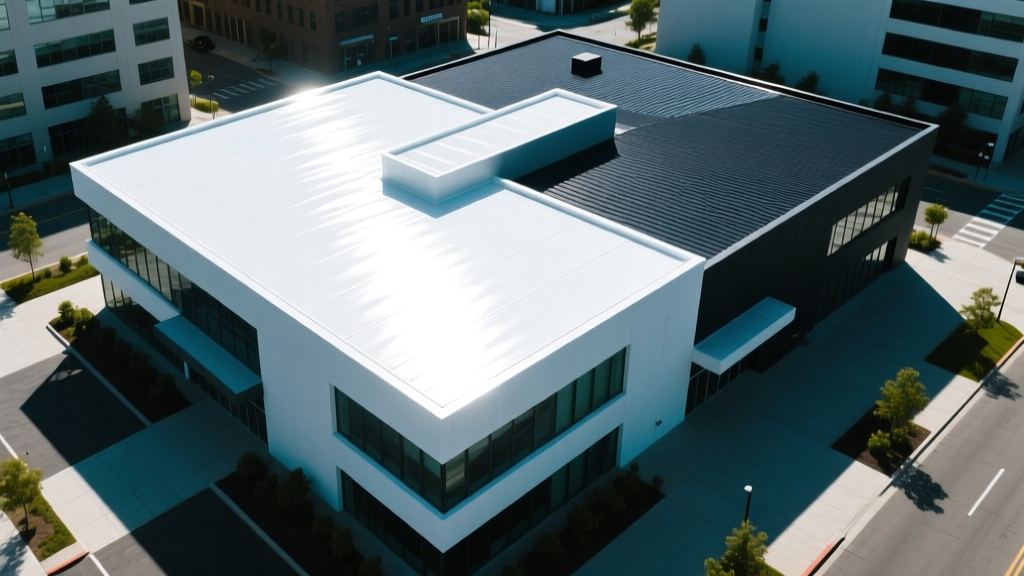
The Solution: 60-Mil+ White TPO or PVC
Thermoplastic Polyolefin (TPO) and Polyvinyl Chloride (PVC) are the undisputed leaders in hot climates. According to the US Department of Energy, cool roofs must maintain a Solar Reflectance Index (SRI) of at least 78 to qualify for energy efficiency standards. Premium 60-mil white TPO membranes, such as GAF EverGuard or Carlisle Sure-Weld, start with an SRI of 104 and maintain an SRI above 83 after three years of weathering.
Cold & Snowy Climates: Managing Freeze-Thaw and Static Loads
Buildings in the Midwest and Northeast face a different enemy: thermal shock. Winter temperatures can swing from 10°F to 45°F in a single day, causing roofing materials to expand and contract violently. Furthermore, heavy snow accumulation adds immense static weight, and ice dams can force water backward under poorly sealed seams.
The Solution: 60-Mil Black EPDM or SBS Modified Bitumen
Ethylene Propylene Diene Terpolymer (EPDM) remains the gold standard for cold climates. Unlike thermoplastics, EPDM is a thermoset rubber that retains its flexibility down to -40°F. Installing a black EPDM membrane (like Elevate RubberGard) is a deliberate thermal strategy: the dark surface absorbs solar radiation, raising the roof temperature just enough to melt the bottom layer of snowpack, facilitating drainage and reducing the risk of structural overload.
Seam Vulnerability in Winter
The Achilles heel of EPDM is the seam. Traditional liquid adhesives and peel-and-stick tapes can become brittle in sub-zero temperatures, leading to ice wedging. For cold-climate EPDM installations, mandate the use of 3-inch or 6-inch butyl-backed seam tape applied with a specialized primer, and ensure all perimeter flashings are mechanically fastened with termination bars rather than relying solely on adhesive.
Coastal & High-Wind Zones: Engineering for Uplift
Florida, the Gulf Coast, and the Eastern Seaboard require flat roofs that can survive Category 4 hurricane wind uplift and resist corrosive salt spray. Wind does not just blow across a roof; it creates negative pressure (uplift) at the corners and perimeters that can peel a poorly secured membrane off the deck in seconds.
The Solution: Fleece-Backed Reinforced PVC
PVC membranes, specifically those reinforced with polyester scrim and backed with fleece (such as Sika Sarnafil G410), offer the highest wind-uplift ratings. The Insurance Institute for Business & Home Safety (IBHS) emphasizes that membrane adhesion and seam integrity are the most critical factors in windstorm survival. PVC seams are fused together using hot-air welding at 1,000°F, creating a monolithic, continuous sheet that is physically stronger than the membrane itself.
- Fastening Protocol: Avoid fully adhered systems on coastal concrete decks unless the concrete has cured for a minimum of 28 days and passed a moisture vapor emission test. Instead, utilize a mechanically attached system with heavy-duty corrosion-resistant fasteners and stress plates, spaced no more than 12 inches apart in the perimeter zones.
- FM 1-90 Rating: Ensure the specified PVC system carries an FM Global 1-90 wind uplift rating, indicating it can withstand 90 pounds per square foot of negative pressure.
High-Precipitation & Humid Zones: Slope and Biological Resistance
In the Pacific Northwest and the Southeast, flat roofs are subjected to relentless rainfall and high humidity. The primary threat is not the water itself, but ponding water and the biological growth (algae, moss, and mold) that thrives in damp, shaded conditions.
The Solution: Tapered Polyiso Insulation with PVC or Mod-Bit
The National Roofing Contractors Association (NRCA) strictly defines a low-slope roof as having a minimum pitch of 1/4 inch per foot. On structurally flat decks, this slope must be engineered using tapered polyisocyanurate (polyiso) insulation boards.
Most single-ply membrane manufacturers (including major TPO and EPDM brands) include a 'ponding water exclusion' in their standard warranties. If water remains on the roof for more than 48 hours after rainfall, the warranty is voided. PVC is the only single-ply membrane that consistently offers warranties that explicitly cover ponding water, making it the safest choice for roofs with complex HVAC layouts that impede drainage.
2026 Installed Cost Breakdown by Material
Pricing for commercial and residential flat roofing has stabilized following the supply chain disruptions of the early 2020s, though labor rates for specialized hot-air welding and torch-application continue to rise. The following ranges reflect fully installed costs (materials, labor, tear-off of one existing layer, and standard fasteners) for a 10,000 sq. ft. commercial roof in 2026.
| Membrane Type | 2026 Installed Cost (per sq. ft.) | Labor Intensity | Expected Lifespan |
|---|---|---|---|
| 60-mil TPO (Mechanically Attached) | $5.50 - $7.50 | Moderate | 20 - 25 Years |
| 60-mil Black EPDM (Fully Adhered) | $6.00 - $8.50 | High | 25 - 30 Years |
| 50-mil Reinforced PVC (Fully Adhered) | $8.00 - $11.50 | High (Specialized Welding) | 25 - 35 Years |
| Two-Ply SBS Modified Bitumen (Torch) | $6.50 - $9.00 | High (Fire Risk/Insurance) | 20 - 25 Years |
Making the Final Selection
Choosing the correct flat roof material requires looking past the initial price per square foot. A $6.00 TPO roof in a coastal hurricane zone will likely fail its seams within a decade due to uplift and salt degradation, whereas a $10.00 PVC system will easily survive 30 years. Always cross-reference the manufacturer's technical data sheets for specific SRI values, cold-weather flexibility ratings (ASTM D2136), and wind uplift certifications (FM 4474) before finalizing your material schedule.
Written by
Sarah WhitfieldSarah Whitfield is a chartered quantity surveyor (MRICS) and construction cost analyst with 15 years of experience in material pricing, procurement strategy, and project budgeting. She earned her degree in Construction Management from the University of Reading (UK) and has worked on projects ranging from $2M custom homes to $180M mixed-use developments across North America and Europe. Sarah currently leads cost estimating for BuildMat Insight, maintaining a proprietary database of 4,000+ material price points updated quarterly. She is a frequent contributor to RSMeans cost data panels and has presented at the International Cost Engineering Council (ICEC) congress. Based in Denver, CO, Sarah is an avid trail runner and volunteer mentor for Women in Construction.
More from Sarah Whitfield
View all
Wood & Lumber
What Are the Different Types of Wood? A Builder's Guide
Compare structural softwoods, finish hardwoods, and engineered lumber. Analyze Janka ratings, MOE values, and 2026 pricing for construction.
Aug 4, 2026

Walls & Panels
Steel Framing vs Wood Framing: Corrosion and Moisture Defense
Compare steel framing vs wood framing for moisture resistance. Learn about galvanized coatings, condensation risks, and corrosion protection strategies.
Jul 21, 2026

Stone & Masonry
How to Cut Stone Veneer: Wet Saw vs Grinder Comparison
Compare the best tools for cutting stone veneer. We review wet saws, angle grinders, and chop saws to help you achieve clean, chip-free cuts.
Jul 21, 2026