Flat Roof Repair Materials: 2026 Cost Breakdown & Guide
Compare 2026 costs for flat roof repair materials including EPDM, TPO, Mod-Bit, and liquid silicone. Get exact pricing, product picks, and hidden fees.

The 2026 Flat Roof Repair Materials Cost Matrix
Selecting the correct flat roof repair materials requires understanding that low-slope systems (under 3:12 pitch) manage water through continuous membranes rather than gravity-driven shedding. In 2026, material costs have stabilized following post-pandemic supply chain shifts, but specialized chemical adhesives and high-solids silicone coatings have seen a 6-8% price increase due to raw material constraints. The matrix below outlines baseline material costs for localized repairs, excluding full tear-offs or structural decking replacement.
| Material Type | Primary Repair Use | Material Cost (Per Sq. Ft.) | Labor/Equipment Add-on | Expected Repair Lifespan |
|---|---|---|---|---|
| EPDM Tape & Primer | Seam separation, flashing pulls | $0.85 - $1.20 / lin. ft. | Low (Hand tools) | 10 - 15 Years |
| TPO/PVC Welded Patches | Punctures, membrane shrinkage | $1.50 - $2.25 / sq. ft. | High (Hot-air welder req.) | 15 - 20 Years |
| Modified Bitumen (Cold) | Blisters, granule loss, cracks | $1.75 - $2.50 / sq. ft. | Medium (Trowel/roller) | 8 - 12 Years |
| 100% Silicone Coating | Ponding water, UV restoration | $1.40 - $1.90 / sq. ft. | Medium (Airless sprayer) | 10 - 15 Years |
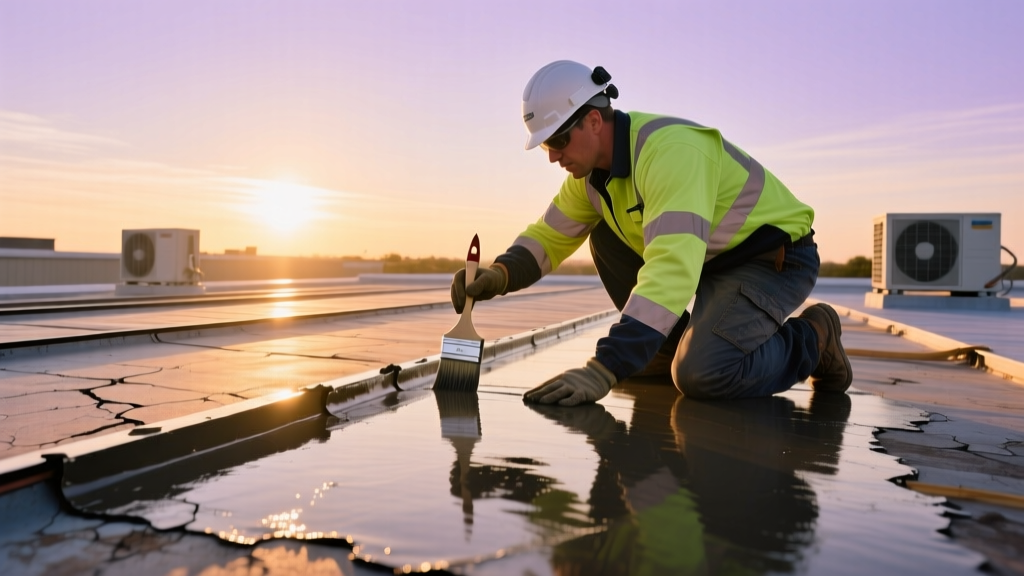
Material-Specific Repair Costs & Product Specifications
Generic patching compounds fail on low-slope roofs because they cannot withstand prolonged UV exposure or ponding water. Below is a breakdown of industry-standard flat roof repair materials, specific product recommendations, and exact application parameters for 2026.
EPDM (Rubber) Membrane Repairs
EPDM roofs primarily fail at the seams due to thermal expansion and contraction breaking down the original lap sealant. The most reliable repair method avoids liquid adhesives in favor of butyl-based tape systems.
- Recommended Product: Eternabond RoofSeal (4-inch width for standard seams, 6-inch for inside/outside corners).
- Material Cost: A 50-foot roll of 4-inch tape costs approximately $45 ($0.90 per linear foot).
- Preparation Requirement: You must use a specialized primer like Firestone QuickPrime Plus ($85 per gallon, covers ~250 linear feet) applied with a scrub pad to activate the EPDM surface before tape application. Skipping the primer reduces repair lifespan by 70%.
- Application Edge Case: Never apply EPDM tape over silicone-based caulking or wet surfaces. The butyl adhesive will not bond, leading to immediate fish-mouthing and water infiltration.
TPO & PVC (Thermoplastic) Repairs
Unlike EPDM, TPO and PVC membranes cannot be reliably repaired with tapes or cold adhesives. The chemical composition requires thermal fusion to create a watertight, monolithic patch.
- Recommended Product: Carlisle Sure-Weld TPO or GAF EverGuard TPO patching membranes.
- Material Cost: $1.50 to $2.25 per square foot for the patching membrane itself.
- Equipment Cost Barrier: A professional hot-air welder (e.g., Leister Triac) costs between $600 and $1,200. The welding tip must be set precisely between 1100°F and 1300°F depending on ambient temperature and wind speed.
- Failure Mode: 'Cold welds' occur when the welder moves too fast or the temperature is too low, allowing the patch to peel under wind uplift. 'Burn-throughs' happen when the welder lingers too long, melting the reinforcing scrim layer inside the TPO.
Modified Bitumen (Mod-Bit) Repairs
Mod-bit roofs (SBS or APP) are essentially asphalt-based systems reinforced with fiberglass or polyester. While torch-down is standard for installation, cold-process adhesives are safer and more practical for localized repairs.
- Recommended Product: Henry 885 Tropi-Cool or GAF RUBEROID Cold Process Adhesive paired with granulated cap sheets.
- Material Cost: $1.75 to $2.50 per square foot (including adhesive and cap sheet).
- Application Specifics: For blister repairs, cut an 'X' into the blister, fold back the flaps, dry the interior with a heat gun, apply mastic, and press flat. Cover with a Mod-Bit patch extending at least 4 inches beyond the blister edges in all directions.
Liquid Applied Coatings (Silicone)
For roofs suffering from widespread seam fatigue, alligatoring, or ponding water issues, localized patching is a temporary bandage. Fluid-applied silicone coatings restore the entire membrane.
Never use acrylic or urethane coatings on flat roofs with ponding water. Acrylics will re-emulsify and wash away after 48 hours of standing water. Only 100% high-solids silicone (like GacoRoof 100% Silicone) can withstand indefinite ponding water without degrading.
- Material Cost: A 5-gallon pail of high-solids silicone costs $380 - $450. At a required thickness of 20 dry mils, coverage is roughly 50 square feet per gallon, equating to $1.52 - $1.80 per square foot.
- Preparation: Power washing and treating biological growth (mold/algae) with a biocide is mandatory. Silicone will not adhere to dirt or chalked oxidation.
Hidden Costs That Destroy Flat Roof Repair Budgets
When estimating flat roof repair materials, contractors and facility managers often overlook the substrate. The membrane is only as good as the insulation beneath it.
The most common budget-killer in flat roof repairs is hidden moisture in the polyisocyanurate (polyiso) insulation layer. If water has infiltrated the membrane and saturated the insulation, applying surface-level flat roof repair materials will trap the moisture. When the sun heats the roof, the trapped water turns to steam, causing massive blistering and deck rot. Always perform 3-4 core cuts per 10,000 sq. ft. before purchasing materials. If the core cut reveals moisture content above 25%, the affected insulation must be cut out and replaced. Budget an additional $3.50 - $5.00 per sq. ft. for localized insulation replacement and new vapor barriers.
According to the National Roofing Contractors Association (NRCA), applying a new membrane or coating over wet insulation is the leading cause of premature flat roof replacement, voiding almost all manufacturer warranties.
Diagnostic Framework: Matching Material to Damage
Use this decision tree to select the exact flat roof repair materials required for your specific failure mode:
- Is the leak originating at a seam or flashing detail?
- If EPDM: Purchase QuickPrime Plus and 4-inch butyl seam tape.
- If TPO/PVC: Purchase matching membrane strips and rent a hot-air hand welder.
- Is the membrane punctured by debris or foot traffic?
- Action: Cut away the damaged section. Install a new patch that extends 6 inches past the puncture in all directions. For Mod-Bit, use cold mastic and a granulated cap sheet. For single-ply, use the manufacturer's approved welding or bonding adhesive.
- Is the roof experiencing widespread 'alligatoring' or seam fatigue?
- Action: Localized patches will fail within months. Transition to a fluid-applied system. Purchase 100% silicone coating, polyester reinforcing fabric for all seams, and a heavy-duty airless sprayer capable of handling high-viscosity materials.
- Is there visible ponding water lasting more than 48 hours?
- Action: Do not rely on standard acrylic elastomerics. Source high-build silicone or polyurethane mastics specifically rated for ponding water, and consider installing tapered EPS crickets to redirect water to scuppers before coating.
Procurement & Sourcing Strategies for 2026
Sourcing flat roof repair materials directly from big-box home improvement centers often results in purchasing consumer-grade products that lack commercial UV stabilizers. For lasting repairs, procure materials through specialized roofing distributors (e.g., ABC Supply, Beacon Building Products, or SRS Distribution).
When purchasing TPO or EPDM membranes for patches, ensure you are buying from the exact same manufacturer as the existing roof. Mixing TPO formulations from different manufacturers (e.g., welding a Carlisle patch onto a Johns Manville roof) can result in incompatible polymer blends that fail to fuse properly, leading to cold welds and immediate leak recurrence. Always verify the membrane's manufacturing date; TPO stored in unclimate-controlled warehouses for more than 18 months can experience surface oxidation that requires aggressive wire-brushing before it will accept a thermal weld.
Written by
Sarah WhitfieldSarah Whitfield is a chartered quantity surveyor (MRICS) and construction cost analyst with 15 years of experience in material pricing, procurement strategy, and project budgeting. She earned her degree in Construction Management from the University of Reading (UK) and has worked on projects ranging from $2M custom homes to $180M mixed-use developments across North America and Europe. Sarah currently leads cost estimating for BuildMat Insight, maintaining a proprietary database of 4,000+ material price points updated quarterly. She is a frequent contributor to RSMeans cost data panels and has presented at the International Cost Engineering Council (ICEC) congress. Based in Denver, CO, Sarah is an avid trail runner and volunteer mentor for Women in Construction.
More from Sarah Whitfield
View all
Wood & Lumber
What Are the Different Types of Wood? A Builder's Guide
Compare structural softwoods, finish hardwoods, and engineered lumber. Analyze Janka ratings, MOE values, and 2026 pricing for construction.
Aug 4, 2026

Walls & Panels
Steel Framing vs Wood Framing: Corrosion and Moisture Defense
Compare steel framing vs wood framing for moisture resistance. Learn about galvanized coatings, condensation risks, and corrosion protection strategies.
Jul 21, 2026

Stone & Masonry
How to Cut Stone Veneer: Wet Saw vs Grinder Comparison
Compare the best tools for cutting stone veneer. We review wet saws, angle grinders, and chop saws to help you achieve clean, chip-free cuts.
Jul 21, 2026