Flat Roofing Materials Compared: EPDM vs TPO vs PVC in 2026
Compare top flat roofing materials for 2026. We break down EPDM, TPO, and PVC membranes by cost, lifespan, and energy efficiency to help you choose.

The Big Three: Single-Ply Membrane Showdown
When evaluating flat roofing materials for commercial or low-slope residential projects, the market is dominated by three single-ply synthetic membranes: EPDM, TPO, and PVC. Each possesses distinct chemical properties, installation requirements, and failure modes. Selecting the wrong membrane for a specific building use—such as installing standard TPO over a commercial kitchen exhaust—can lead to catastrophic membrane degradation within five years. This guide breaks down the exact material science, 2026 pricing, and application-specific decision frameworks required to make a definitive choice.
Ethylene Propylene Diene Monomer (EPDM)
EPDM is a vulcanized synthetic rubber derived from oil and natural gas. It has been the industry workhorse since the 1960s. The most common commercial product, Elevate (formerly Firestone) RubberGard, is available in 45-mil, 60-mil, and 90-mil thicknesses. For any fully adhered or mechanically attached commercial application in 2026, 60-mil is the absolute minimum baseline to ensure adequate puncture resistance.
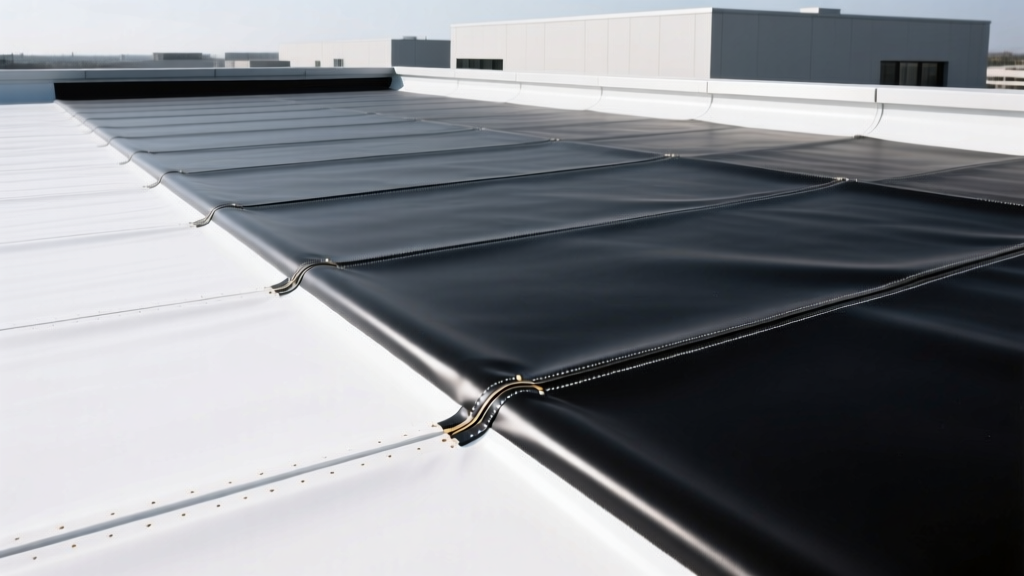
Standard EPDM is black, which yields a very low Solar Reflectance Index (SRI). While this is a liability in cooling-dominated climates, black EPDM is highly advantageous in northern, heating-dominated climates where solar heat gain reduces winter HVAC loads and helps melt snow accumulation. White EPDM is available but typically carries a 25% to 30% material premium and requires more frequent cleaning to maintain its reflectivity.
The Achilles Heel: EPDM relies on seam tape and liquid lap sealants rather than heat welding. Over a 15-year period, UV exposure and thermal cycling cause the membrane to shrink, placing immense shear stress on the taped seams. Seam failure is the number one cause of leaks in aging EPDM systems.
Thermoplastic Polyolefin (TPO)
TPO is a blend of polypropylene and ethylene-propylene rubber, engineered to combine the durability of EPDM with the heat-weldable seams of PVC. Because the seams are thermally fused using a hot-air welder at roughly 1,000°F, the seam becomes as strong as the membrane itself, virtually eliminating the shrinkage-related seam failures seen in EPDM.
Early generations of TPO (pre-2015) suffered from severe brittleness and cracking due to inadequate UV stabilizers. Modern 2026 formulations, such as Carlisle Sure-Weld and GAF EverGuard Extreme, utilize advanced HALS (Hindered Amine Light Stabilizers) and thicker top weathering plies. When specifying TPO, ensure the product meets the latest ASTM D6878 standard, and opt for an 80-mil thickness if the building is located in a high-hail region or experiences severe thermal shock.
Polyvinyl Chloride (PVC) and KEE Membranes
PVC is the premium tier of single-ply membranes. Standard PVC relies on liquid plasticizers to maintain flexibility. Over decades, these plasticizers can migrate out of the membrane, leading to brittleness. However, high-end PVC membranes like Sika Sarnafil utilize advanced scrim reinforcement and proprietary plasticizer retention technologies to achieve lifespans exceeding 30 years.
For facilities exposed to harsh chemicals, animal fats, or vegetable oils (such as restaurants, food processing plants, or hospitals), standard PVC and TPO will rapidly degrade. In these scenarios, you must specify a KEE (Ketone Ethylene Ester) membrane, such as FiberTite. KEE is a solid polymer, not a liquid plasticizer, meaning it cannot leach out. It offers unmatched chemical resistance and remains permanently flexible, justifying its premium cost.
Head-to-Head Cost and Performance Matrix
The following data reflects national average commercial installation costs and performance metrics for 2026. Prices assume a standard 10,000+ square foot roof deck with polyisocyanurate insulation.
| Material | Standard Thickness | Installed Cost (per sq. ft.) | Expected Lifespan | Seam Method | Best Application |
|---|---|---|---|---|---|
| EPDM (Black) | 60-mil | $5.50 - $8.00 | 15 - 25 Years | Primer & Tape | Budget warehouses, Northern climates |
| TPO | 60-mil / 80-mil | $6.50 - $9.50 | 20 - 30 Years | Heat Welded | Retail, offices, cooling-dominated climates |
| PVC (Standard) | 50-mil / 60-mil | $8.50 - $11.50 | 25 - 35 Years | Heat / Solvent Welded | Hospitals, high-wind coastal zones |
| PVC (KEE) | 36-mil / 50-mil | $10.50 - $14.00 | 30 - 40+ Years | Hot Air Welded | Restaurants, chemical plants, grease exhaust |
Critical Failure Modes and Edge Cases
Warning: The Grease Trap Effect
Installing TPO or standard EPDM on a building with commercial kitchen exhaust fans is a critical error. Animal fats and vegetable oils aerosolized by HVAC systems condense on the roof. These lipids chemically break down the polymers in TPO and EPDM, causing the membrane to dissolve into a sticky sludge near the exhaust curbs. Always specify KEE or heavy-duty PVC with welded grease guards in these zones.
Insight: Wind Uplift and Fastener Back-Out
In mechanically attached TPO and PVC systems, the membrane is secured with screws and stress plates. In regions with high diurnal temperature swings, the metal roof deck expands and contracts at a different rate than the fasteners. Over 10 years, this thermal ratcheting can cause fasteners to back out, compromising the FM Global wind uplift rating. For buildings in hurricane-prone or high-wind corridors, fully adhered systems (using low-VOC contact adhesives) are mandatory to achieve FM 1-135 uplift ratings.
Installation Methodologies: How They Impact Cost and Performance
The membrane itself is only half the equation. The attachment method dictates the system's wind resistance, aesthetic profile, and final cost.
- Mechanically Attached: The membrane is fastened to the deck using screws and plates, with the next sheet overlapping and covering the fasteners. This is the fastest and most cost-effective method but leaves the roof vulnerable to wind billowing and fastener fatigue. Adds roughly $0.50 to $1.00 per sq. ft. to material costs.
- Fully Adhered: The membrane is glued directly to the insulation cover board using specialized bonding adhesives. This creates a monolithic, wrinkle-free surface with superior wind uplift resistance and hail performance (as there is no air gap for the hail to flex the membrane). Adds $1.50 to $2.50 per sq. ft. in labor and adhesive costs.
- Ballasted: Primarily used for EPDM. The membrane is laid loose over the deck and held down by river-washed stone or concrete pavers. This is highly cost-effective for large, flat, structurally robust buildings (the deck must support 10-15 lbs per sq. ft. of dead load). However, locating leaks under ballast is notoriously difficult.
Climate-Specific Decision Framework
According to the U.S. Environmental Protection Agency's guidelines on cool roofs, selecting a roofing material with high solar reflectance can reduce peak cooling demand by 10% to 15%. However, energy efficiency must be balanced against local climate realities.
- ASHRAE Climate Zones 1-3 (Hot/Humid & Hot/Dry): White TPO or PVC is mandatory. The high SRI (typically 80+) drastically reduces cooling loads and mitigates the urban heat island effect. Ensure the TPO features a reinforced scrim to resist thermal shock from sudden afternoon rainstorms.
- ASHRAE Climate Zones 5-7 (Cold & Very Cold): Black EPDM or dark-colored PVC becomes highly viable. The solar heat gain reduces winter heating costs, which often outweighs the summer cooling penalty. Furthermore, the darker surface aids in melting snow, reducing the risk of structural overload and ice damming at parapets.
- Coastal and High-Wind Zones: Avoid ballasted systems entirely due to the risk of ballast becoming airborne projectiles during hurricanes. Specify a fully adhered PVC system with a fleece backing, which provides superior adhesive bonding and added puncture resistance against wind-borne debris.
Final Procurement Advice for 2026
When drafting your roofing specifications, do not simply write '60-mil TPO'. You must specify the exact manufacturer, product line, and ASTM standard (e.g., 'Carlisle Sure-Weld 60-mil TPO, meeting ASTM D6878-23a'). Furthermore, always mandate a third-party roof observer or independent quality assurance (QA) representative during installation. The Building Science Corporation repeatedly highlights that the majority of single-ply roof failures are not due to material defects, but rather poor seam welding, inadequate fastener placement, and improper flashing details executed in the field. A $3,000 investment in third-party QA will protect a $150,000 roofing investment and ensure the manufacturer's 20-year NDL (No Dollar Limit) warranty remains fully valid.
Written by
Marcus ChenMarcus Chen is a licensed structural engineer (PE) and building materials analyst with over 12 years of experience across residential, commercial, and industrial construction. He holds a Master of Science in Civil Engineering from UC Berkeley and spent six years at Thornton Tomasetti before transitioning to independent consulting and technical writing. Marcus specializes in material selection for seismic-prone regions, concrete reinforcement strategies, and lifecycle cost analysis. His work has been cited by the American Concrete Institute (ACI) and the Structural Engineers Association of California (SEAOC). When he is not on a job site or at his desk, you will find him hiking the Sierra Nevada or restoring a 1920s craftsman bungalow in Oakland, CA.
More from Marcus Chen
View all
Construction Cost
How Much Did the Eiffel Tower Cost to Build?
How much did the Eiffel Tower cost to build in 1889? We adjust for inflation and compare its budget to modern skyscraper construction.
Aug 4, 2026

Fire Resistance
What Is a Fire Resistant Material? Testing & Certification Guide
Discover what is a fire resistant material through ASTM and UL testing. Learn how fire ratings, certifications, and assemblies work in construction.
Aug 4, 2026

Construction Cost
How Much Did the Burj Khalifa Cost to Build?
How much did the Burj Khalifa cost to build? We break down the $1.5B project and extract 5 money-saving strategies for your next build.
Jul 30, 2026