Metal Roofing Material Options Compared: Steel vs Aluminum vs Copper
Compare top metal roofing material options including steel, aluminum, and copper. Discover 2026 costs, gauge specs, and coastal vs inland durability.

The Core Metallurgy: Decoding Your Metal Roofing Material Options
Choosing the right metal roof requires looking past the surface finish and understanding the underlying metallurgy. The phrase "metal roof" encompasses vastly different alloys, each with unique thermal expansion rates, corrosion resistance, and structural rigidity. In 2026, material costs have stabilized, but the performance gap between properly specified alloys and budget substitutes remains stark. According to the Metal Construction Association, the lifespan of a metal roof is dictated not just by the base metal, but by the coating systems and fastener mechanics paired with it.
- Inland / Standard Residential: 24-gauge Galvalume steel with PVDF paint.
- Coastal / Salt-Air (Within 1,500 ft of surf): 0.032" Aluminum (3003-H14 alloy).
- Heritage / Architectural Landmarks: 16 oz or 20 oz Cold-Rolled Copper.
Galvalume Steel: The Inland Workhorse
When evaluating metal roofing material options for standard residential and commercial applications, steel dominates the market. However, not all steel is equal. You must specify Galvalume (ASTM A792), which features an aluminum-zinc alloy coating (typically AZ50 or AZ55). Avoid standard G90 galvanized steel for roofing; it lacks the aluminum barrier that prevents "edge creep" (rusting at the cut edges) and offers only a fraction of the salt-spray resistance.
Gauge and Rigidity Specifications
For standing seam profiles, 24-gauge (0.0239" thick) is the industry standard for residential roofs, providing the necessary rigidity to span purlins without oil-canning (visible rippling). For corrugated or exposed-fastener agricultural profiles, 26-gauge is acceptable but prone to dimpling around the fastener heads if over-driven.
2026 Pricing: Expect to pay between $10.50 and $15.00 per square foot for a fully installed 24-gauge Galvalume standing seam system, including synthetic underlayment and concealed clips.
Failure Modes to Avoid
The most common failure in steel roofing is galvanic corrosion caused by dissimilar metal contact. If your Galvalume steel panels are fastened using standard zinc-plated screws or come into contact with copper flashing, the steel will rapidly corrode. Always specify stainless steel fasteners or heavily coated carbon steel fasteners with a ceramic topcoat rated for the specific paint system.
Aluminum Roofing: The Coastal Champion
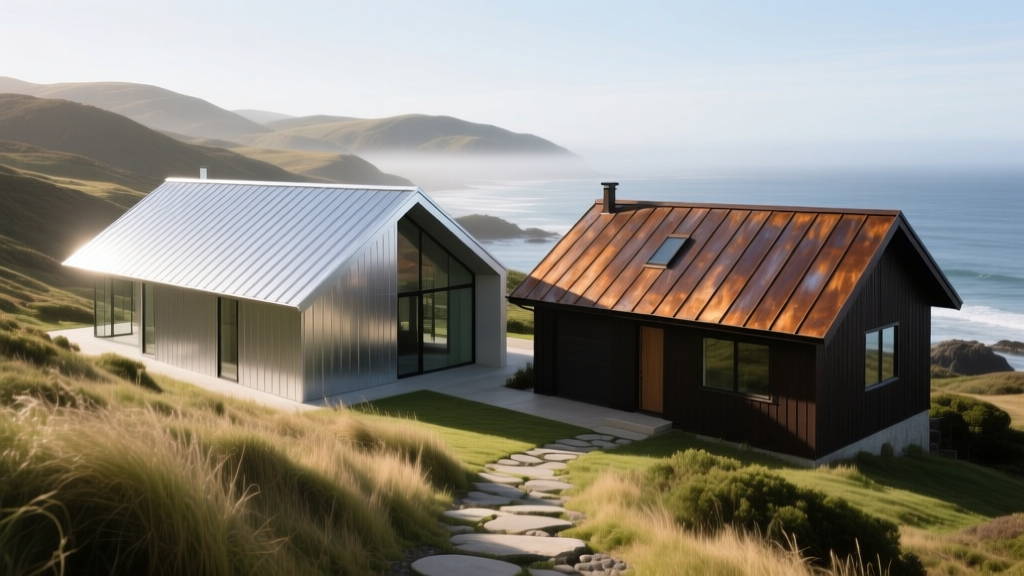
If your property is located within 1,500 feet of a saltwater coastline, steel is a liability. Aluminum is the only viable metal roofing material option for severe marine environments because it does not rust; it oxidizes, forming a microscopic, self-healing protective layer.
Alloy and Thickness Requirements
Roofing aluminum is typically formed from 3003-H14 or 3105-H14 alloys. The "H14" designation means the metal has been strain-hardened to increase its yield strength. Because aluminum is inherently less rigid than steel, you cannot use the same gauge numbers. A 26-g aluminum panel is flimsy and will tear under wind uplift. You must specify a minimum thickness of 0.032 inches (roughly equivalent to 22-gauge steel) for standing seam applications, or 0.040 inches for high-wind coastal zones.
2026 Pricing: Aluminum carries a premium due to raw material markets, averaging $14.00 to $19.50 per square foot installed.
Aluminum is highly anodic. If an aluminum roof panel touches a steel drip edge, a copper chimney cap, or even pressure-treated lumber (which contains alkaline copper quaternary), the aluminum will sacrifice itself and corrode rapidly. Always use heavy-duty rubberized peel-and-stick membranes or plastic slip sheets to isolate aluminum from dissimilar materials.
Copper and Zinc: The Premium Architectural Standards
For historical restorations or high-end architectural statements, copper and zinc represent the pinnacle of metal roofing material options. The Copper Development Association notes that a properly installed copper roof can easily exceed 100 years of service life, outlasting the building's underlying timber framing.
Specifying Copper Weight
Copper is measured in ounces per square foot rather than gauges. 16 oz copper (0.0216" thick) is standard for continuous standing seam roofs, while 20 oz copper (0.027" thick) is required for flat-lock seam roofs, valleys, and high-traffic areas.
The Patina and Runoff Reality
Copper's iconic verdigris patina takes 10 to 30 years to fully develop, depending on local rainfall and atmospheric sulfates. The critical design consideration is copper runoff. During the weathering process, copper ions wash off the roof and will permanently stain adjacent masonry, light-colored siding, and asphalt shingles. Furthermore, copper runoff will destroy standard aluminum gutters via galvanic action. You must design the drainage system to capture and route copper runoff independently, often using stainless steel or specialized polymer gutters.
2026 Pricing: Copper is a luxury investment, ranging from $32.00 to $48.00+ per square foot installed, heavily dependent on the complexity of the seam work and regional labor rates.
Head-to-Head Performance Matrix
| Material | Standard Spec | Installed Cost (2026) | Thermal Expansion | Best Environment |
|---|---|---|---|---|
| Galvalume Steel | 24-Gauge, AZ50 | $10.50 - $15.00 / sq ft | Low (Requires standard clips) | Inland, Standard Residential |
| Aluminum | 0.032" 3003-H14 | $14.00 - $19.50 / sq ft | High (Requires slotted clips) | Coastal, High-Humidity |
| Copper | 16 oz Cold-Rolled | $32.00 - $48.00 / sq ft | Moderate (Cleats required) | Heritage, Architectural |
Thermal Movement and Fastener Mechanics
The most frequently overlooked aspect of comparing metal roofing material options is the coefficient of thermal expansion. Metal roofs expand and contract significantly with daily and seasonal temperature swings. If the fastening system does not accommodate this movement, the panels will buckle, tear at the seams, or pop fasteners.
Aluminum expands at roughly twice the rate of steel. A 30-foot aluminum panel will move approximately 1/2 inch from a freezing winter night to a scorching summer afternoon. Therefore, aluminum standing seam roofs must be installed using floating clips with slotted holes, allowing the panel to slide over the clip as it expands. Steel panels move roughly 1/4 inch over the same span and can often utilize fixed clips on shorter roof runs, though floating clips are still recommended for runs exceeding 40 feet.
Paint Systems: PVDF vs. SMP
For steel and aluminum, the painted finish is your primary defense against UV degradation. There are two main resin systems used in architectural metal roofing:
- SMP (Silicone Modified Polyester): A budget-friendly option. SMP paints offer excellent hardness and scratch resistance during installation but are prone to chalking and fading after 10 to 15 years of UV exposure. Avoid SMP for dark colors (like charcoal or bronze), which absorb more heat and fade faster.
- PVDF (Polyvinylidene Fluoride): Marketed under brand names like Kynar 500 or Hylar 5000. PVDF resins are highly resistant to UV breakdown, retaining their color and chalk resistance for 30 to 40 years. The Department of Energy highlights that specialized cool-roof PVDF pigments can reflect significant solar radiation, reducing cooling loads by up to 15% in hot climates. Always specify PVDF for residential architectural roofs.
Expert Verdict: Finalizing Your Specification
Do not let a contractor dictate your alloy choice based solely on their inventory. If you live inland and want a cost-effective, highly durable roof, specify 24-gauge Galvalume steel with a PVDF coating and concealed stainless-steel clips. If you are building on the coast, reject steel entirely and mandate 0.032" aluminum with proper galvanic isolation membranes. For legacy projects where budget is secondary to a century-long lifespan, 16 oz copper remains unmatched—provided you engineer the drainage to handle the patina runoff. By matching the exact metallurgical properties to your specific environmental stressors, your metal roof will easily outlast traditional asphalt alternatives by a factor of three or more.
Written by
Marcus ChenMarcus Chen is a licensed structural engineer (PE) and building materials analyst with over 12 years of experience across residential, commercial, and industrial construction. He holds a Master of Science in Civil Engineering from UC Berkeley and spent six years at Thornton Tomasetti before transitioning to independent consulting and technical writing. Marcus specializes in material selection for seismic-prone regions, concrete reinforcement strategies, and lifecycle cost analysis. His work has been cited by the American Concrete Institute (ACI) and the Structural Engineers Association of California (SEAOC). When he is not on a job site or at his desk, you will find him hiking the Sierra Nevada or restoring a 1920s craftsman bungalow in Oakland, CA.
More from Marcus Chen
View all
Construction Cost
How Much Did the Eiffel Tower Cost to Build?
How much did the Eiffel Tower cost to build in 1889? We adjust for inflation and compare its budget to modern skyscraper construction.
Aug 4, 2026

Fire Resistance
What Is a Fire Resistant Material? Testing & Certification Guide
Discover what is a fire resistant material through ASTM and UL testing. Learn how fire ratings, certifications, and assemblies work in construction.
Aug 4, 2026

Construction Cost
How Much Did the Burj Khalifa Cost to Build?
How much did the Burj Khalifa cost to build? We break down the $1.5B project and extract 5 money-saving strategies for your next build.
Jul 30, 2026