Old Roofing Materials vs Modern Equivalents: A Full Comparison
Compare old roofing materials like slate, cedar, and clay tile against modern equivalents. Expert analysis on costs, weight, and lifespan.

The Restoration Dilemma: Authenticity vs. Engineering
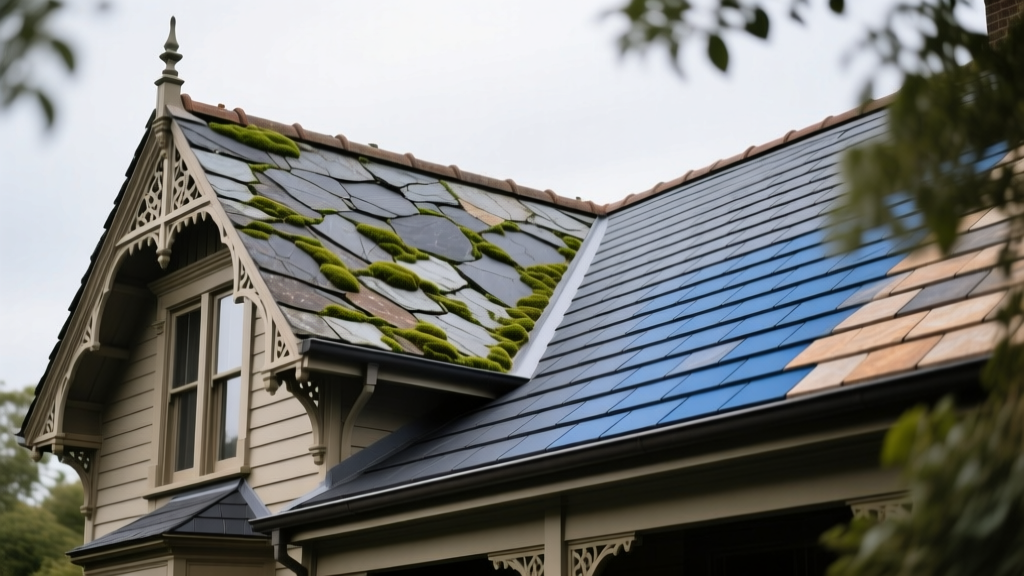
Property owners managing historic structures or aging residential builds frequently face a critical crossroads: repair failing old roofing materials or replace them with modern engineered alternatives. The decision extends far beyond aesthetics. It involves structural load limits, municipal fire codes, insurance premiums, and long-term lifecycle costs. While traditional materials like natural slate, old-growth cedar, and built-up tar offer undeniable historical authenticity, modern composites and single-ply membranes provide superior fire resistance, drastic weight reduction, and simplified installation.
Natural Slate vs. Synthetic Polymer Slate
Natural slate is the benchmark for longevity among old roofing materials, routinely lasting 100 to 150 years. However, its extreme weight and brittle nature make it a structural liability in regions with heavy snow loads or seismic activity.
Weight and Structural Framing
Natural slate weighs between 800 and 1,500 pounds per square (100 square feet). Installing it requires a minimum of 3/4-inch solid wood decking; modern spaced sheathing or standard 1/2-inch OSB will deflect and crack the tiles. Conversely, synthetic polymer slates (such as those manufactured by DaVinci Roofscapes or EcoStar) weigh approximately 300 pounds per square. This 75% weight reduction often eliminates the need for costly structural reinforcement when re-roofing older homes.
Fastening and Failure Modes
The most common failure mode in historic slate roofs is not the stone itself, but 'nail sickness.' Original installations often used hot-dipped galvanized or cut nails that rust through after 40-60 years, causing the pristine slate to slide off the roof. Modern synthetic slates are installed using standard roofing nails or staples, and because the material is flexible, it resists the micro-fractures that plague natural stone during freeze-thaw cycles.
Wood Shakes vs. Composite and Metal Alternatives
Traditional cedar shakes, particularly old-growth heartwood, were prized for their natural rot resistance and distinct shadow lines. Today, the use of natural wood is heavily restricted due to wildfire risks.
Fire Ratings and WUI Compliance
Untreated cedar shakes carry a Class C fire rating at best, and are entirely banned in Wildland-Urban Interface (WUI) zones across California, Colorado, and parts of the Pacific Northwest. Modern composite shakes (like CeDUR polyurethane shakes) and stone-coated metal shakes achieve a Class A fire rating, meaning they can withstand severe fire exposure without igniting. According to the Insurance Institute for Business & Home Safety (IBHS), upgrading to a Class A roof in WUI zones is a primary requirement for obtaining the FORTIFIED Home designation, which can reduce annual property insurance premiums by 15% to 30%.
Maintenance and Algae Resistance
Natural cedar requires periodic treatments for moss, algae, and UV degradation. Composite alternatives are molded with UV stabilizers and algae-resistant compounds, requiring zero chemical maintenance over their 50-year warranted lifespans.
Flat Roof Systems: Built-Up vs. Single-Ply Membranes
For commercial buildings and historic homes with low-slope additions, the traditional built-up roof (BUR)—consisting of alternating layers of asphalt and felts topped with gravel—was the standard for decades. While the gravel ballast provides excellent UV protection, BUR systems are incredibly heavy and prone to trapped moisture blistering.
Thermal Performance and Albedo
Old tar and gravel roofs absorb massive amounts of solar heat, driving up cooling costs. Modern 60-mil TPO (Thermoplastic Polyolefin) and PVC single-ply membranes are highly reflective. The U.S. Department of Energy notes that cool roof coatings and white single-ply membranes can reduce peak cooling demand by 10% to 15% by reflecting up to 80% of the sun's rays, compared to the 5% to 25% reflectivity of aged BUR systems.
Seam Integrity
BUR systems rely on hot-mopped asphalt adhesion, which degrades at the seams over time. Modern TPO and PVC membranes utilize hot-air welded seams, creating a monolithic, watertight bond that is physically stronger than the membrane itself.
Cost, Weight, and Lifespan Comparison Matrix
| Material Type | Weight per Square | Installed Cost (per sq.) | Expected Lifespan | Fire Rating |
|---|---|---|---|---|
| Natural Slate | 800 - 1,500 lbs | $1,500 - $2,500 | 100+ Years | Class A |
| Synthetic Polymer Slate | 250 - 350 lbs | $900 - $1,400 | 50 - 75 Years | Class A |
| Old-Growth Cedar Shake | 200 - 300 lbs | $800 - $1,200 | 25 - 40 Years | Class C |
| Composite/Metal Shake | 120 - 150 lbs | $900 - $1,500 | 50+ Years | Class A |
| Built-Up Tar & Gravel | 600 - 800 lbs | $500 - $800 | 20 - 30 Years | Class A |
| 60-Mil TPO / PVC | 30 - 50 lbs | $450 - $750 | 25 - 40 Years | Class A |
Structural and Code Considerations for Historic Homes
Replacing old roofing materials with lighter modern alternatives introduces a non-obvious structural dynamic: uplift vulnerability. Heavy materials like natural slate and clay tile act as a massive dead load that helps hold the roof structure down during high-wind events. When you remove 1,200 lbs per square of slate and replace it with 300 lbs per square of synthetic slate, the roof framing becomes significantly more susceptible to wind uplift.
Critical Engineering Note: Before downgrading from a heavy traditional roof to a lightweight modern equivalent, a structural engineer must recalculate the wind uplift loads. You will likely need to upgrade the roof-to-wall connections (e.g., adding hurricane ties or structural screws) to compensate for the lost dead load weight.
Furthermore, historic preservation guidelines strictly govern exterior alterations. The National Park Service Preservation Brief on Historic Roofing dictates that replacing highly visible historic materials with incompatible modern substitutes can compromise the building's architectural integrity. If the property is located within a designated historic district, synthetic slates or metal shakes must possess a high-fidelity profile and color-fastness to pass the local Historic Architectural Review Board (HARB) inspection.
Decision Framework: Restore or Replace?
Use this actionable framework to determine the optimal path for your specific property:
- Assess Historic Designation: Is the home on the National Register of Historic Places or in a strict HARB district? If yes, you must restore using original materials (natural slate, clay, or cedar) or source high-end architectural composites that have received prior board approval.
- Evaluate Framing Capacity: Hire a structural engineer to inspect the roof decking and trusses. If the framing is sagging or undersized by modern codes, you cannot install heavy natural slate or clay tile without a $15,000+ framing reinforcement. Switch to synthetic equivalents.
- Check WUI and Insurance Requirements: If your property is in a wildfire zone, natural cedar is legally prohibited or uninsurable. Mandate a switch to Class A composite or stone-coated metal shakes.
- Calculate Lifecycle ROI: For flat roofs, never replace old BUR with new BUR. The labor costs for hot-mopping are prohibitive, and the technology is obsolete. Upgrade to a mechanically fastened or fully adhered 60-mil TPO system to immediately reduce cooling loads and eliminate hot-work fire hazards during installation.
Choosing between old roofing materials and modern equivalents requires balancing historical fidelity with modern building science. By matching the material's weight, fire rating, and profile to your specific structural capacity and local code requirements, you can secure a roof that protects the asset for the next half-century without compromising its architectural legacy.
Written by
Marcus ChenMarcus Chen is a licensed structural engineer (PE) and building materials analyst with over 12 years of experience across residential, commercial, and industrial construction. He holds a Master of Science in Civil Engineering from UC Berkeley and spent six years at Thornton Tomasetti before transitioning to independent consulting and technical writing. Marcus specializes in material selection for seismic-prone regions, concrete reinforcement strategies, and lifecycle cost analysis. His work has been cited by the American Concrete Institute (ACI) and the Structural Engineers Association of California (SEAOC). When he is not on a job site or at his desk, you will find him hiking the Sierra Nevada or restoring a 1920s craftsman bungalow in Oakland, CA.
More from Marcus Chen
View all
Construction Cost
How Much Did the Eiffel Tower Cost to Build?
How much did the Eiffel Tower cost to build in 1889? We adjust for inflation and compare its budget to modern skyscraper construction.
Aug 4, 2026

Fire Resistance
What Is a Fire Resistant Material? Testing & Certification Guide
Discover what is a fire resistant material through ASTM and UL testing. Learn how fire ratings, certifications, and assemblies work in construction.
Aug 4, 2026

Construction Cost
How Much Did the Burj Khalifa Cost to Build?
How much did the Burj Khalifa cost to build? We break down the $1.5B project and extract 5 money-saving strategies for your next build.
Jul 30, 2026