True Cost to Build a Pergola with Roof: Maintenance & Repair Guide
Discover the true cost to build a pergola with roof by factoring in 10-year maintenance, material failure modes, and 2026 repair pricing.

The Hidden Lifecycle: Initial Build vs. Long-Term Upkeep
When homeowners research the cost to build a pergola with roof, standard calculators typically only factor in initial material and labor expenses. In 2026, the baseline cost to build a pergola with roof ranges from $4,500 to $12,500 for a standard 12x16-foot structure, depending on whether you choose pressure-treated pine, cedar, or composite framing. However, this initial figure ignores the most critical variable in outdoor construction: the 10-to-20-year maintenance and repair cycle.
A pergola roof is subjected to extreme thermal expansion, direct UV radiation, and structural deflection that standard residential roofs do not face. Because pergolas are often open-sided and lack the rigid shear walls of a home, the roofing materials experience unique stress vectors. Failing to account for long-term upkeep can easily add 30% to 60% to your total cost of ownership over a decade. This guide breaks down the true lifecycle costs, specific material failure modes, and exact 2026 repair pricing for the four most common pergola roofing systems.
Material-Specific Maintenance & Repair Cost Matrix
The table below contrasts the initial build costs with the projected 10-year maintenance expenses for a 192-square-foot (12x16) pergola roof.
| Roofing Material | Initial Build Cost (per sq ft) | 10-Year Maint. Cost (Total) | Primary Failure Mode | Repair Frequency |
|---|---|---|---|---|
| Multi-Wall Polycarbonate | $2.50 - $4.50 | $650 - $900 | UV yellowing, flute condensation | Every 4-6 years |
| Corrugated Metal (29-ga) | $4.00 - $7.50 | $350 - $550 | Fastener back-out, washer dry-rot | Every 7-10 years |
| Asphalt Shingles (Architectural) | $3.50 - $6.00 | $900 - $1,400 | Low-slope water pooling, decking rot | Every 5-8 years |
| EPDM Rubber Membrane (60-mil) | $4.50 - $8.00 | $400 - $700 | Seam tape adhesive failure, punctures | Every 8-12 years |
Polycarbonate Panels: UV Degradation and Hardware Fatigue
Multi-wall polycarbonate panels, such as Palram SunTuf or Tuftex PolyCarb, are the most popular choice for pergolas because they filter light while blocking rain. However, they require meticulous maintenance to prevent catastrophic degradation.
The Flute Contamination Problem
Polycarbonate sheets are extruded with hollow flutes (channels) that run the length of the panel. If the installer fails to apply breathable closure tape to the bottom edge and solid foil tape to the top edge, dust, algae, and moisture will enter the flutes. Within three years, the panels will develop dark, streaky internal condensation that cannot be cleaned. Repairing this requires removing the panels, power-washing the flutes with a mild bleach solution, drying them completely, and reapplying specialized polycarbonate tape. In 2026, professional labor for this restorative process costs between $450 and $700 per structure.
Hardware and Closure Strip Replacement
Polycarbonate expands and contracts significantly with temperature shifts. Standard aluminum or plastic closure strips that sit between the panel and the purlins will compress and degrade after 5 to 7 years, leading to wind-driven rain leaks. Furthermore, if the panels were installed with the UV-protective coating facing downward instead of upward, the sheets will yellow and become brittle, requiring a full replacement at $2.50 to $4.50 per square foot.
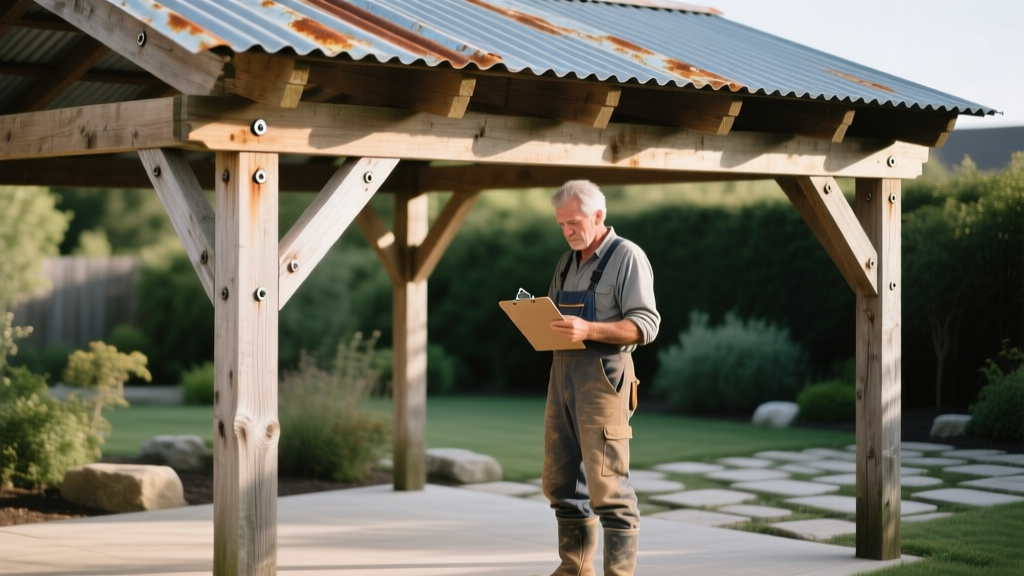
Corrugated Metal Roofing: Fastener Back-Out and Sealant Drying
Corrugated steel roofing, like Fabral Grandrib 3 or Pro-Rib, offers excellent longevity, but the weak point in any metal pergola roof is the fastening system. According to technical bulletins from the Metal Construction Association (MCA), thermal cycling causes metal panels to expand and contract, which slowly backs out self-drilling screws over time.
The Neoprene Washer Failure Cycle
Standard metal roofing screws utilize a neoprene or EPDM washer to create a watertight seal. After 7 to 10 years of direct UV exposure and thermal shock, these washers dry out, crack, and lose their compression. When this happens, water wicks directly into the wooden purlins, causing hidden structural rot.
Actionable Repair Protocol
When maintaining a metal pergola roof, do not simply tighten the existing loose screws; the hole in the wood is already stripped. The correct 2026 repair methodology involves: 1. Removing the failed fastener. 2. Inspecting the underlying purlin for rot and treating it with a liquid wood epoxy consolidant if necessary. 3. Re-driving a larger diameter fastener (e.g., upgrading from a #10 to a #14 x 2.5-inch grip screw) with a fresh, oversized EPDM washer. 4. Applying a dab of TPO lap sealant over the screw head for redundant waterproofing. Expect to pay a roofing contractor $85 to $135 per hour for this targeted fastener replacement, totaling roughly $350 to $550 for a standard pergola.
Shingled Pergola Roofs: Decking Rot and Ice Dam Vulnerability
Many homeowners choose architectural asphalt shingles (such as GAF Timberline HDZ) to match their primary residence. However, applying shingles to a pergola introduces severe maintenance liabilities due to roof pitch.
The Low-Slope Trap
Standard asphalt shingles require a minimum roof pitch of 4:12 to shed water effectively. Most pergolas are built with a much lower slope, often 2:12 or 3:12, to maintain head clearance. The National Roofing Contractors Association (NRCA) explicitly warns that installing shingles on low-slope applications leads to capillary action, where wind drives water upward under the shingle tabs.
Repairing Pergola Decking Rot
Because of this low-slope vulnerability, the OSB or plywood decking beneath the shingles frequently rots out long before the shingles themselves reach the end of their 30-year warranty. Repairing a rotted pergola roof deck requires:
- Stripping the existing shingles and underlayment.
- Replacing the rotted tongue-and-groove or plywood decking (material cost: $45 to $70 per 4x8 sheet in 2026).
- Installing a high-temp ice and water shield membrane (e.g., Grace Ice & Water Shield) over the entire deck, rather than just felt paper, to prevent future capillary leaks.
- Re-shingling the structure.
Flat and Low-Slope EPDM Membranes: Punctures and Seam Separation
For modern, flat-roofed pergolas, 60-mil EPDM rubber membranes (like Firestone Rubberguard) are the gold standard. While highly durable against UV and temperature extremes, EPDM requires specific maintenance at the seams and penetrations.
Seam Tape Adhesive Failure
EPDM sheets are joined using double-sided butyl seam tape. Over a decade, the adhesive can degrade, especially if the original installer failed to use EPDM primer before applying the tape. When seams separate, water pools on the flat pergola surface. Repairing this requires cleaning the seam with a specialized EPDM splice wash, applying fresh primer, and rolling on a new 3-inch or 6-inch wide cover tape. Liquid rubber coatings (like Henry 212) can also be brushed over suspect seams as a preventative measure.
Structural Deflection and Ponding Water
The American Wood Council (AWC) notes that outdoor structures are highly susceptible to deflection (sagging) under dead and live loads. If a pergola's joists are undersized (e.g., using 2x6s instead of 2x8s for a 12-foot span), the roof will sag in the center. This creates a ponding water issue that accelerates EPDM degradation and invites algae growth. Correcting this requires sistering new joists to the existing ones or adding mid-span support beams, a structural repair that can cost $1,500 to $3,000 in labor and materials.
'A common mistake in pergola maintenance is treating the roof in isolation. The roofing material is only as stable as the post-to-beam connections below it. Always inspect your metal post bases and carriage bolts for corrosion before investing in roof membrane repairs.'
Proactive Maintenance Checklist to Minimize Repair Costs
To keep your 10-year maintenance costs at the absolute minimum, execute this biannual inspection protocol in early spring and late autumn:
- Clear Debris from Valleys and Seams: Remove leaves and pine needles that trap moisture against polycarbonate closures or EPDM seams.
- Torque Check Metal Fasteners: Use a drill with a clutch setting to gently check for backed-out screws on metal roofs. Do not over-tighten, as this crushes the EPDM washer.
- Inspect Wood Purlins for Moisture: Use a moisture meter on the wooden framing directly beneath roofing overlaps. Readings above 19% indicate an active leak requiring immediate sealant intervention.
- Wash Polycarbonate with Mild Detergent: Use a soft sponge and a mixture of water and mild dish soap. Never use abrasive brushes or ammonia-based cleaners (like Windex), which will strip the co-extruded UV protective layer.
- Verify Structural Plumb: Use a 4-foot level on the primary support posts. If the pergola has shifted out of plumb due to frost heave or soil settlement, the roof pitch has changed, altering drainage patterns and requiring structural shimming.
Summary: Budgeting for the True Cost
Understanding the true cost to build a pergola with roof requires looking past the day-one invoice. If your priority is the lowest possible 10-year maintenance cost, a properly pitched corrugated metal roof with upgraded #14 fasteners is the superior choice. If you prefer the light-filtering aesthetics of polycarbonate, you must budget for flute-tape restorations and closure strip replacements. By selecting the right material for your specific climate and adhering to a strict biannual maintenance schedule, you can protect your investment and ensure your outdoor living space remains structurally sound and watertight for decades.
Written by
David NakamuraDavid Nakamura is a licensed architect (AIA) and construction technology writer focused on sustainable building methods, mass timber engineering, and high-performance building envelopes. He holds a Master of Architecture from the University of Washington and is a certified Passive House Consultant (CPHC). David spent eight years at the Seattle firm Mithun, where he led the design of three LEED Platinum projects, before founding his own practice specializing in net-zero residential design. He serves on the editorial advisory board of GreenBuilder Magazine and has authored peer-reviewed papers on cross-laminated timber (CLT) connections for the Journal of Structural Engineering. In his spare time, David teaches woodworking at Pratt Fine Arts Center and kayaks the Puget Sound.
More from David Nakamura
View all
Construction Cost
Labor Cost to Build a Deck Per Sq Ft: 2026 Installation Guide
Discover the exact labor cost to build a deck per sq ft in 2026. This installation guide breaks down contractor rates, complexity factors, and hidden fees.
Aug 4, 2026

Construction Cost
How Much Does It Cost to Build a 3 Bedroom House? Financing Guide
Learn exactly how much it costs to build a 3 bedroom house and explore 2026 financing options, construction loan types, and budget frameworks for your build.
Aug 4, 2026

Construction Cost
Cost to Build a Tennis Court: 2026 Guide
How much does it cost to build a tennis court in 2026? Breakdowns for asphalt, concrete, and synthetic surfaces plus fencing and lighting.
Jul 30, 2026