PVC Roof Material Cost Breakdown & 2026 Installation Guide
Detailed 2026 cost breakdown for PVC roof material. Compare 45, 60, and 80-mil membrane prices, installation labor, and long-term ROI for flat roofs.

The True Cost of PVC Roofing in 2026
Polyvinyl Chloride (PVC) roofing remains the premier single-ply membrane for commercial flat roofs, particularly for buildings with high chemical exposure, such as restaurants and manufacturing facilities. While the initial investment is higher than alternatives like TPO or EPDM, the long-term durability and heat-welded seam integrity offer a superior lifecycle value. As of 2026, the total installed cost for a commercial PVC roof system ranges from $8.50 to $14.50 per square foot, depending on membrane thickness, insulation requirements, and attachment methods.
Quick 2026 Cost Summary (Per Square Foot)
- Material Only (Membrane): $1.50 – $2.80
- Labor & Installation: $3.50 – $6.00
- Polyiso Insulation (2-inch): $1.80 – $2.50
- Total Installed System: $8.50 – $14.50
Membrane Thickness & Material Pricing Matrix
PVC membranes are manufactured in various thicknesses, measured in mils (thousandths of an inch). The National Roofing Contractors Association (NRCA) recommends a minimum of 60-mil for commercial applications to ensure adequate puncture resistance and long-term weathering. Premium brands like Sika Sarnafil and Carlisle SynTec dominate the market, with reinforced scrims (usually polyester) providing dimensional stability.
| Membrane Thickness | Material Cost (per sq. ft.) | Best Application | Warranty Expectancy |
|---|---|---|---|
| 45-Mil | $1.20 – $1.60 | Low-traffic, budget-conscious retrofits | 10 – 15 Years |
| 60-Mil (Standard) | $1.50 – $2.10 | Standard commercial flat roofs, restaurants | 20 Years (NDL) |
| 80-Mil (Heavy Duty) | $2.00 – $2.80 | High wind/hail zones, heavy rooftop traffic | 25 – 30 Years (NDL) |
Installation Methods & Labor Costs
The method used to secure the PVC membrane to the roof deck significantly impacts labor costs and overall wind-uplift resistance. Hot-air welding is the defining characteristic of PVC installation, creating a monolithic, watertight bond that is actually stronger than the membrane itself.
- Fully Adhered ($4.50 – $6.00/sq. ft. labor): The membrane is glued directly to the insulation using specialized PVC bonding adhesives. This method provides the highest wind-uplift ratings and a smooth, aesthetically pleasing finish without visible fastener plates. It is the most labor-intensive and expensive option.
- Mechanically Attached ($3.50 – $4.50/sq. ft. labor): The membrane is fastened to the structural deck using screws and stress plates, with the seams overlapping the fasteners before being hot-air welded. This is the most common and cost-effective method for new construction with steel or wood decks.
- Induction Welded ($4.00 – $5.50/sq. ft. labor): A hybrid approach where specialized plates are mechanically fastened to the deck, and an electromagnetic induction tool (like the RhinoBond system) is used to melt the underside of the PVC to the plates. This reduces membrane stress and allows for wider fastener spacing.
Hidden Costs: Insulation, Flashing, and Deck Prep
Contractors quoting a low 'per square foot' price often exclude critical system components. A functional PVC roof is a multi-layered assembly, and the ancillary materials can account for up to 40% of the total project cost.
Polyiso Insulation Upgrades
To meet modern energy codes, polyisocyanurate (polyiso) insulation is required. A standard 2-inch layer of polyiso adds $1.80 to $2.50 per square foot. If your building requires an R-30 or higher rating, you will need multiple staggered layers (e.g., two 2.5-inch boards), which increases material costs and requires longer mechanical fasteners, driving up labor.
Edge Metal and Penetration Flashing
PVC membranes cannot be simply caulked at the edges; they require specialized PVC-coated edge metal and custom-fabricated pipe boots. Budget an additional $1,500 to $3,500 for edge metal termination bars, parapet coping caps, and heat-welded penetration flashings for HVAC units and plumbing vents.
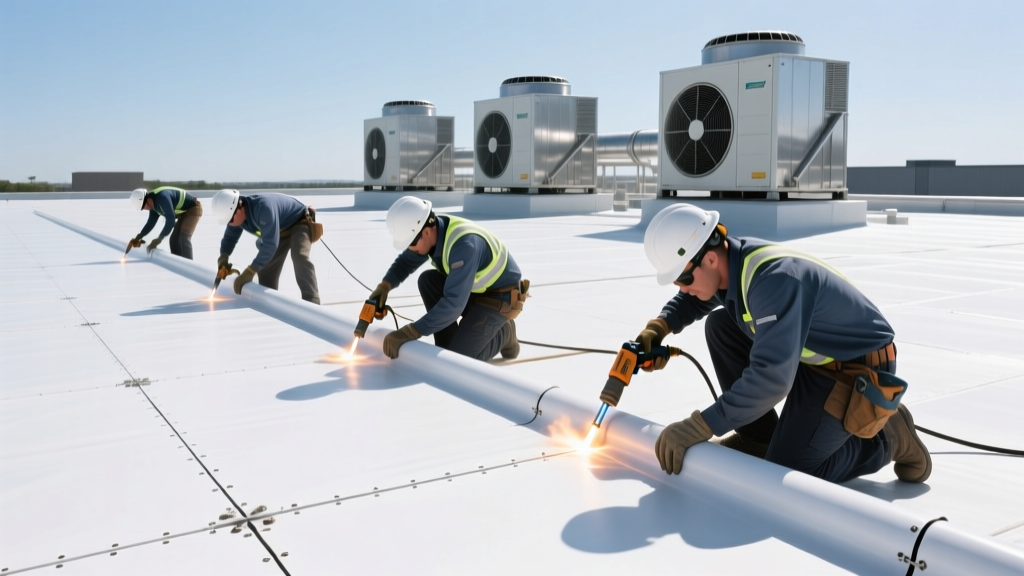
PVC vs. TPO vs. EPDM: Commercial Flat Roof ROI
When evaluating the cost of PVC roof material, it is essential to compare it against its primary competitors. While PVC commands a premium upfront, its chemical resistance and reflective properties offer distinct advantages. According to the U.S. Department of Energy, highly reflective cool roofs like white PVC can reduce peak cooling demand by 10% to 15%, significantly offsetting the initial material premium over a 20-year lifecycle.
| Feature | PVC (Polyvinyl Chloride) | TPO (Thermoplastic Polyolefin) | EPDM (Rubber) |
|---|---|---|---|
| Installed Cost (per sq. ft.) | $8.50 – $14.50 | $7.00 – $11.00 | $6.50 – $10.50 |
| Seam Integrity | Hot-Air Welded (Permanent) | Hot-Air Welded (Prone to user error) | Tape / Liquid Adhesive (Fails over time) |
| Chemical/Grease Resistance | Excellent (Ideal for restaurants) | Poor (Degrades with animal fats) | Poor (Degrades with oils/grease) |
| Flexibility in Cold Weather | Moderate (Requires plasticizers) | High | Excellent |
Common Failure Modes & Warranty Impacts
Understanding how PVC fails is critical for protecting your investment and ensuring your manufacturer warranty remains valid. The most common issues stem from improper material compatibility and poor welding techniques.
⚠️ Warning: Plasticizer Migration and EPS Incompatibility
PVC relies on plasticizers to remain flexible. If a PVC membrane is installed in direct contact with Expanded Polystyrene (EPS) insulation or unseparated asphalt-based products, the plasticizers will leach out of the PVC and into the incompatible material. This process, known as plasticizer migration, causes the PVC membrane to become brittle, shrink, and ultimately shatter. Always mandate a separation layer (such as a geotextile fleece or a layer of polyiso) between PVC and EPS or existing bitumen roofs to maintain your NDL (No Dollar Limit) warranty.
Welding Temperature Calibration
PVC seams are welded using hot-air tools (like the Leister Triac) at temperatures between 1,000°F and 1,200°F. If the ambient temperature drops or wind speeds increase, the welder must adjust the speed and heat output. 'Cold welds' will peel apart under thermal stress, while 'burn-throughs' compromise the membrane's scrim. Require your contractor to perform destructive peel tests every morning and after any weather change to verify weld integrity.
Final Verdict: Is PVC Worth the Premium?
If you are roofing a standard warehouse with no chemical exhaust, a high-quality 60-mil TPO system may provide adequate performance at a 15% to 20% lower cost. However, if your facility houses a restaurant, a manufacturing plant with oily exhaust, or a building where long-term seam reliability is paramount, PVC roof material is the undisputed industry standard. The heat-welded seams eliminate the primary failure point of single-ply roofs, and the material's inherent resistance to chemical degradation ensures the membrane will outlast its warranty period, providing a superior return on investment over a 25-to-30-year lifecycle.
Written by
Elena RodriguezElena Rodriguez is a civil engineer and technical writer specializing in concrete technology, masonry systems, and ASTM/ACI compliance. She earned her B.S. in Civil Engineering from Texas A&M University and spent a decade at a materials testing laboratory, performing over 2,000 concrete compressive strength tests and masonry prism evaluations. Elena is an ACI-certified Field Testing Technician (Grade I) and a member of ASTM Committee C12 on Natural Building Stone. She currently consults on forensic engineering cases involving concrete failures and moisture intrusion. Based in San Antonio, TX, Elena is a proud member of the Society of Women Engineers (SWE) and coaches her daughter's FIRST Robotics team.
More from Elena Rodriguez
View all
Walls & Panels
Cost Analysis: Light Gauge Steel Framing Advantages and Disadvantages
Evaluate light gauge steel framing advantages and disadvantages through a strict cost analysis lens, comparing material, labor, and lifecycle expenses.
Aug 4, 2026

Walls & Panels
Gypsum Board Types: Exact Specifications, Thickness & Dimensions
Compare standard, Type X, and moisture-resistant gypsum board types. Get exact specifications, thicknesses, dimensions, and ASTM standards for your project.
Aug 4, 2026

Fire Resistance
Best Fire-Resistant Outdoor Decking Materials: 2026 Buyer Guide
Discover the best fire-resistant outdoor decking materials for 2026. Compare Class A PVC, aluminum, and hardwood options for WUI compliance and safety.
Aug 4, 2026