What Is Composition Roof Material? Complete Roof Guide
Discover what composition roof material is, including asphalt shingle anatomy, 2026 costs, architectural vs. 3-tab types, and expert installation tips.

Defining Composition Roofing Material
When homeowners, inspectors, and contractors ask what is composition roof material, they are referring to a manufactured roofing product primarily composed of asphalt, reinforcement mats, and protective mineral granules. While the term is frequently used interchangeably with "asphalt shingles," composition roofing technically encompasses a broader category of composite materials, including modified bitumen and synthetic polymer blends. However, in 95% of residential applications, composition roofing specifically denotes fiberglass-reinforced asphalt shingles. These materials dominate the North American market due to their balance of cost-effectiveness, fire resistance, and adaptability to complex roof geometries.
The Micro-Anatomy of a Composition Shingle
Understanding the performance and lifespan of composition roofing requires examining its layered engineering. A standard architectural shingle consists of four distinct functional layers:
- Fiberglass Mat Base: A non-woven web of glass fibers bonded with urea-formaldehyde or acrylic resins. This provides the shingle's tensile strength and dimensional stability, preventing stretching or tearing during thermal expansion.
- Asphalt Coating: Oxidized or modified asphalt saturates and coats the mat. Premium shingles utilize SBS (Styrene-Butadiene-Styrene) modifiers, which impart rubber-like flexibility, drastically improving impact resistance and cold-weather installation properties.
- Ceramic-Coated Granules: Crushed igneous rock coated with ceramic pigments. These granules shield the underlying asphalt from ultraviolet (UV) degradation, provide fire resistance (Class A rating), and dictate the roof's solar reflectance.
- Thermoplastic Sealant: Applied to the top or bottom surface, this asphalt-based adhesive activates under solar heat to bond overlapping shingles, creating a unified, wind-resistant membrane.
Classification Matrix: 3-Tab vs. Architectural vs. Premium
Composition materials are segmented into three primary tiers based on thickness, weight, and manufacturing complexity. Selecting the correct tier dictates both the aesthetic profile and the structural load on the roof deck.
| Shingle Type | Construction Profile | Weight (per square) | Max Wind Rating | Expected Lifespan |
|---|---|---|---|---|
| 3-Tab (Strip) | Single-layer, uniform cutouts | 200 - 230 lbs | 60 mph | 15 - 20 Years |
| Architectural (Dimensional) | Two or more laminated layers | 250 - 300 lbs | 110 - 130 mph | 25 - 35 Years |
| Premium (Designer) | Multi-layer, contoured profiles | 350 - 450 lbs | 110 - 130 mph | 35 - 50 Years |
2026 Cost Breakdown and ROI Metrics
Pricing for composition roofing has stabilized following the supply chain fluctuations of the early 2020s. When budgeting for a complete tear-off and replacement, factor in the following national averages for a standard 2,000 sq. ft. residential roof:
Material Costs (per sq. ft.): $1.20 (3-Tab) | $1.80 - $2.50 (Architectural) | $3.50 - $5.50 (Premium)
Labor & Installation: $2.50 - $4.00 per sq. ft.
Tear-Off & Disposal: $1.50 - $2.25 per sq. ft. (varies by local landfill tipping fees)
Total Installed Cost: $5.20 - $9.75 per sq. ft.
Note: Upgrading from 3-tab to architectural shingles typically yields a 68% cost recoup at resale, according to recent remodeling impact reports, while significantly reducing insurance premiums in hail-prone regions when paired with impact-resistant (UL 2218 Class 4) ratings.
Forensic Analysis: Why Composition Roofs Fail
While composition materials are highly reliable, premature failure almost always traces back to specific installation errors or environmental mismatches. Recognizing these failure modes is critical for long-term performance.
Thermal Splitting and Blistering
Blistering appears as small, raised bubbles on the shingle surface that eventually rupture, exposing the asphalt mat. This is caused by moisture trapped within the fiberglass mat during manufacturing or, more commonly, by excessive attic heat and humidity escaping through the roof deck. If your attic lacks a balanced ventilation system (1 sq. ft. of Net Free Area per 150 sq. ft. of attic space), the trapped heat bakes the shingles from underneath, accelerating asphalt oxidation and causing thermal splitting at the joints.
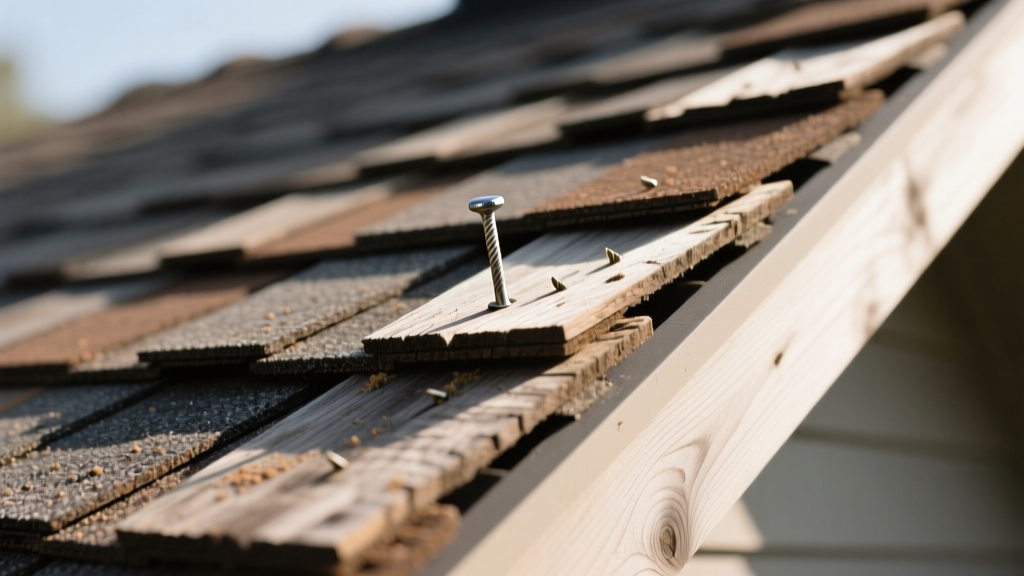
Wind Uplift and Nail Pops
Granule Loss and UV Degradation
Some granule loss in the first year is normal as loose manufacturing residue washes away. However, accelerated granule loss exposes the asphalt to UV radiation, causing it to become brittle and crack. This is frequently exacerbated by abrasive overhanging tree branches or improper pressure washing. Never use high-pressure water on a composition roof; rely on low-pressure soft washing with specialized algaecides to remove Gloeocapsa magma (black algae streaks).
The High-Performance Installation Protocol
The longevity of composition roof material relies entirely on the underlying deck preparation. A premium shingle installed over a compromised deck will fail prematurely. Follow this strict sequence for maximum durability:
- Deck Inspection: Replace any rotted or delaminated OSB/plywood. Ensure the deck is clean, dry, and free of protruding nails.
- Drip Edge Installation: Install metal drip edge along the eaves first, then over the rake edges. This directs water away from the fascia and prevents capillary action.
- Ice and Water Barrier: Apply a self-adhering modified bitumen membrane (e.g., Grace Ice & Water Shield) along all eaves (minimum 24 inches past the interior wall line), in all valleys, and around all penetrations (chimneys, skylights, vent pipes).
- Synthetic Underlayment: Roll out high-tensile synthetic underlayment (e.g., GAF FeltBuster or Owens Corning ProArmor) over the remaining deck. Synthetic options resist tearing and water absorption far better than traditional #15 asphalt felt.
- Starter Strip: Apply a specialized starter strip shingle along the eaves. This seals the bottom edge of the first course and prevents wind-driven rain infiltration.
- Field Shingles & Ridge Caps: Install field shingles using the manufacturer-specified offset pattern. Finish with pre-formed, high-profile ridge cap shingles rather than cutting up 3-tab shingles, ensuring superior wind resistance at the roof's peak.
Environmental and Thermal Performance
Modern composition materials have evolved to address urban heat island effects and energy efficiency. Standard dark composition shingles can reach surface temperatures of 150°F to 170°F in peak summer, increasing cooling loads by up to 20%. To mitigate this, manufacturers now offer "cool roof" variants featuring specialized solar-reflective granules. According to EPA Heat Island Effect guidelines, utilizing Energy Star-rated cool roof shingles can lower peak cooling demand by 10-15%. When specifying materials for hot climates, look for products with a Solar Reflectance Index (SRI) of 20 or higher to comply with local energy codes and maximize HVAC efficiency.
Frequently Asked Questions
Can composition shingles be installed over an existing roof?
While local building codes often permit installing a second layer of composition shingles over an existing layer, it is highly discouraged. Overlaying traps heat, accelerates the degradation of the new shingles, hides deck rot, and voids most manufacturer wind and algae warranties. A complete tear-off to the deck is the only way to guarantee a 30+ year lifespan.
Are composition roofs impact-resistant against hail?
Standard architectural shingles will fracture under severe hail (1.5 inches or larger). If you reside in a hail-prone region (e.g., Texas, Colorado, the Midwest), you must specifically request UL 2218 Class 4 impact-resistant shingles, such as the CertainTeed NorthGate or Malarkey Vista AR. These utilize SBS rubberized asphalt modifiers that allow the shingle to absorb and disperse kinetic energy without cracking.
How does composition roofing compare to standing seam metal?
Composition roofing costs 40-60% less upfront than standing seam metal and offers easier repairability for localized damage. However, metal roofing lasts 50-70 years, sheds snow more efficiently, and is non-combustible. Composition is the superior choice for complex rooflines with multiple valleys and dormers, where metal flashing and panel detailing become prohibitively expensive.
Written by
Elena RodriguezElena Rodriguez is a civil engineer and technical writer specializing in concrete technology, masonry systems, and ASTM/ACI compliance. She earned her B.S. in Civil Engineering from Texas A&M University and spent a decade at a materials testing laboratory, performing over 2,000 concrete compressive strength tests and masonry prism evaluations. Elena is an ACI-certified Field Testing Technician (Grade I) and a member of ASTM Committee C12 on Natural Building Stone. She currently consults on forensic engineering cases involving concrete failures and moisture intrusion. Based in San Antonio, TX, Elena is a proud member of the Society of Women Engineers (SWE) and coaches her daughter's FIRST Robotics team.
More from Elena Rodriguez
View all
Walls & Panels
Cost Analysis: Light Gauge Steel Framing Advantages and Disadvantages
Evaluate light gauge steel framing advantages and disadvantages through a strict cost analysis lens, comparing material, labor, and lifecycle expenses.
Aug 4, 2026

Walls & Panels
Gypsum Board Types: Exact Specifications, Thickness & Dimensions
Compare standard, Type X, and moisture-resistant gypsum board types. Get exact specifications, thicknesses, dimensions, and ASTM standards for your project.
Aug 4, 2026

Fire Resistance
Best Fire-Resistant Outdoor Decking Materials: 2026 Buyer Guide
Discover the best fire-resistant outdoor decking materials for 2026. Compare Class A PVC, aluminum, and hardwood options for WUI compliance and safety.
Aug 4, 2026