Flat Roof Repair Material Guide: Maximizing Roof Lifespan
Compare the best flat roof repair material options for durability. Learn lifespans, costs, and failure modes for silicone, polyurethane, and patches.

The Physics of Low-Slope Degradation
Selecting the correct flat roof repair material requires understanding the unique mechanical and environmental stresses placed on low-slope structures. Unlike pitched roofs that shed water immediately, flat roofs (defined as having a slope of 3:12 or less) are subjected to prolonged ponding water, extreme thermal cycling, and concentrated UV radiation. According to the Building Science Corporation, the primary driver of premature membrane failure in low-slope assemblies is the differential expansion and contraction between the roof deck, insulation, and the membrane itself during daily temperature swings.
When a leak or seam failure occurs, applying an incompatible or low-durability patch creates a localized weak point. The repair material must possess a coefficient of thermal expansion that closely matches the existing substrate, or it must be applied as a fully reinforced, elastomeric liquid that bridges the structural gaps without transferring stress to the membrane edges.
Evaluating Flat Roof Repair Materials by Expected Lifespan
Not all repair chemistries are created equal. While asphalt-based cements and acrylic elastomers offer low upfront costs, their long-term durability is severely compromised by UV degradation and hydrolysis. The table below breaks down the high-performance repair materials used by commercial roofing contractors in 2026, focusing strictly on longevity and environmental resistance.
| Material Chemistry | Primary Use Case | Ponding Water Resistance | Expected Repair Lifespan | Installed Cost (per sq. ft.) |
|---|---|---|---|---|
| 100% Silicone (High Solids) | Seam sealing, broad surface restoration | Excellent (Immersion rated) | 15 – 20 Years | $2.50 – $4.00 |
| Aliphatic Polyurethane | High foot-traffic areas, parapet walls | Good (Requires proper slope) | 20 – 25 Years | $5.00 – $8.00 |
| PMMA (Methyl Methacrylate) | Emergency cold-weather repairs, flashings | Excellent | 15 – 20 Years | $6.50 – $10.00 |
| Cured EPDM/TPO Patches | Puncture repairs, localized seam failure | Excellent (When primed) | 10 – 15 Years | $15.00 – $25.00 (per patch) |
| Acrylic Elastomers | Temporary UV protection, sloped areas only | Poor (Re-emulsifies) | 3 – 5 Years | $1.00 – $2.00 |
Deep Dive: Top 3 High-Durability Repair Materials
1. High-Solids Silicone Roof Coatings
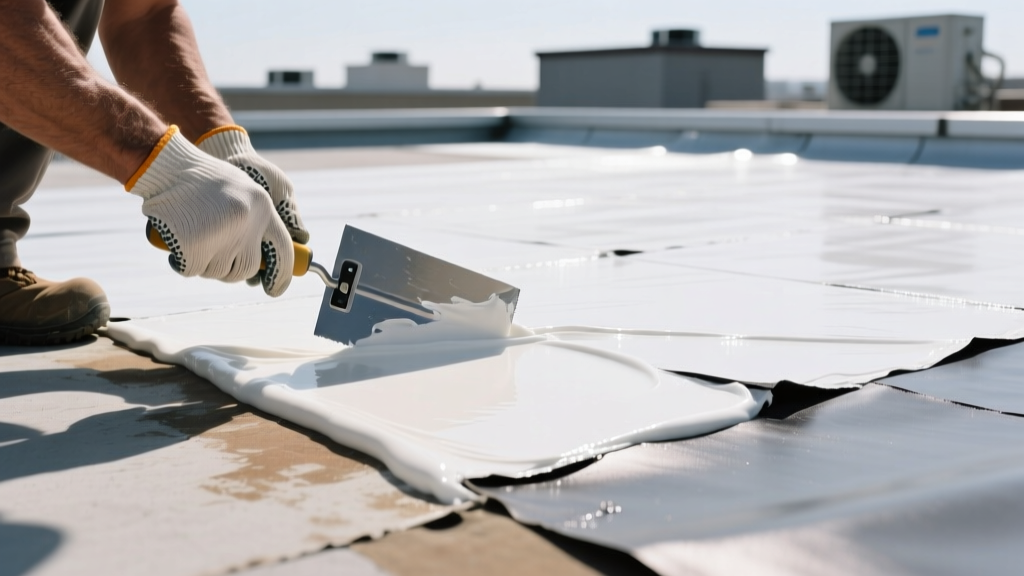
For broad seam repairs, blistering, and general membrane restoration, 100% silicone is the industry standard for water resistance. Products like Henry 887 HS Tropi-Cool or Gaco Western S2000 contain up to 96% solids by volume. Unlike solvent-based alternatives that shrink as the carrier evaporates, high-solids silicone cures to the exact wet-mil thickness applied. The Florida Solar Energy Center notes that silicone's inorganic backbone makes it virtually immune to UV degradation, meaning it will not chalk, crack, or become brittle over decades of sun exposure. Its primary limitation is low tensile strength; it must be reinforced with polyester stitching fabric at all seams and penetrations to prevent tearing during thermal movement.
2. Aliphatic Polyurethane Liquid Membranes
When repairing flat roofs that experience heavy HVAC maintenance foot traffic, polyurethane is the superior flat roof repair material. Aliphatic polyurethanes (such as those in the Kemper System or ALTRA lines) offer tensile strengths exceeding 2,000 PSI and elongation properties over 400%. Because they are aliphatic, they do not yellow or degrade under UV light, unlike cheaper aromatic polyurethanes which require a topcoat. Polyurethane bonds aggressively to concrete, metal, and existing modified bitumen, making it ideal for repairing complex flashing details and parapet walls where physical abuse is common.
3. PMMA (Polymethyl Methacrylate) Resins
PMMA represents the cutting edge of rapid-cure, high-durability repairs. Originally developed for waterproofing bridge decks, PMMA systems (like Triflex or Prodeck) cure in under 45 minutes, even in sub-freezing temperatures. This makes PMMA the ultimate emergency repair material for active leaks during winter months. It chemically welds to most substrates, including stubborn PVC and TPO membranes that normally reject liquid adhesives, creating a monolithic, fully reinforced patch that outlasts the original roof assembly.
Failure Modes: Why Flat Roof Repairs Fail Prematurely
Even the most expensive flat roof repair material will fail if the underlying mechanics of the failure are ignored. Analyzing warranty claims and field inspections reveals three dominant failure modes:
- Thermal Shock Tearing: Single-ply membranes (TPO/EPDM) can expand and contract up to 1 inch per 100 feet during a 100°F daily temperature swing. If a rigid repair material (like standard asphalt mastic or uncured flashing) is applied without an expansion loop or reinforcing fabric, the membrane movement will sheer the patch off the substrate within one season.
- Hydrolysis in Polyesters: Some liquid-applied membranes utilize polyester reinforcement mats. If the roof lacks adequate drainage and remains submerged, the polyester mat can undergo hydrolysis, losing its structural integrity and allowing the liquid coating to split.
- Substrate Contamination: Applying liquid flashings over chalky, oxidized EPDM or dirt-laden TPO without a rigorous power-washing and primer application (such as Firestone QuickPrime Plus) results in adhesive failure. The repair material bonds to the dirt, not the membrane.
Step-by-Step Decision Framework for Matching Material to Damage
Use this diagnostic framework to select the correct repair chemistry based on the specific symptom observed on the roof deck.
Diagnostic Decision Tree
Symptom 1: Active leak at an inside corner or pipe penetration during freezing rain.
Action: Use PMMA resin with fleece reinforcement. It cures in 30 minutes at 20°F and chemically bonds to damp substrates.
Symptom 2: Long, linear splitting along membrane seams in a high-UV, ponding water zone.
Action: Clean with TPO/EPDM cleaner, apply manufacturer-specific primer, and embed a 6-inch wide polyester reinforcing fabric into a bed of 100% high-solids silicone. Top with a second silicone layer to achieve 60 dry mils.
Symptom 3: Puncture or physical tear near an HVAC access hatch.
Action: Apply an aliphatic polyurethane liquid membrane with an aggregate broadcast (like aluminum oxide sand) into the topcoat to provide a slip-resistant, high-impact wear surface.
Long-Term Maintenance to Maximize Repair Lifespan
The durability of any flat roof repair material is intrinsically linked to post-repair maintenance. The U.S. Department of Energy highlights that maintaining the reflectivity and physical integrity of low-slope roofs significantly reduces building cooling loads and extends membrane life. To ensure your repairs reach their maximum expected lifespan, implement the following protocols:
- Bi-Annual Drain Clearing: Ponding water is the enemy of roof longevity. Clear all scuppers, gutters, and internal drains in late autumn and early spring. Standing water accelerates the breakdown of almost all repair chemistries except silicone and PMMA.
- Infrared Moisture Surveys: Every 3 to 5 years, commission an infrared thermographic scan. This identifies trapped moisture within the roof insulation that is invisible to the naked eye. Wet insulation loses its R-value and acts as a sponge, eventually causing the membrane above it to blister and rupture, rendering surface repairs useless.
- Chemical Compatibility Checks: If the building exhausts oils, greases, or animal fats (common in restaurant HVAC systems), do not use silicone or standard EPDM patches near the exhaust vents. Oils will liquefy these materials. Instead, specify a grease-resistant fluoropolymer or specialized polyurethane coating for repairs in these zones.
By matching the specific chemical properties of the repair material to the exact mechanical and environmental stressors of the roof, facility managers and contractors can transition from a cycle of endless emergency patching to a strategy of permanent, decades-long structural restoration.
Written by
Sarah WhitfieldSarah Whitfield is a chartered quantity surveyor (MRICS) and construction cost analyst with 15 years of experience in material pricing, procurement strategy, and project budgeting. She earned her degree in Construction Management from the University of Reading (UK) and has worked on projects ranging from $2M custom homes to $180M mixed-use developments across North America and Europe. Sarah currently leads cost estimating for BuildMat Insight, maintaining a proprietary database of 4,000+ material price points updated quarterly. She is a frequent contributor to RSMeans cost data panels and has presented at the International Cost Engineering Council (ICEC) congress. Based in Denver, CO, Sarah is an avid trail runner and volunteer mentor for Women in Construction.
More from Sarah Whitfield
View all
Wood & Lumber
What Are the Different Types of Wood? A Builder's Guide
Compare structural softwoods, finish hardwoods, and engineered lumber. Analyze Janka ratings, MOE values, and 2026 pricing for construction.
Aug 4, 2026

Walls & Panels
Steel Framing vs Wood Framing: Corrosion and Moisture Defense
Compare steel framing vs wood framing for moisture resistance. Learn about galvanized coatings, condensation risks, and corrosion protection strategies.
Jul 21, 2026

Stone & Masonry
How to Cut Stone Veneer: Wet Saw vs Grinder Comparison
Compare the best tools for cutting stone veneer. We review wet saws, angle grinders, and chop saws to help you achieve clean, chip-free cuts.
Jul 21, 2026